
COP31 Donor Scorecard: Comparing the $11.7bn Public Climate Finance Pool With the $300bn 2035 Goal
Outside the opening plenary a protester held a sign that read make rich polluters pay. Credit: IISD/ENB – Kiara Worth
Short answer: almost no serious donor has renewed its cheque. Strip the donor ledger back to commitments that carry a number and a date, and the picture Carbon Brief derives from the NRDC and E3G tracker is a collapse of more than 70% in 2026 — an annual total of $11.7bn against recent levels of around $40bn. Only five nations have tabled replacement pledges, with just one major donor inside that group. The comparison below sorts who is still funding the goal, who has walked away, and what the shortfall does to carbon and ESG budgeting through 2030.
The hardware cost curve cleared years before the money line. Of all utility-scale renewable projects commissioned in 2024, 91% delivered electricity below the cost of the cheapest new fossil-fuel alternative, per IRENA's Renewable Power Generation Costs in 2024. Cheap electrons were supposed to be the hard part. With COP31 convening in Antalya, Turkey, the scarce input is sovereign cash — which turns a climate summit into something closer to a delivery audit.
What exactly collapsed, and how the fall is counted
Conclusion first: this is a pledge cliff, not yet a disbursement cliff. Under the Paris Agreement, developed countries are obliged to provide climate finance to help developing countries cut emissions and prepare for climate disasters, and they have historically done so through multi-year targets that sit underneath global commitments. That scaffolding has now been largely pulled away.
- Replacement targets covering the period out to 2030 have barely appeared, because nearly all the old pledges expired in 2025.
- Washington has exited international climate efforts, while several European aid envelopes have been trimmed hard.
- Money can be routed through multilateral development banks, UN climate funds and investment mobilised from the private sector. Direct budget transfers — mostly from foreign-aid line items — have nonetheless made up roughly a third of climate finance flowing to developing countries in recent years.
- The political benchmark is recent: just two years ago, the EU, the US and others agreed they would take the lead on scaling annual climate finance from $100bn in the early 2020s to $300bn by 2035.
Speaking to Carbon Brief, researchers trace the retrenchment to a common set of domestic pressures — a stronger far right, defence-driven fiscal squeeze and ongoing global conflict — that make new commitments electorally expensive.
| Measure | Pre-2026 baseline | Pledges covering the remainder of the 2020s |
|---|---|---|
| Annualised donor pledges (sterling) | around £42bn a year | £11.8bn — a fall of around 71% |
| Same picture in dollars | recent levels of around $40bn | $11.7bn a year, down more than 70% |
| Actual bilateral flows | £43.9bn in 2024 | Official 2025 data not yet available |
| Donors with replacement pledges | A broad club of major economies | five nations, one major donor |
| Concentration risk | Five countries plus the EU supplied around 90% of bilateral public climate finance | Dependency on a single fresh pledger has deepened |
The contraction is plotted below. Two caveats apply to the pre-2026 period: not every contributor announced public climate-finance pledges in advance, and delivery sometimes undershot or overshot the stated target.
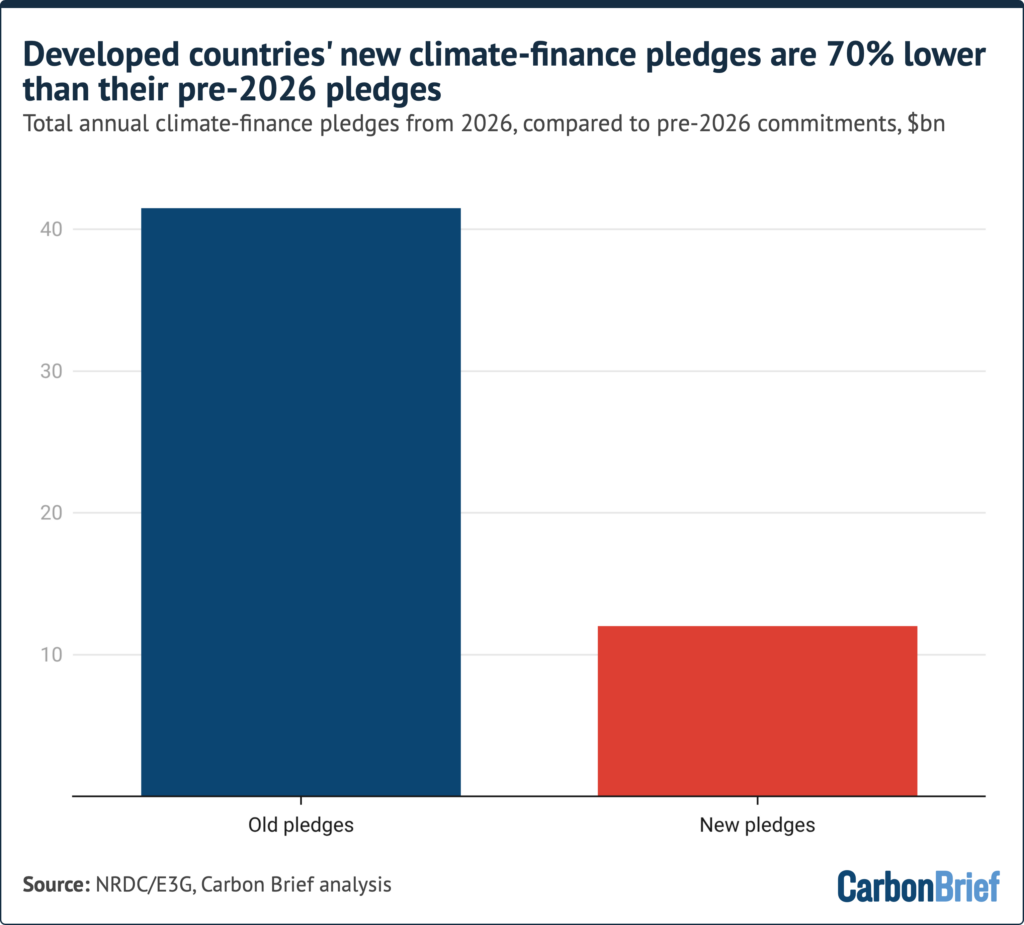
Verified outturns for 2025 have not been published; bilateral public finance reached £43.9bn in 2024, broadly in line with what donor treasuries had promised.
Donor-by-donor comparison: who is still in, who is out
Japan, Germany, France, the US and the UK — the five nations that have consistently dominated this market — plus the EU account for around 90% of bilateral public climate finance historically delivered. Score the current field channel by channel and the redistribution of burden becomes obvious.
| Donor | What is on the table | Annualised value | Planning read for 2026-2030 |
|---|---|---|---|
| UK | £6bn ($8bn) of aid between 2026-27 and 2028-29, plus £6.7bn ($8.9bn) from outside its aid budget | Half of all annual funds pledged from 2026 onwards, averaging $5.7bn a year | The only fresh large-donor anchor — resting partly on a counting change |
| European Commission | Commitment to spend €28bn ($31.8bn) over its 2021-2027 budget period | An average annual contribution of $4.5bn out to 2027 | Carry-over rather than a new pledge; the post-2027 figure is still inside EU budget negotiations |
| Canada | CA$5.3bn ($4.1bn) by 2030 | Averaging $860m a year | Predictable but small; supports stable pipelines only |
| Netherlands | The Dutch government has signalled at least €300m ($334m) of specific climate funding annually out to 2031 | Likely considerably higher in 2026 and 2027 | Direction positive, figure provisional — no formal multi-year target yet |
| Switzerland, Belgium | Relatively small sums | Modest annualised values | Relevant to niche windows, not system-level budgets |
| Germany, France | Nothing committed beyond €6bn ($6.8bn) per year by 2025 | No new annualised pledge | Europe's two biggest contributors are the largest hole in the schedule |
| Japan | Largest overall contributor, but sets bundled goals that fold in private flows | Not captured as a public-finance target | Absence here is a metric gap, not proof of withdrawal |
| US | None expected | No official climate finance in the coming years | The single biggest swing factor against any $300bn trajectory |
| Australia | No pledge despite co-hosting | None announced | Presidency credibility risk |
On ambition rather than headline numbers, the replacements are either less ambitious – or only slightly more ambitious – than what they supersede. London appears to buck that pattern only because the government redrew the boundary of what counts, adding $8.9bn in additional public finance covering equity, debt, guarantees, insurance and export credit aimed at mobilising private capital. Compare like-for-like aid components and the "increase" becomes a cut; our audit of how reclassification rules closed the UK's £11.6bn climate-finance pledge traces that accounting step by step.
The largest vacuum is in Washington. The Biden administration had committed to reaching $11.4bn in annual support by 2024. Since president Donald Trump took power, the US has withdrawn from the Paris Agreement for the second time and compressed its aid architecture, meaning no official climate finance is on offer for the coming years.
Australia, jointly hosting the upcoming COP31 summit alongside Turkey, is the second conspicuous non-pledger — an awkward position for a presidency. Josie Lee, policy and advocacy lead at Oxfam Australia, tells Carbon Brief:
If Australia fails to announce a climate-finance pledge as president of negotiations, it would send a problematic message to those resisting action on climate change that might serve to embolden their agenda.
Tokyo is harder to grade. Japan is the largest overall contributor of public climate finance, but has not traditionally announced stand-alone targets of this type; its goals bundle in finance mobilised from the private sector, so its public-finance ambitions fall outside this analysis. The Japanese government has so far announced no new multi-year climate-finance pledge from either the public or the private side.
Why Europe's biggest payers have gone quiet
Europe still supplies the majority of international climate finance, yet its governments have cut aid sharply in recent years, citing economic strain and defence requirements. Germany and France — the two largest European climate-finance contributors — had each pledged to reach €6bn ($6.8bn) per year by 2025 and have committed to nothing beyond that point. Both trimmed aid budgets including climate programmes, and Germany missed its 2025 climate-finance goal as a result.
The file has also become politically radioactive in Berlin. Dr Anja Carolin Gebel, senior policy advisor at Germanwatch, tells Carbon Brief that the topic slipped since the centre-right Christian Democratic Union (CDU) won the 2025 election and formed the leading party of the coalition:
The issue of climate change – and, subsequently, climate finance – has taken a back seat in the current government coalition.
Paris shows the same drift through an electoral lens. Gaïa Febvre, international policy coordinator at Réseau Action Climat, tells Carbon Brief that "The upcoming presidential election and the growing influence of the far right are likely to make new international financial commitments politically more difficult."
Calendar effects compound the problem. Spain's centre-left government has triggered a snap election for the end of November, which makes a new climate-finance pledge during COP31 unlikely. In Sweden, a centre-left bloc emerged from a narrow win and is still negotiating a coalition. Where nobody has formalised a number, a few capitals are at least signalling continuity — the Netherlands is the clearest case.
Developing countries are answering with process: they are championing a climate-finance work programme at COP31 that would open space to discuss scaling up public climate finance from developed countries. The EU's counter-position is that its member states are the largest providers of public climate finance — a record €32.3bn ($40bn) in 2025 — and that developing countries should submit overdue emission-cutting plans. EU climate chief Wopke Hoekstra recently told Bloomberg that "any conversation on new fresh money is dead in the water".
Joe Thwaites, international climate finance director at NRDC and custodian of the commitment tracker, argues that developed countries would be wise to show how they are continuing to lead on climate finance:
The lack of new announcements is making the finance negotiations tougher than they need to be. The debate around the climate-finance work programme is arising because developing countries have little clarity about how much public climate finance there will be in coming years.
How far is the cash on the table from the $300bn target?
Framed honestly, the bilateral route cannot reach it. The New Collective Quantified Goal agreed at COP29 sets a floor of at least $300bn a year by 2035 alongside an aspirational $1.3tn, and World Resources Institute's explainer stresses that the accounting draws on a wide set of providers, multilateral development banks included. NRDC has separately argued that counting MDB finance toward the goal lets leverage and on-lending substitute for treasury lines that donors are no longer opening.
Adaptation shows where the arithmetic fails. UNEP's Adaptation Gap Report 2025 puts developing-country adaptation costs near $310bn a year by 2035 on modelled estimates, against roughly $26bn of international public adaptation finance in 2023. Set that beside $11.7bn a year of new bilateral pledges and the mismatch is structural rather than cyclical — an inference from the two data sets, not a figure either institution publishes directly.
Which channel should compliance and carbon teams actually plan around?
With donor budgets shrinking, the scarce asset is not appetite for projects but dated, bankable public cash. The comparison below ranks the main channels by reliability and fit.
| Channel | Trend 2026-2030 | Best suited to | Main risk to model |
|---|---|---|---|
| Bilateral grant finance | Falling more than 70% on a pledge basis | Technical assistance, readiness programmes, MRV build-out | Renewal risk at every electoral cycle |
| Multilateral development banks and UN climate funds | Absorbing more of the political load | Utility-scale infrastructure, blended debt | Concessional capital rationed by balance-sheet rules |
| Article 6.2 cooperation | Building institutional plumbing; Verra and Gold Standard have launched a corresponding-adjustments reporting tool for host countries | NDC-linked demand and cross-border offset supply | Authorisation queues and double-counting rules |
| Privately mobilised finance | Counted generously in targets, thin in adaptation | Renewables, storage and grid work with bankable offtake | Currency, offtake and interest-rate risk stay with the host |
Three actions follow. Treat pledge totals as marketing until each carries a payment date — our piece on why COP31 needs dated transfer calendars instead of another pledge count sets out the register test. Price adaptation exposure explicitly, because grant-concessionary support is where the pledge collapse lands hardest. And keep sovereign-risk assumptions conservative in emerging-market project models, since guarantees and export credit, the very instruments inside the UK's $8.9bn of additional public finance, are the tools most likely to be stretched thin.
Four misreadings worth avoiding
- A pledge drop of this size is not a delivery drop of this size. Disbursements lag commitments by years, and 2024 bilateral flows of £43.9bn were broadly in line with promises made.
- Japan is not hiding. It does not publish stand-alone public-finance targets, so tracker-based comparisons under-represent it.
- One headline increase is an accounting artefact. Change the counting boundary and the UK's like-for-like comparison turns negative.
- The $300bn is not a donor-only number. Reading pledges against it without adjusting for MDB and private flows overstates the shortfall — while understating the concessional squeeze that actually hits project sponsors.
FAQ: what policy teams are asking at COP31
Why did pledges fall so far in 2026?
Three drivers stack: the old multi-year targets expired in 2025, the US has left international climate efforts again and shrunk aid, and European treasuries are prioritising defence. Researchers consulted by Carbon Brief point to the same mix of far-right electoral gains, conflict and fiscal constraint.
Is the $300bn by 2035 goal now unreachable?
Not via bilateral budgets. What is left is a target that must be filled by multilateral banks, counted private flows and borrowed-forward political commitments — exactly the argument developing countries are pressing through the climate-finance work programme.
Why does Australia's silence matter more than its chequebook?
Because it co-hosts COP31 with Turkey. In Oxfam Australia's framing, a presidency that brings no pledge supplies rhetorical cover to governments resisting action.
What should an ESG team watch between now and 2027?
Three items: the EU budget negotiation that fixes the Commission's post-2027 contribution, France's presidential cycle, and whether the UK's aid-versus-non-aid split survives audit-style scrutiny.
How this comparison was built
The underlying data is the climate-finance commitments tracker run by the NGOs NRDC and E3G, supplemented by additional research. Scope is limited to the 23 developed countries obliged to provide climate finance, plus the EU, spanning western Europe, the US, Australia, Canada and New Zealand. Japan and Norway both move substantial sums but have announced no specific public-finance pledges, so neither is included. Multi-year pledges were annualised with 2025 as the baseline pre-2026 year: where a country promised to reach a level by 2025, that value is used; where it promised a total across several years, the per-year average is used. Belgium, Switzerland and the US set initial targets only as far as 2024, so their 2024 values substitute for 2025.
The forward comparison averages the annual contribution across the remainder of the 2020s, built from new pledges by the UK, Canada, Belgium, Switzerland and the Netherlands. The Netherlands has committed some climate finance but this is not expected to be its full contribution. Older pledges from the EU, Portugal and Greece run into the latter half of the 2020s, though the last two contribute very small amounts. NRDC and E3G count all newly pledged UK public finance, including $8.9bn in additional public finance for equity, debt, guarantees, insurance and export credit intended to mobilise private money; earlier Carbon Brief work comparing London's new and old targets excluded those funds, since the government had previously measured ambition through aid spending alone. Pledges to the Tropical Forest Forever Facility (TFFF) by some countries, including Germany and France, sit outside this analysis, and would shift the overall reduction from 71% to 70% — a rounding difference, not a verdict change.
The technical trend line and the funding line have come apart, and that divergence is the number to carry out of Antalya. For investors it implies a decade in which concessional public money, not equipment, is the binding input — with returns set by currency, grid connection and permitting risk. For policymakers the cheap fix is procedural: publish dated, auditable disbursement schedules through 2030 before the next fiscal cycle shuts the window.
Sources
- Carbon Brief — analysis of developed-country public climate finance pledges: https://www.carbonbrief.org/
- IRENA, Renewable Power Generation Costs in 2024: https://www.irena.org/Publications/2025/Jun/Renewable-Power-Generation-Costs-in-2024
- UNEP, Adaptation Gap Report 2025: https://www.unep.org/en/publications/report/adaptation-gap-report-2025
- World Resources Institute, NCQG deep dive on the $300bn and $1.3tn goals: https://www.wri.org/insights/ncqg-climate-finance-goals-explained
- Verra, Article 6.2 Corresponding Adjustments Reporting Tool: https://verra.org/programs/verified-carbon-standard/article-6-2-corresponding-adjustments-reporting-tool/
- NRDC on delivering the new climate finance goal (Joe Thwaites): https://www.nrdc.org/bio/joe-thwaites/how-deliver-new-climate-finance-goal