
The BAM Playbook for COP31: A Practical Guide to the Belém-Antalya just transition Mechanism
By Iris Vaughan, GreencarbonWorld ClimatePolicy desk · Editorial queries: info@greencarbonworld.com
Protesters hold a banner reading “just transition rising”. Credit: IISD/ENB | Mike Muzurakis.
Direct answer: the “Belém-Antalya mechanism” (BAM) is a planned UNFCCC body meant to centralise support for workers and communities as countries move away from fossil fuels, and COP31 in Antalya, Turkey, is where negotiators are expected to launch it. For compliance, ESG and policy teams the practical takeaway is narrow but decisive: BAM is being designed as coordination, knowledge and technical assistance — not as a new fund — so near-term exposure lands on disclosure, workforce planning and social dialogue.
The summit runs from 9 to 20 November 2026 under a shared Turkey-Australia presidency, according to the UNFCCC conference calendar, and the just transition mechanism sits among the handful of deliverables on which the presidency will be judged.
These calls follow years of demands from civil society for support for a “just transition” while countries move towards low-emissions energy systems and away from fossil fuels.
Groups that have championed the BAM want it to function as a central hub on just transitions, offering support for workers and communities around the world. Yet the exact makeup of the much-touted BAM remains vague, as developed and developing countries disagree about its functions and purpose.
Disagreements continued at the UN climate talks in Bonn in June 2026, including on the crucial question of how the BAM will be financed.
This GreencarbonWorld guide builds on Carbon Brief’s reporting and turns it into an operating brief: what the mechanism is, how it was built, what it will cost, what Antalya can plausibly deliver — plus a step-by-step checklist, a working case, and the misreadings we see most often in corporate notes.
What is the BAM — and what is it not?
Conclusion first: it is an institutional arrangement for cooperation and delivery, not a financing window and not a corporate compliance regime. At the COP30 UN climate talks last year in Belém, Brazil, parties agreed to establish a “mechanism” to support this goal; in the negotiated text it is only described as a “mechanism”, sometimes also referred to as the “just transition mechanism”, while civil society labels it the “Belém-Antalya mechanism” (BAM).
The purpose language agreed in Belém is worth reading closely. Independent trackers such as the Center for Clean Air Policy (C2ES) summarise the COP30 outcome as a decision to develop a just transition mechanism to enhance international cooperation, technical assistance, capacity building and knowledge exchange — a list of functions, not a list of entitlements.
- What it is: a coordination and delivery hub sitting alongside the existing Just Transition Work Programme (JTWP), designed to identify gaps, mobilise assistance and connect practitioners.
- What it is not: a new climate-finance fund. Bert De Wel of the International Trade Union Confederation (ITUC) is explicit that advocates are “we’re clearly not asking for a new [just-transition] fund, we want all climate finance to be just-transition proof”.
- Why it matters to you: if BAM accelerates national just-transition planning, its effects reach companies through permit and social-conditionality expectations, workforce commitments in NDC-linked plans, and buyer and investor screening on labour and community impacts.
Where has “just transition” appeared in UN climate talks?
The short version: a trade-union idea from the 1980s became treaty language in 2015, a negotiating work programme in 2022, and an institution in 2025.
The idea of a “just transition” holds that workers and communities should receive support as economies shift to low-carbon systems. It is a central principle behind climate justice. It often refers to people linked to the fossil-fuel industry, but it can also cover transitions taking place in agriculture, heavy industry and various other sectors. The concept originated in the 1980s, when US labour unions forged alliances with environmental justice groups, and it has since become a key part of international climate discussions.
The preamble to the 2015 Paris Agreement includes a commitment to “tak[e] into account the imperatives of a just transition of the workforce and the creation of decent work and quality jobs in accordance with nationally defined development priorities”.
Bert De Wel, policy officer at the International Trade Union Confederation (ITUC), tells Carbon Brief:
“The labour movement is very happy with the wide audience and broad political support that the concept has received since its inception in the 1980s. The inclusion in the Paris Agreement, with the reference to the creation of decent work and quality jobs was a milestone for the movement. While other demands have been added…we continue to stress the labour dimension as being central to the concept.”
Three years after the creation of the Paris Agreement, COP24 in the former coal-mining city of Katowice saw the Polish presidency highlight the issue of just transitions. During the first week of COP24, the presidency issued the “Silesia declaration”, which included the need for carbon-cutting policies to ensure “a just transition of the workforce” that creates “decent work and quality jobs”. The declaration was signed by only 50 countries — roughly a quarter of the parties at the summit — but it was still “noted” in the final COP text.
That momentum culminated in formal agreement at COP27 in Egypt to launch a “work programme on just transition” (JTWP). De Wel says the establishment of the JTWP was a “major step forward”, allowing parties to “speak about just transition in more concrete terms”. Talks at the COP29 summit in 2024 then closed without an agreement, in what one observer dubbed a “betrayal”. Despite these frustrations, parties at COP30 in Brazil agreed to establish a new institutional mechanism on just transitions, widely known as the BAM, and civil society hailed the move as a “victory”.
| Milestone | What happened | Why a compliance team should care |
|---|---|---|
| 1980s | US labour unions ally with environmental justice groups | The labour dimension is the concept’s core, not an add-on — expect it in union asks and just-transition clauses |
| 2015 | Paris Agreement preamble references just transition of the workforce, decent work and quality jobs | Treaty-level anchor for national workforce clauses |
| COP24, Katowice | Silesia declaration signed by 50 countries, then “noted” in the COP text | Shows how a weak, non-binding presidency document can still set the agenda |
| COP27, Egypt | Launch of the work programme on just transition (JTWP) | The standing forum where your jurisdiction’s guidance will be shaped |
| COP29, 2024 | Talks closed without agreement — labelled a “betrayal” | Proof that outcomes are not linear; plan for slippage |
| COP30, Belém | Parties agree to develop the mechanism hailed as a “victory” | Mandate exists; design is being written now |
| COP31, Antalya (9-20 November 2026) | Expected launch of the BAM | Watch the decision text for committee dates and work programme hooks |
How did a “mechanism” get onto the table — and what can teams copy from that campaign?
In the run-up to COP30, civil society began to push for an “institutional arrangement” that would move work under the JTWP from talk into action. Civil society groups originally called this the “Belém action mechanism”, then updated it to the “Belém-Antalya mechanism” after the outcome at COP30.
Anabella Rosemberg, senior advisor on just transition at NGO umbrella group Climate Action Network (CAN) International, tells Carbon Brief:
“The idea of the mechanism emerged from the collaboration of civil society, trade unions, feminist groups, youth and Indigenous peoples in the UNFCCC.
It was clear that the kind of activities being run under the JTWP – two dialogues a year and one ministerial – would not support the delivery of just-transition strategies on the ground, so a new approach was developed to get words into action.”
After the idea emerged, civil society did “tonnes of stuff to boost it up the agenda”, says Dr Leon Sealey-Huggins, a senior campaigner at the charity War on Want. These efforts ranged from presenting demands and proposals to different constituents, organising joint letters and writing policy papers, to designing logos, creating memes and even a song.
The tactical lesson for corporate affairs teams is that the proposal entered the text as an option before it became a decision. During the Bonn climate negotiations in June 2025, one draft text included the idea for a new institutional arrangement, and one of the options in the draft text was for a “toolbox, guidance framework, global platform, technical assistance network [or] mechanism”.
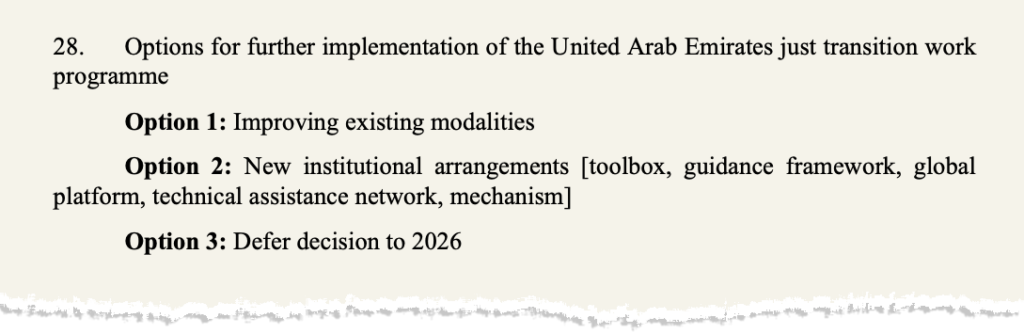
The image shows Paragraph 28 of the JTWP text published 25 June 2025. Credit: UNFCCC.
Civil society groups broadly welcomed this inclusion as a “big win”, although parties acknowledged that more needed to be done to flesh out the idea. Going into COP30, groups continued to push the idea of creating a BAM, with protests, banners and badges visible around the venue.
Early in negotiations, the G77 and China — a large coalition of developing countries at UN climate talks — put forward their own proposal for a just transition “mechanism”. They suggested it could provide technical assistance, support international cooperation and help to foster partnerships to address implementation gaps. Developed-country parties including Norway, the UK and others initially pushed back, opposing it due to concerns that it would duplicate existing systems and require additional funding. Developed countries also opposed the use of the term “mechanism”, with the EU suggesting an “action plan” as a potential alternative. Nevertheless, the creation of a “mechanism” was included in the final draft text on the JTWP, and the text was formally approved during the COP30 closing plenary, amid extended applause from many in the hall.
In a statement at the time, Chiara Martinelli, director at CAN Europe, welcomed the decision:
“Delivering BAM was a major civil society win. It creates a coordinated institutional home to drive forward progress on the just transition.”
The decision to develop the mechanism included a request for parties to work over the subsequent year – through to COP31 – on a plan to get things started. That twelve-month window is the practical reason the design fight is happening now rather than after Antalya.
What role could the mechanism play — and which design is on the table?
According to civil society, the BAM could help tackle the fractured just-transition landscape by centralising resources and helping to overcome a number of barriers. Speaking to Carbon Brief, Rosemberg says the just-transition space “lacks coordination and the right kind of support and is quite disconnected from climate action imperatives”. She adds:
“The BAM can play a role in bringing those [people] trying to make just transition happen together, identify gaps and barriers, foster cooperation and accelerate support.”
Civil society has put forward a number of proposals likely to inform the structure of the BAM. Most consist of a mechanism with three parts, which would encompass and expand upon work currently carried out under the JTWP. One proposal by a coalition of five NGOs suggests the mechanism would be formed of a steering body, a “knowledge arm” and an “implementation arm”. The steering body would coordinate the work of the two arms of the BAM, including deciding topics that should be discussed under the ongoing JTWP; the proposal suggests the body would recommend topics that require negotiation when “gaps that require political guidance are identified”.
Their proposal is illustrated in the infographic below, which shows the steering body acting as a central hub for work within the BAM.
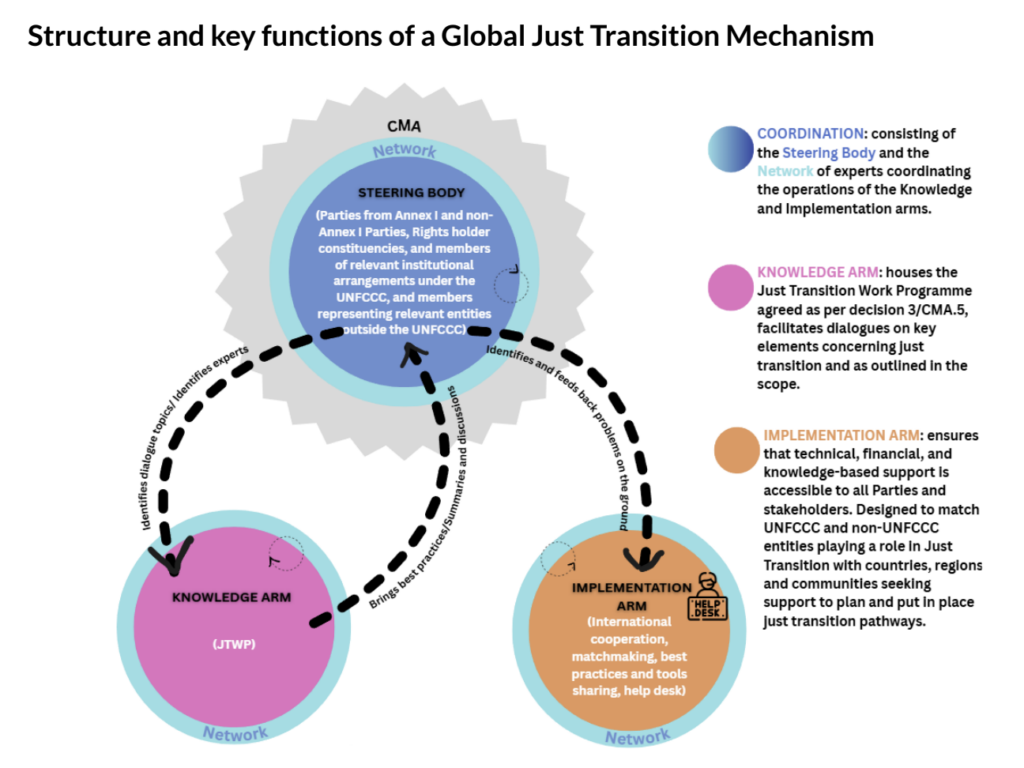
The infographic shows a suggested structure and key functions of the just transition mechanism. Credit: Women & Gender Constituency, CAN, DCJ, YOUNGO and TUNGO.
The final part of the BAM, the “implementation arm”, would act as a hub to enable and coordinate technical, financial and knowledge-based assistance for those pursuing a just transition. Rosemberg says the vision of civil society is for work to go “beyond negotiators’ dialogues”. She says the BAM could enable the organisation of a “matchmaking platform” to provide support faster, as well as dedicated groups to identify and mobilise financial resources. She adds:
“Finally, through bottom-up identification of barriers, the BAM can also allow a discussion on enabling just transition that is informed by practitioners. The BAM can show that implementation does not necessarily mean taking issues outside of the UNFCCC.”
A separate proposal for the structure of the BAM from the Global Campaign to Demand Climate Justice (DCJ) — a separate coalition of NGOs — similarly proposes three elements: coordination and coherence; knowledge generation; and international cooperation and support. Sealey-Huggins, who is affiliated with DCJ, notes:
“If it works in practice, what we’ll see is a cascade of just-transition policies implemented across countries, across sectors in a unifying, transformational moment for justice-centered climate action, and that will be the key to unlocking the transition that’s been missing so far.”
Another proposal comes from the Grantham Institute at the London School of Economics. It suggests the three functions of the mechanism should be capacity-building, technical assistance and knowledge-sharing, while recommending a dual-arm structure comprising a policy arm and an operational arm. De Wel tells Carbon Brief that while there is “rather broad consensus on the functions”, parties are pushing in “very different directions” on how the BAM will be set up.
| Proposal | Suggested structure | Named functions | Signal for practitioners |
|---|---|---|---|
| Coalition of five NGOs | Steering body + knowledge arm + implementation arm | Topic-setting under the JTWP, gap identification, coordinated assistance | A single entry point for technical help; most likely to absorb existing dialogues |
| Global Campaign to Demand Climate Justice (DCJ) | Three elements: coordination and coherence; knowledge generation; international cooperation and support | Policy cascade across countries and sectors | Strongest read on political momentum and rights-based framing |
| Grantham Institute, London School of Economics | Dual-arm structure: policy arm + operational arm | Three functions: capacity-building, technical assistance and knowledge-sharing | Closest to an operational agency model — most legible to institutions and lenders |
What will it cost — and is there a precedent worth copying?
Conclusion first: the money question will decide the design. Within UN climate negotiations, some parties have raised concerns about the potential cost of the mechanism. The push to launch the BAM comes as the UNFCCC itself faces a funding gap following the US withdrawal, while several other parties have delayed or reduced contributions in response to changes in domestic priorities. As a result, the UNFCCC has cancelled events and left vacated positions unfilled, as the organisation struggles to carry out existing functions.
Some parties have therefore expressed hesitancy about creating another mechanism under the remit of the UNFCCC, which also requires funding, though proponents of the BAM argue the costs of running it would be minimal. Rosemberg tells Carbon Brief that the BAM represents “an opportunity to streamline and make efficient use of public resources”. She adds:
“The mechanism does not necessarily require the creation of a costly new institution. Instead, it can leverage existing climate-finance channels and philanthropy.”
She adds that a “similar body” to the potential mechanism, the Climate Technology Centre and Network, costs less than $10m a year, noting this is “not an impossible amount to be found if there is political will to make just transition happen”. De Wel notes that the mechanism will build on existing work inside the UNFCCC and out, including the International Labour Organization’s “just transition policy gateway”. Alongside highlighting the potential efficiencies of the BAM design, many have argued the benefits are well worth the cost, with Sealey-Huggins telling Carbon Brief: “The cost to the [BAM] secretariat pales in comparison to the potential benefit of the action.”
A reference scale: what just-transition money already looks like
BAM is being argued over at a time when large, established just-transition budgets exist elsewhere. The European Commission’s Just Transition Mechanism targets mobilising around €55bn across 2021-2027 in the regions most affected by the shift to climate neutrality, anchored by a Just Transition Fund budgeted at €17.5bn, according to a European Parliament briefing. That is the benchmark many delegations have in mind when they ask whether a global coordination body needs its own budget line — and why advocates insist BAM should route existing finance rather than create it.
Case study: the Spanish coal deal as a delivery template
If you want a working model of the “implementation arm”, Spain is the most-cited national precedent.
- A written, tripartite deal first, closure second. In October 2018 the Spanish government and trade unions agreed to close ten coal mines with roughly €250m of public investment attached, alongside early retirement for miners aged over 48, retraining for green jobs and environmental restoration — the sequencing European social-partnership documents and the European Trade Union Confederation describe as the reason the phase-out faced limited political backlash.
- A standing strategy, not a one-off announcement. Spain folded a Just Transition Strategy into its energy and climate framework in 2019; the German development agency’s International Climate Initiative (IKI) describes it as the first country to adopt such a national strategy, implemented through negotiated agreements with affected regions.
- Read-across for BAM: the transferable elements are a named delivery vehicle, a budget line agreed with social partners, and region-level agreements — precisely the three gaps a coordination mechanism is meant to close for countries that lack them.
What is likely to happen in Antalya?
Conclusion first: expect a launch decision with a work plan, not a fully built institution. Despite the “victory” in Belém of agreeing to set up the new just-transition mechanism, climate negotiations in Bonn in June 2026 quickly hit sticking points. Bonn did ultimately agree on a “skeleton” draft text to send forward for further negotiations at COP31, but many details still need to be agreed in Antalya for the BAM to start functioning.
De Wel cautions that a “swift approval of the agenda of COP31 allowing parties to start the negotiations” is “crucial”. He adds:
“We can’t lose any time, there is so much work that needs to be done on [just transition]. Then we need a constructive approach by the major country blocs. If one of them starts playing tactical games, then it will be lost.”
In a submission to the UNFCCC earlier this year, CAN called for a series of measures to get the BAM up and running, including a decision on a first face-to-face meeting of a “just-transition committee” — a core part of the mechanism in the group’s proposal — to be held in April 2027.
Ahead of COP31, negotiating groups such as the Alliance of Small Island States (AOSIS), the least developed countries (LDCs) and the African group expressed support for the mechanism and called for it to be focused on implementation. The EU also supported the launch of the mechanism, but, along with other parties, cautioned that it should be complementary to the JTWP. No submissions opposed the creation of the mechanism, but groups such as LDCs called for a focus on “means of implementation” — commonly understood as finance — highlighting that it is likely to continue to be a key point of discussion in the upcoming summit.
Sealey-Huggins tells Carbon Brief what his “pie in the sky best-case scenario vision” for the outcome at COP31 would look like. He continues:
“G77 and China make the case again that the mechanism must be equally resourced. It must be well-designed. It must include people’s participation. It must address the barriers to implementation of just transition. It must facilitate the means of implementation. It must ensure justice at the very heart of climate action.
And then it’s agreed and it’s implemented immediately. So this work begins straight after Antalya to start forming committees and other bodies that can undertake the implementation.”
However, Rosemberg cautions that there is still a “question mark [remaining over] the level of ambition of the [COP31] presidencies, who need to move from simply talking about establishing any [just-transition] mechanism to engaging parties, so that we get a mechanism that is fit for purpose”.
A six-step action plan for climate policy and ESG teams
Use this sequence whether or not Antalya produces the full design. Nothing here depends on contested details; all of it improves your position if the BAM starts working.
- Read the texts, not the press releases. Bracketed language in the COP31 draft tells you where the fight is. Work through the options, agenda items and status markers methodically — our step-by-step guide to tracking and decoding COP31 negotiating texts shows how to log brackets and options weekly.
- Map your exposure beyond energy. The concept covers agriculture, heavy industry and other sectors, so screen site-by-site for closure, reprofiling and rehiring risk, including in your supply chain.
- Put social dialogue on the record. The ITUC’s business guidance frames just transition on the co-creation of plans through dialogue between workers, employers and, where relevant, government and communities — minuted, dated and repeatable dialogue is now what auditors and unions both expect.
- Align disclosure before you are asked. GRI’s revised climate standard, GRI 102: Climate Change 2025, requires disclosure of just-transition impacts on workers and communities, including hiring, phasing out of roles, retraining and gender-disaggregated workforce data; if you report under it, close the data gaps now.
- Build a barriers dossier. The bottom-up identification route Rosemberg describes is the channel through which private-sector implementation problems enter the UNFCCC record — write yours in plain language, with evidence, so it can be cited in JTWP submissions by your industry association.
- Watch the calendar past Antalya. Track the proposed first meeting of a just-transition committee in April 2027, and the national planning cycles that will absorb whatever guidance the mechanism issues. Two other tracks will shape the same compliance environment — see our read on the five COP31 negotiating tracks and the readiness checklist for where finance, adaptation and mitigation positions are converging.
Five common misreads of the Belém-Antalya mechanism
- “BAM will open a grant window companies can tap.” Unlikely in the near term: advocates explicitly say they are not seeking a new fund, and the design language points to technical assistance and matchmaking.
- “The mechanism will replace the JTWP.” The EU and other parties have cautioned it should be complementary to the work programme; the five-NGO model keeps the JTWP as the negotiating layer with a steering body setting its topics.
- “A launch decision in Antalya creates obligations.” The framework is voluntary and guidance-oriented; the binding pressure arrives through national plans and disclosure rules, not through the COP decision itself.
- “It duplicates existing institutions.” That is the developed-country objection recorded in Belém and Bonn; the counter is overlap with bodies such as the Climate Technology Centre and Network, which runs at a modest cost.
- “Cost is the blocker.” Cost is the stated blocker; the unresolved blocker is the mandate — whether the BAM can mobilise means of implementation, which LDCs have kept at the top of the agenda.
FAQ: what teams ask before the Antalya summit
Is the BAM the same thing as the EU’s Just Transition Mechanism?
No. The EU instrument is a regional funding package of around €55bn for 2021-2027; the BAM is a proposed UNFCCC coordination body with no comparable budget proposed. The two are often confused because the names rhyme.
When was the decision to develop it taken?
At COP30 in Belém, Brazil — last year’s conference — with the formal request for parties to work on a start-up plan over the subsequent year, through to COP31 in Antalya.
Will companies report directly to the mechanism?
Nothing in the current proposals creates a corporate reporting channel to the UNFCCC. Company-facing requirements flow through national planning, procurement and disclosure standards such as GRI 102, not through a BAM registry.
Who opposes it?
No submissions opposed the creation of the mechanism. The split runs along functions and financing: Norway, the UK and others worried about duplication and cost, and the EU floated an “action plan” instead of a “mechanism” before the COP30 text settled.
What is the single best indicator that the BAM is becoming real?
A decision on the first meeting of a standing body — CAN’s proposal puts a just-transition committee face-to-face in April 2027 — plus any language tying existing climate-finance channels to just-transition criteria.
Bottom line for GreencarbonWorld readers
Do not wait for Antalya to finish your just-transition homework. The mandate is already agreed; the arguments are about plumbing — who chairs it, how many arms it has, and whose money moves through it. Teams that arrive at the post-COP31 period with a costed workforce plan, minuted social dialogue and clean just-transition disclosure data will be the ones that can borrow a national transition narrative when permits, buyers and lenders start asking for it. Teams that treat BAM as a future fund will be structurally late.
GreencarbonWorld’s ClimatePolicy desk will continue tracking the COP31 text stream. For corrections, source requests or briefings for compliance teams, write to Iris Vaughan at info@greencarbonworld.com.
Sources and further reading
- UNFCCC — COP31 dates and presidency: https://unfccc.int/cop31
- C2ES — Key negotiations and outcomes of the Belém climate conference: https://www.c2es.org/document/key-negotiations-related-outcomes-of-the-un-climate-conference-in-belem/
- Carbon Brief — Q&A: What is the Belém-Antalya mechanism for a just transition: https://www.carbonbrief.org/qa-what-is-the-belem-antalya-mechanism-for-a-just-transition
- European Commission — The Just Transition Mechanism (€55bn mobilisation, 2021-2027): https://commission.europa.eu/topics/regional-and-urban-policy/just-transition-mechanism_en
- European Parliament briefing — Just Transition Fund, €17.5bn: https://www.europarl.europa.eu/RegData/etudes/ATAG/2021/690602/EPRS_ATA(2021)690602_EN.pdf
- ETUC — Spain guarantees a just transition for miners (October 2018 coal agreement): https://www.etuc.org/en/spain-guarantees-just-transition-miners
- International Climate Initiative (GIZ) — Just transition policies: lessons from Europe, on Spain’s 2019 national strategy: https://www.international-climate-initiative.com/fileadmin/iki/Dokumente/Publikationen/Projekte/20_I_423/20250526_new-climate_giz_Report-Just-Transition-Policies.pdf
- ITUC — Just transition: a business guide: https://www.ituc-csi.org/IMG/pdf/just_transition_-_a_business_guide.pdf
- GRI — Topic Standard for Climate Change and Energy (GRI 102: Climate Change 2025): https://www.globalreporting.org/standards/standards-development/topic-standard-for-climate-change-and-energy/
- IISD — COP 30 outcome: what it means and what’s next: https://www.iisd.org/articles/insight/cop-30-outcome-what-it-means-and-whats-next