
How Reclassification Rules Closed the UK's £11.6bn Climate Finance Gap: An Audit-Ready Checklist for Policy Teams
A pledge can be honoured in two very different ways: by writing genuinely new cheques, or by widening the definition of what counts as spending. GreencarbonWorld's ClimatePolicy desk has tracked the UK's international climate finance files across the full delivery cycle, and the verdict on the closing year leaves little room for ambiguity — by 2026 the UK stood at its commitment to deliver at least £11.6bn of overseas climate finance between 2021 and 2026, but the headline depended on questionable accounting.
Treat this as a governance case study, not merely a development-finance story. Any organisation reporting against a multi-year environmental or social target meets the same temptation: when budgets tighten, the cheapest route to apparent compliance is to alter the tagging rule rather than the outturn. What follows reconstructs the ledger, dissects the three reclassification channels that produced it, walks one case file through two competing rulebooks, and closes with a verification checklist, common pitfalls, a FAQ and concrete recommendations for compliance, ESG and policy leads.
The two obligations sitting behind the number
Under the Paris Agreement, and more broadly under UN climate treaties, the UK and other developed countries must supply new and additional climate finance to help developing countries tackle climate change. Alongside that qualitative test sit collective volume targets: donors face commitments to mobilise $100bn of climate finance per year through to 2025 and at least $300bn by 2035. The 2035 figure flows from the new collective quantified goal adopted at COP29 in Baku, whose decision text also calls on all actors to raise climate financing from all public and private sources to at least $1.3 trillion per year by 2035, with a "Baku to Belém" roadmap steering delivery up to and beyond 2030 (UNFCCC decision text on the NCQG, unfccc.int).
Into that architecture, the Conservative government pledged in 2019 to provide £11.6bn between the financial years 2021-22 and 2025-26, a move it described as doubling its previous five-year target. A second, less-noticed rule followed: from 2023 the UK required that all new bilateral official development assistance be aligned with the Paris Agreement, embedded in FCDO's programme operating framework and separately scrutinised by ICAI in a dedicated review of UK aid's Paris alignment. The pledge was therefore always a combined test — volume, additionality and alignment.
Successive governments then cut the money flowing to foreign aid, pointing to economic strain and a need for more defence spending, which put great pressure on a target paid for from the UK aid budget. To keep honouring the £11.6bn goal while spending less, the Conservative government decided in 2023 to loosen the criteria for what it defined as climate spending. The current Labour government has chosen to maintain this approach, while pledging to cut aid spending even further. Campaigners, MPs and even the UK's official aid watchdog have strongly criticised the move, calling it "creative accounting" — or, in the phrase that stuck, "Moving the goalposts".
The reconstructed ledger: reported totals versus rule-adjusted totals
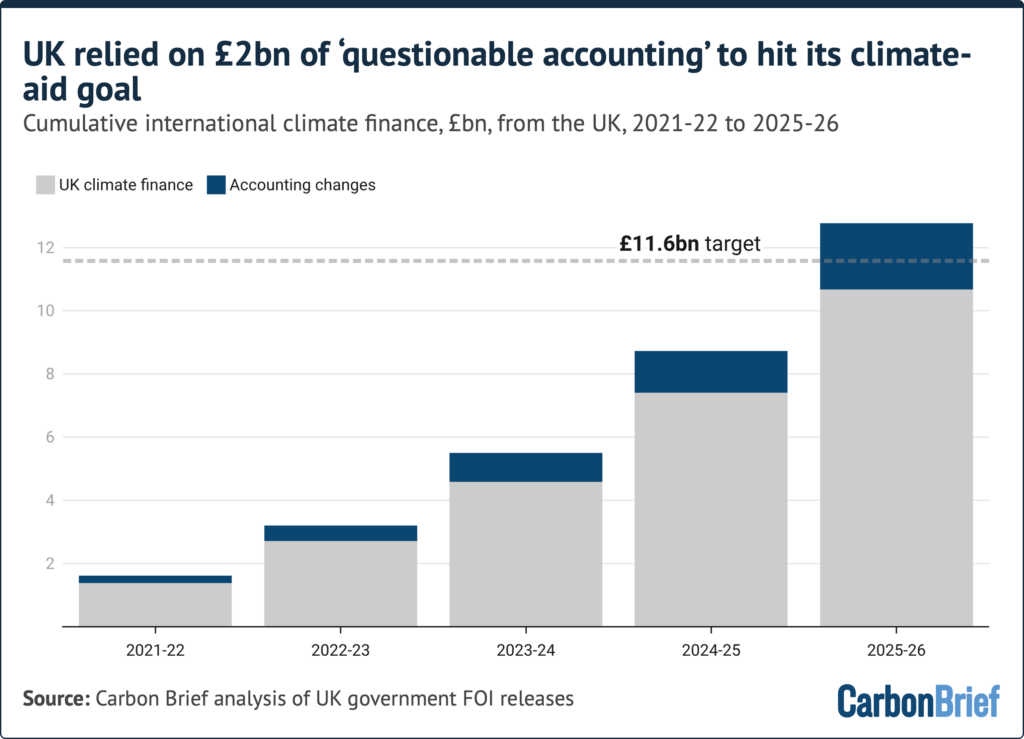
The UK government says it met the £11.6bn target, but has not published the full details of how it did so, or even the total amount provided by 2025-26. Freedom-of-information data obtained by Carbon Brief over the course of several months shows that total climate finance over the past five years actually reached £12.8bn, including a record £4bn in the past year alone.
Re-scored against the definitions that applied before 2023, around £2.1bn — nearly a fifth of the booked total — is attributable to the government's accounting changes rather than to fresh money. Excluding those rebranded amounts, cumulative UK climate finance would only have reached roughly £10.7bn, leaving a shortfall of £924m; in plain terms, the UK would still have missed the target by nearly £1bn.
| Ledger view to 2026 | Amount | What a reviewer should read into it |
|---|---|---|
| Reported cumulative spend | £12.8bn | The headline the UK government relies on |
| Booked via reclassification | £2.1bn (nearly a fifth) | Existing money, new label |
| Cumulative on pre-2023 rules | £10.7bn | Below the declared pledge |
| Gap against the pledge | £924m | Approximately £1bn of unfunded delivery |
| Watchdog forecast made in 2024 | £1.7bn | ICAI's earlier estimate, overtaken by the final figure |
This final figure of £2.1bn is higher than the UK Independent Commission for Aid Impact (ICAI) forecast in 2024, when ICAI estimated that total reclassified climate finance would reach £1.7bn. The government's own position is that its accounting changes are consistent with internationally agreed ways of calculating ICF, used by other major donors.
The chart below traces how the cumulative line behaves with and without the definitional shift.
Three reclassification routes, dissected
Route 1: counting core funding of the development banks — £1.1bn
The first and by far the largest component counts a share of core funding for multilateral development banks (MDBs) as climate finance. These are un-earmarked contributions governments provide to keep the banks operating, which in turn underpin loans and grants to developing countries. Booking that spending adds £1.1bn to the total of £12.8bn, split mainly between the World Bank and the African Development Bank.
The justification is that the World Bank and other banks run their own targets for channelling core resources into climate-relevant projects. Three weaknesses stand out for anyone auditing a similar structure. MDBs have faced criticism for limited transparency around climate finance and for relying on loans rather than grants, whereas nearly all of the UK's climate finance so far has been grant-based. The US has been pressuring MDBs to drop their climate plans altogether, and the Trump administration has already forced the World Bank to abandon its overall target to put 45% of its funds towards climate finance. Jon Sward, environment project manager at the Bretton Woods Project NGO, tells Carbon Brief: "One thing removing the overall [World Bank] target definitely does is it adds…a lack of predictability of the flows going forward."
Route 2: an automatic 30% on humanitarian aid — nearly £600m
The second-largest change, contributing nearly £600m, automatically counts 30% of humanitarian aid as climate finance when it goes to one of the countries judged most vulnerable to climate change. It covers some of the most war-torn and low-income nations, including Afghanistan, Sudan and the Democratic Republic of the Congo. Crucially, projects are counted even without a discernible link to climate change, such as helping conflict-affected people in Yemen, or orphans in Zimbabwe. The Center for Global Development (CGD) has described this revision as arbitrary, since every aid project is already screened for any climate-relevant components.
The benchmarking point matters. Under the OECD Development Assistance Committee's Rio Marker convention, activities where climate is the principal objective are normally reported at 100% of value, while those where climate is a significant but secondary objective are counted at a lower coefficient — the DAC's own reporting survey records 40% as the standard significant-score coefficient (OECD DAC statistics committee notes, one.oecd.org; OECD climate finance explainer, oecd.org). A blanket share assigned by destination country, rather than by what an activity actually does, therefore sits outside the marker logic. That mismatch is exactly what an external assessor flags.
Route 3: re-basing private-sector counting at British International Investment — £133m booked
A third significant portion comes from counting more private-sector investments through British International Investment (BII) as climate finance. BII is a publicly owned, for-profit company investing in developing-country businesses and partly funded by injections of UK aid money. The government moved to calculate the climate share of its BII spending from real-world BII investments, rather than from a default, fixed share of 30%.
Data obtained by Carbon Brief via freedom of information suggests £133m of extra BII funding was labelled as climate finance over the first four years of the £11.6bn target. Government records of BII climate finance have been inconsistent, however, making the total impact hard to pin down; Carbon Brief therefore used an earlier internal government forecast estimating that this change would add a total of £266m over the five-year target period. In recent years, BII has increasingly turned its attention to investing in clean power, reaching more than £1bn in climate investments in 2025. The company has faced criticism, however, for investments that conflict with UK priorities, including legacy fossil-fuel investments, and for channelling aid money to billionaires.
A smaller retrospective line: £99m of spending on COP26
Some extra spending was also counted as climate aid, notably £99m of spending on COP26, from when the UK hosted the climate summit — a reminder that retrospective re-tagging of historical costs is itself an accounting device worth tracking.
Case file: one programme, two rulebooks
To see how quickly a headline can outrun delivery, run an illustrative humanitarian or basic-services programme in a climate-vulnerable recipient country through both rulebooks. Under the pre-2023 UK approach, that programme would only appear in the climate ledger if a specific, identified climate component survived the existing screening of every aid project; under the post-2023 approach, 30% of its value is booked automatically because of where it lands, regardless of what it funds. Move the same activity through the OECD marker convention and it must first be classified as principal or significant, which then determines whether 100% or 40% is reported — a test of activity design, not of geography.
Result reporting compounds the problem. ICAI's 2024 review of UK aid's international climate finance commitments notes that the results indicators attached to the programme are scored internally by the departments responsible for the spending, a governance arrangement also discussed in the Center for Global Development's analysis of UK climate finance results (cgdev.org, February 2025). For comparison, the official UK International Climate Finance results publications credit the programme with reaching, among other outputs, 137 million people helped to adapt to climate impacts and 89 million people gaining improved access to clean energy (GOV.UK international climate finance collection, gov.uk). None of that is impossible — but self-scored indicators plus relaxed tagging rules mean an external reviewer cannot independently retrace the steps. That, rather than the missing £924m, is the deeper governance finding.
What the watchdog and the committee concluded
Experts have noted that the UK was traditionally viewed as taking a more rigorous approach to climate-finance accounting, which is notoriously unregulated and opaque. A recent International Development Committee (IDC) report noted that developed countries have committed to providing new and additional climate finance to developing countries, generally interpreted as extra funds on top of existing aid. The IDC concluded from its evidence that, alongside aid cuts, the UK's accounting changes have eroded the additionality and credibility of its climate finance.
Responding to Carbon Brief's findings, IDC chair Sarah Champion said the data shines a new light on the committee's findings:
"The picture is not getting any better. If questionable accounting has been used to get around a £1bn shortfall on ICF spend between 2021-22 and 2025-26, this only underlines my concerns that the government has been cutting corners to maintain headline climate-spending commitments, rather than working to deliver genuine climate and nature outcomes."
Responding to the analysis, a UK government spokesperson says:
"We are proud to have both hit, and exceeded, our third international climate-finance target – and will continue to work hard on protecting climate and nature."
"Climate change and nature loss pose a real and significant threat to global security and prosperity. That is why the UK is leading action on climate and nature, and prioritising climate finance in its aid budget."
The next cycle: £6bn and why the rules still bite
The accounting changes still matter as the UK starts its next phase of international climate finance, while reducing the aid budget further. The government has pledged £6bn of foreign aid for climate projects over the next three years, making the UK one of the only major donor countries to set out a new climate-finance target for the period after 2025, despite a global pledge to scale up support.
Even so, the new UK goal halves spending from £4bn in the financial year 2025-26 to £2bn a year, on average. Previous Carbon Brief analysis also indicates that continued use of questionable accounting is likely to make up around a third of the new target. Shruti Agarwal, senior climate finance adviser at Save the Children UK, tells Carbon Brief that the reduction in overall financial effort by the UK is a concerning pattern that must cease. She adds:
"[The UK should] strengthen transparency by publishing timely, detailed data on international climate spending and stop classifying expenditure as climate finance retrospectively, as seen with COP26 expenses."
Common pitfalls when inheriting a headline target
- Confusing arithmetic compliance with policy compliance. Meeting a total is not the same as satisfying the "new and additional" test that the Paris Agreement framework assumes.
- Treating international conventions as a blank cheque. Practices can be consistent with internationally agreed ways of calculating ICF and still fail a domestic additionality standard.
- Tagging by geography instead of by activity. A flat share applied to all spending in a vulnerable country invites the "arbitrary" objection the CGD raises.
- Retrospective classification. Historic costs such as spending on COP26 re-entering the climate ledger undermines year-on-year comparability.
- Ignoring ring-fenced sub-targets. The headline total conceals whether earmarked slices were protected — the pledge included at least £3bn of the £11.6bn for nature-related solutions, with £1.5bn specifically for forests, according to GOV.UK results publications and ICAI's 2024 review.
- Leaving indicators with the spender. Internally scored results indicators remove the second line of defence.
Verification checklist: eight steps before certifying a target as met
- Freeze the classification rule at the start of the period and log every subsequent amendment with date, author and rationale.
- Maintain two parallel ledgers throughout — reported figures and figures on the original definitions — so a restatement never has to be reverse-engineered.
- Tag each line by what the activity does, using an explicit coefficient where a secondary objective is claimed, and record the evidence used.
- Separate grants from loans and from core, un-earmarked institutional funding; the risk of double counting is highest in the last two.
- Never book costs incurred before the commitment window; if a legacy item must appear, disclose it as a distinct line.
- Reconcile your own total against an external estimate — here, the gap between £2.1bn and ICAI's £1.7bn forecast in 2024 is instructive.
- Have indicators scored by a function that does not own the budget, and keep the underlying business cases retrievable.
- Publish the dataset while the period is still open, in machine-readable form, rather than a summary after the fact.
How the figures were produced — and why revisions keep coming
Carbon Brief obtained full datasets of international climate-finance spending via freedom of information, covering the five-year period 2021-22 to 2025-26; the full dataset is set out in Carbon Brief's analysis of the £12.8bn in spending over this period. In addition, Carbon Brief requested from the Foreign, Commonwealth and Development Office (FCDO) details of what climate-finance spending would have been prior to the 2023 accounting changes, for the period 2021-22 to 2024-25, then used this information to calculate the impact of accounting changes in 2025-26, combining the figures to work out the full impact. UK climate-finance figures have been subject to regular revisions: although this analysis is based on final figures provided via FOI requests in recent months, departments may still change the figures in future releases. Practitioners should therefore treat any single-year climate tag as provisional and build a revision buffer into their disclosures.
FAQ: what policy and compliance teams ask us first
Was the pledge actually met?
On the government's published definitions, yes: the £11.6bn goal was cleared, with reported spending of £12.8bn over the past five years. On pre-2023 definitions, the reconstructed total of £10.7bn implies a shortfall of £924m.
Is this practice unique to the UK?
No. Other major donors apply overlapping conventions, which is why the government argues its approach is consistent with internationally agreed ways of calculating ICF. The UK's difficulty is reputational: experts have noted it was traditionally viewed as taking a more rigorous approach to climate-finance accounting, a standard now judged to have eroded additionality and credibility.
Why does the next target matter more?
Because the base is smaller. The £6bn pledge over the next three years halves the annual run rate from £4bn in the financial year 2025-26 to £2bn on average, and continued use of questionable accounting is likely to supply around a third of it — so definitional choices carry proportionally more weight.
Where can independent data be found?
Three routes are usable today: UK climate-finance results and statistics publications on GOV.UK, project-level aid disclosures released through FCDO's DevTracker and the d-portal aggregate, and the UK's reporting under the UNFCCC, including its first Biennial Transparency Report, alongside ICAI's 2024 review of international climate finance commitments.
What should a corporate or programme team do on day one?
Document the tagging rule before spending against it, keep evidence at activity level, and state plainly which conventions a figure follows — the "Baku to Belém" era of climate finance will reward comparability, not headline size.
Action recommendations
- Policy teams: publish a definition sheet at target-setting, and require a dual-ledger report each year rather than a single end-of-period claim.
- Compliance and ESG leads: map your classification practice against the OECD marker convention (100% principal, 40% significant) and justify any deviation in writing.
- Delivery and pipeline teams bidding into public climate funds: assume Paris-alignment evidence and activity-level climate rationale will be requested, and archive business cases so they remain retrievable.
- Analysts and investors: discount headline totals by the reclassification share, and treat self-scored outcome indicators as unaudited until independently verified.
Definitions are the quiet half of every climate commitment. The UK's closing year shows how a target can be declared met while genuine new and additional support contracts, and how a watchdog, a parliamentary committee and a freedom-of-information trail can still force the arithmetic into the open. For anyone writing or auditing a multi-year climate pledge, the practical lesson is to decide what counts before the money moves — and to publish that rule as prominently as the total.