
GreencarbonWorld ClimatePolicy Guide: How to Track and Decode COP31 Negotiating Texts, Step by Step
Short answer: COP31 is decided by wording, not speeches. Read a topic's status colour inside a text tracker and you know where it stands: red means nothing is on paper, orange an early informal text, yellow a draft still full of [square brackets] and options, green agreement, grey postponement under rule 16. For ESG and compliance teams, those colours preview which clauses will harden into national law, carbon-market rules and disclosure duties.
That is the logic behind Carbon Brief's real-time text tracker, the tool this guide teaches you to use. Negotiating documents are the least readable genre in climate governance and, at the same time, the single most reliable early-warning system for regulated companies. Below is a step-by-step method — frame, colour code, bracket arithmetic, agenda risks, sector exposure — plus a desk checklist, common misconceptions and an action list for the fortnight.
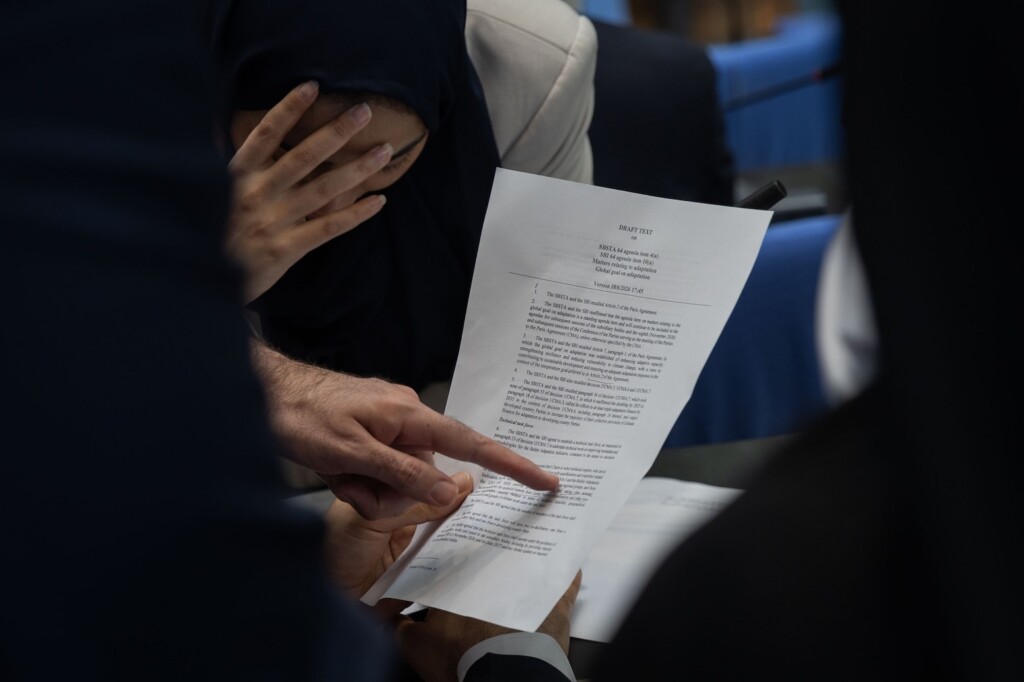
During informal consultations on the “global goal on adaptation”, delegates discuss texts. Credit: IISD/ENB – Kiara Worth
Why the text, not the communiqué, is the compliance signal
At every UN climate summit, countries negotiate the wording of a large number of legal agreements, and COP31 is no different. The UN confirms the conference runs from 9 to 20 November 2026 in Antalya, a coastal city in Turkey, which holds the presidency.
Behind closed doors in the blue zone, diplomats from nearly 200 nations — this cycle not including the US — haggle over each individual verb as texts are hashed out. Over the two-week summit, negotiators try to reach consensus on more than 100 separate agreements, but they must first agree which issues are on the agenda at all.
For a reader outside the negotiation bubble, that complexity is the problem: it is genuinely hard to keep track of what countries are fighting about and how fast the talks are moving. For a compliance officer, the same complexity is the opportunity. One bracketed phrase about “provision of information”, “corresponding adjustments” or “non-market approaches” can decide whether a carbon-market rule, a reporting obligation or a credit-issuance methodology lands in 2027 — or slips to the following cycle.
What the Carbon Brief tracker actually shows
It shows process, not ambition. Carbon Brief's tracker decodes the agenda and keeps a searchable record of every document for each part of the negotiations. The first column lists the topic of each agenda item; further columns carry dates, page counts and links to the original PDFs, so you can always verify a claim against primary source material rather than a summary. The table can be filtered through the interactive text box and reordered with the arrow icons.
Ahead of the opening of the summit, the tracker counts 104 substantive items on the agenda, not including procedural matters such as the election of COP officials.
Two practical notes for first-time users:
- Page counts measure volume, not progress. A 40-page compilation of party submissions can sit next to a two-page bridging text that actually moves the file.
- Pair the tracker with position mapping. Carbon Brief's companion interactive, published on 2 November 2026, analysed roughly 100 pre-summit documents to map what each bloc wants (“Interactive: Who wants what at the COP31 climate change summit”). Use it to predict which files will stay red.
Step 1 — Fix the frame: who can move a text
This year's talks come with a twist. Turkey holds the presidency and hosts the summit, while Australia is jointly running the show as “president of negotiations”. Power over the paper is therefore split, and you should read the outputs of both offices separately.
The pair have already announced their intention to produce a “cover text”, an overarching political document summarising key negotiated outcomes along with issues that are not on the official agenda. That single design feature breaks the naive reading strategy of following only the formal items.
Likely cover-text content, as flagged in the master coverage, includes recognition that warming is set to “overshoot” the 1.5C limit and the damage this is already causing, plus potential solutions such as the Turkish presidency's “electrification” target for 35% of global final energy to come from electricity by 2035. For scale: the IEA's electrification analysis puts electricity at roughly 23% of total final energy consumption today, while the Presidency describes the starting point as just over 20%. Reaching 35% within a decade is therefore a step-change in the share of final energy, not a tweak — and, on our reading, the corporate read-through is immediate: Scope 2 procurement strategy, power purchase agreements, heat electrification in industry and product design.
Set expectations honestly. COP31 is not seen as a banner year for the negotiations: it falls half-way between two “global stocktakes” of progress and, in that sense, sits between global stocktakes rather than creating a new one. It still carries major files — finalising the “global goal on adaptation”, deciding whether to continue the contested “mitigation work programme”, and agreeing the details of a new “just transition mechanism”.
Step 2 — Learn the colour code, and what to do at each light
The traffic-light view is the fastest single-glance read of the whole conference. Each agenda item is colour-coded by status; the table below translates those colours into desk actions.
| Status | What it means in the text | What a corporate reader should do | Typical moment in the fortnight |
|---|---|---|---|
| Red | Negotiators have not yet managed to put anything down on paper — often because parties hold fundamentally different views on how to proceed | Treat as a policy vacuum; plan on existing national law and disclose the uncertainty | Week one |
| Orange | Work is under way on an “informal text”: an early draft setting out different parties' views, not yet expressed in formal legal language | Read for direction of travel; flag wording shifts to legal and policy affairs | Week one into week two |
| Yellow | A draft legal agreement exists; remaining disagreement survives as [square brackets] and “options” | Use the bracket count as a risk index for any exposure you have mapped to that item | Week two |
| Green | All brackets and options resolved on that topic | Start translating into your compliance calendar; adoption is still needed | Final days |
| Grey | No agreement; discussions fall under “rule 16”, meaning they are postponed until the next session | Assume a one-cycle delay and re-check at the next Bonn intersessional | Closing plenary |
| “Clean” | Texts with no areas of disagreement, which can be converted into “draft decisions” ready for formal adoption | Low-risk adoption; brief the business on operative verbs | Last 48 hours |
Step 3 — Count brackets and options, not headlines
Disagreement is measurable. Texts with many square brackets or options tend to indicate a high level of disagreement between parties, which is why the tracker counts and displays the number of outstanding brackets and options in each document.
During the summit, negotiators may work through many iterations of texts on each agenda item. Some documents are “bridging text”, designed to resolve differences of opinion and to find a “landing zone” that all groups can agree on. Agreement on a given topic is reached once all brackets and options have been resolved, at which point the item turns green.
Working rule for analysts: track the delta. Compare the bracket count of the latest document against the previous version on the same item, and record only three data points per file — opening count, mid-point count, closing count. That series tells you more about the shape of the outcome than reading every iteration end to end.
Step 4 — Watch the agenda fight, where new obligations are born
Although most agenda items are agreed in advance, parties can suggest late additions; these must be signed off before negotiations can begin, often resulting in an “agenda fight”. Treat the adoption of the agenda as a substantive decision, not housekeeping: whoever gets an item onto the list has bought themselves a mandate for the next cycle.
COP30 agreed to put two new items on the agenda for future summits. These are the provision of climate finance by developed countries under Article 9.1 of the Paris Agreement, and making global “finance flows” consistent with the treaty under Article 2.1c.
Ahead of COP31, the African group of nations filed a request to add climate-related trade tariffs to the agenda; COP30 had agreed to annual “dialogues” on this matter at the Bonn climate talks, and trade-and-climate lobbying was still running into late October 2026, as reported by Carbon Pulse. For exporters and importers of steel, cement, aluminium and electricity, this is the sleeper file: it is where border carbon measures get argued about in treaty language. (This sentence is our analysis, not a negotiated outcome.)
The African group also wants further items added, on tripling adaptation finance and on funding for the Green Climate Fund, a flagship UN body designed to support climate action.
Step 5 — The three files with the most direct corporate exposure
- Adaptation. Efforts to finalise the “global goal on adaptation” continue, alongside the demand for tripling adaptation finance. Physically exposed assets — ports, coastal sites, agriculture and cold-chain logistics — sit in this file even when companies do not think of themselves as “adaptation” businesses.
- Mitigation. Whether to continue the “mitigation work programme” is on the table. Carbon Brief's wrap-up of the June 2026 session noted that the programme — the only formal UNFCCC item specifically about cutting greenhouse gas emissions — closed without agreement, with parties divided over its continuation, role and effectiveness, and the file was carried forward to COP31. If it turns grey, expect mitigation-implementation work to migrate into national determination processes instead.
- Just transition. Negotiators are trying to agree the details of a new “just transition mechanism”, also referred to as the “Belém-Antalya mechanism for global just transitions” (BAM). Labour-intensive decarbonisation is the hard part: pre-summit recommendations from the Climate Action Network's just-transition finance work put needs estimates starting from an “illustrative” USD 50 billion a year by 2035, while funding and governance of the mechanism remained unresolved after the Bonn intersessional.
A fourth channel sits outside the tracker and belongs to the Presidency. As the UNFCCC puts it, the Action Agenda is set by the Presidency, whereas the negotiations are steered but remain a party-driven process requiring consensus. The Presidency launched its Global Climate Action Agenda at the June 2026 session in Bonn, with a set of non-negotiated 2035 targets recorded in the European Parliament's briefing on the conference. Nothing here is legally binding, but it is where utilities, industrials and investors can align announcements with host-country priorities — the electrification target being the clearest example.
Carbon-market teams should also watch the technical track that feeds COP31 rather than appearing in it: the Article 6.4 Supervisory Body scheduled its final meeting of the year in Bonn from 5 to 9 October 2026 ahead of the summit, and the UN-supervised crediting mechanism recently widened eligibility to renewable power projects through a new methodology, according to the UNFCCC.
A desk checklist for the two weeks
- Pick five agenda items that map to your actual risk register — power, industry, land use, finance, trade — and ignore the remaining 99.
- Snapshot the tracker daily at a fixed hour; log colour, bracket count and page count for each of your five files.
- Open the linked original PDFs before quoting any conclusion; the tracker is an index, not the authority.
- Read the adoption of the agenda as a negotiating event in its own right.
- Separate the three documents in circulation: informal text, formal draft, and the cover text that may contain off-agenda material.
- Flag any item that goes grey under rule 16 to your government-affairs lead as a “one-cycle delay” signal.
- Track “clean” versions of texts; that is your earliest reliable forecast of the closing plenary package.
- Book 30 minutes for the closing plenary: the gavel, not the colour, is the legal event.
Five misconceptions that trip up even experienced readers
- “Orange means a deal is close.” An “informal text” only records where parties stand; it is deliberately non-committal and can be discarded.
- “Green means adopted.” Green means the brackets are gone. Adoption requires the president to gavel a draft decision, as the COP29 finale showed.
- “A long document is progress.” Page counts and session dates are metadata, not ambition.
- “Everything relevant is in the tracker.” The Action Agenda and the cover text live outside the formal negotiating record.
- “Grey is dead.” Under rule 16 a topic is postponed to the next session, not abandoned — it usually returns with harder language.
Case in point: what happens when the last row surprises you
Where agreement cannot be reached on a clean text, the closing plenary becomes the risk event. Although the final step is usually a formality, dramatic exceptions are possible: during the closing plenary at COP29, the president of the meeting failed to adopt a deal relating to the “global stocktake” from 2023, which had called for “transitioning away” from fossil fuels.
Two lessons follow. First, headline verbs are fragile — “transitioning away” survived politically precisely because it had already been agreed at the previous COP, while the attempt to operationalise it in a decision text collapsed. Second, text status is not the same as implementation. As one negotiator put it in reporting by The Irish Times on the run-up to the Antalya conference: “Progress should not be measured by detail in negotiating texts but by real impacts on the ground.”
That gap now has a documented shape. The cities-and-regions network, reviewing the texts agreed after COP30, notes that the final outcomes fell short of establishing a mandated multilevel governance framework or predictable, territorial finance to empower local implementers — which is why regional authorities and the companies operating in their territories still depend on domestic budgets rather than COP wording. Comparing cycles is possible: Carbon Brief also ran text trackers for COP28, COP29 and COP30, so bracket and status counts can be baselined against previous presidencies.
Action list: five moves before the gavel falls
- Map your five monitored agenda items onto existing internal policies — transition plan, climate risk disclosure, procurement, taxonomy alignment — and note which policy would have to change if each item goes green.
- Pre-draft two positions for the finance files (Article 9.1 and Article 2.1c): one for a strong outcome, one for a postponement under rule 16.
- Stress-test power strategy against the 35% electrification scenario, treating it as a Presidency ambition rather than a commitment.
- Add just-transition cost exposure to your capital-allocation model while BAM funding and governance remain bracketed.
- Set a 72-hour post-plenary review: convert adopted language into obligations, and log what was deferred.
FAQ: reading COP31 texts
How many decisions are actually in play at COP31?
Negotiators are trying to reach consensus on more than 100 separate agreements across the two-week summit, and Carbon Brief's tracker counted 104 substantive agenda items before the opening, excluding procedural matters. The number can still rise if a late addition wins sign-off in an agenda fight.
Does a green light mean the rule already applies to my business?
No. Green records that all brackets and options on that item have been resolved. The text still has to be gavelled as a draft decision at the closing plenary, and then transposed into domestic law or regulation before it creates a duty for a company.
Is the 35% electrification figure a binding target?
It is a proposal by the Turkish presidency — an “electrification” goal for 35% of global final energy to come from electricity by 2035 — that may appear in the cover text or the non-negotiated Action Agenda. Nothing on that track has treaty status.
What happens to an item that turns grey?
It falls under rule 16: negotiations are postponed until the next session. Practically, that means the topic reappears at the next intersessional in Bonn or at the following COP, so a grey cell is a timing signal rather than a policy reversal.
Which text should I quote in a board paper?
Quote the original PDF linked from the tracker row, identify the document number and date, and state the status colour at the time of reading. If the item is covered by the “cover text” rather than a negotiated decision, say so: the legal weight is different.
Sources and further reading
- Carbon Brief — Interactive: tracking negotiating texts at the COP31 climate summit: https://www.carbonbrief.org/interactive-tracking-negotiating-texts-at-the-cop31-climate-summit
- Carbon Brief — Interactive: who wants what at the COP31 climate change summit: https://www.carbonbrief.org/interactive-who-wants-what-at-the-cop31-climate-change-summit
- United Nations — COP31 to take place 9-20 November 2026 in Antalya, Türkiye: https://www.un.org/en/climatechange/cop31
- UNFCCC — The Road to Antalya: https://unfccc.int/cop31/the-road-to-antalya
- UNFCCC — COP31 Presidency announces new targets on global electrification, cutting waste and resilient cities: https://unfccc.int/news/cop31-presidency-announces-new-targets-on-global-electrification-cutting-waste-resilient-cities
- Carbon Brief — Bonn climate talks: key outcomes from the June 2026 UN climate conference: https://www.carbonbrief.org/bonn-climate-talks-key-outcomes-from-the-june-2026-un-climate-conference
- European Parliament — The COP31 Climate Change Conference (briefing): https://www.europarl.europa.eu/RegData/etudes/BRIE/2026/790565/ECTI_BRI(2026)790565_EN.pdf
- IEA — Electrification (analysis): https://www.iea.org/reports/electrification
- Climate Action Network — Just transition finance and its role in the Belém-Antalya mechanism: https://climatenetwork.org/resource/just-transition-finance-and-its-role-in-the-belem-antalya-just-transition-mechanism/
- UNFCCC — Article 6 of the Paris Agreement: https://unfccc.int/process-and-meetings/the-paris-agreement/article6
- Cities-and-Regions.org — post-COP30 assessment of multilevel governance and territorial finance: https://www.cities-and-regions.org/
- The Irish Times — Can Cop31 be a success against the odds?: https://www.irishtimes.com/special-reports/2026-10-29/can-cop31-be-a-success-against-the-odds/
- Carbon Pulse — African countries pushing trade, climate change link onto COP31 agenda: https://carbon-pulse.com/564930/
This guide is maintained by the GreencarbonWorld ClimatePolicy desk. Written by Iris Vaughan. To ask for the tracker method to be applied to a specific sector, or to report a factual correction, contact the editorial team at info@greencarbonworld.com.