
Brazil's Belém roadmap, decoded: how to diagnose readiness, pick tailored levers and act before COP31
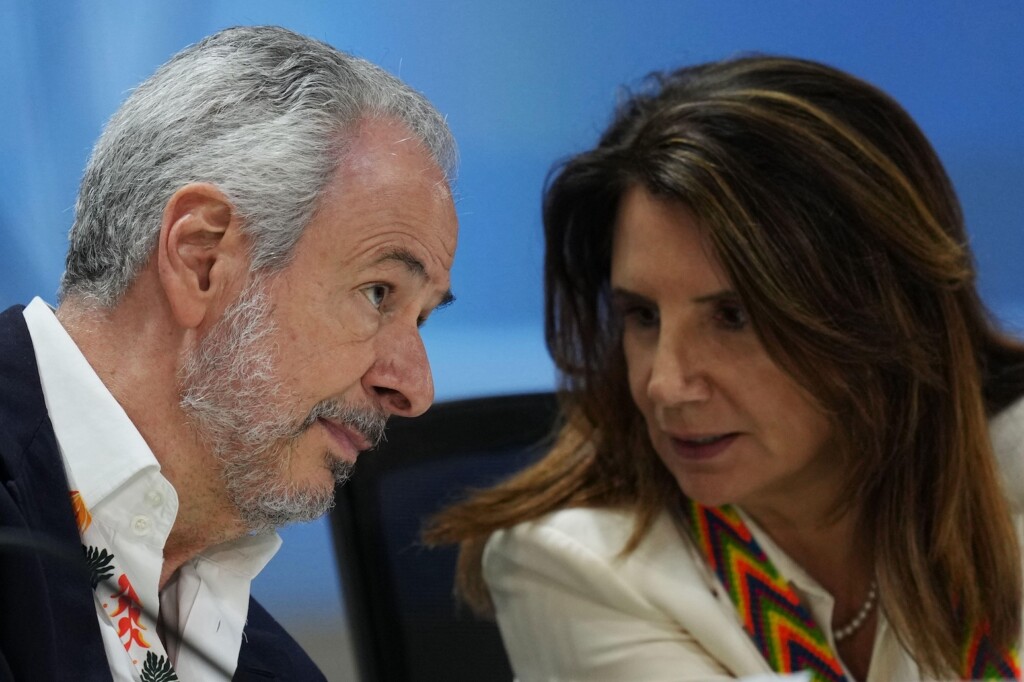
At a news conference on 22 November 2025 in Belem, Brazil, COP30 president André Corrêa do Lago and COP30 CEO Ana Toni are pictured in conversation. Credit: Andre Penner / Alamy Stock Photo
By Iris Vaughan — GreencarbonWorld ClimatePolicy desk · Editorial contact: info@greencarbonworld.com
The short answer: nothing here is binding. This is a voluntary sequence that the COP30 presidency assembled outside the UN after the negotiated text stalled: countries diagnose their own readiness, land in one of four archetypes, pull matching tailored levers, and want the work converged by 2033. For compliance, ESG and strategy teams the value is not obligation but calendar — three windows, 2028, 2030 and 2033, that policy and finance will probably be paced against.
Brazil's framing of the exercise is that transitioning away from fossil fuels is "urgent, inevitable and, yet, possible", while rejecting any one-size-fits-all prescription. This ClimatePolicy guide converts that framework into working instructions: what the document actually says, how the phase logic bites, what three outside experts flag, where the parallel process has already produced machinery, and the checklist your team can run before delegates meet in Turkey next week for COP31.
Is the roadmap binding? Who pushed for it, and who blocked it
Verdict first: the plan is voluntary, and countries are not obligated to respond to its findings. It exists in this form precisely because the formal channel was closed.
For two weeks the negotiations at COP30 in Belém revolved around one demand — insert a global roadmap for moving off coal, oil and gas into the summit's decided text. 85 countries pressed for that reference. A rival camp resisted; the figure circulated for the opposition was 84 countries, yet Carbon Brief's analysis of the informal list found inconsistencies and errors, so the real number of objectors was probably smaller. The political basis for the whole argument goes back to COP28 in Dubai in 2023, where the first global stocktake asked every country to contribute to transitioning away from fossil fuels.
Brazil's workaround was to relocate the roadmap out of the UN negotiating track and keep it a presidency product, issued together with a companion roadmap on ending deforestation — Belém's other unresolved file. The COP30 presidency also said the roadmap would be informed by a first-of-its-kind conference on moving off fossil fuels, convened in Santa Marta, Colombia and co-hosted with the Netherlands in April, where ministers and climate envoys argued informally about the barriers blocking them.
How the mechanism works: four moves from diagnosis to delivery
Conclusion: read it as an operating method, not a target table. The document prescribes a sequence of reasoning, and only then a set of instruments.
- Diagnose before committing. Each country runs the "Belém readiness index", described in the roadmap as a "voluntary self-assessment tool", to measure fossil-fuel dependency and transition capacity. Ana Toni labelled this the "diagnosis" stage — a way of proceeding "instead of imagining there is a one-size-fits-all answer".
- Locate your archetype. On the basis of that readiness read, countries are sorted into four archetypes by exposure and capacity, from revenue-dependent producers to import-exposed, low-capacity consumers.
- Pull the levers that fit. Each archetype points to a different policy mix; the roadmap calls these "tailored levers" rather than a shared menu.
- Sequence to a deadline. Efforts are organised into three phases and should culminate by 2033 — 10 years after the COP28 call.
The presidency's own presentation adds structure: levers are grouped around three pillars — energy demand, energy supply and the wider economy — with the readiness approach at the centre. On the demand side that means transport, industry and buildings; on the supply side the question is how production is managed, not whether production is declared illegal. For a corporate reader, this is the operative insight: dependency and capacity, not symbolism, decide which policies a given market will get first.
What happens in each phase: the 2028, 2030 and 2033 checkpoints
Treat the timetable as three policy windows rather than three engineering deadlines. Each window is deliberately bolted to an existing process — which is how a non-binding plan still generates hard dates.
| Phase | Window | Roadmap focus | Process it hooks into |
|---|---|---|---|
| Phase 1 — institutions | now until 2028 | "efforts focus on institutions and long-term signals" | concludes as the second global stocktake closes at COP33 under the Paris Agreement |
| Phase 2 — hardware | 2028-2030 | "physical transformation of energy systems" | next round of nationally determined contributions (NDCs), due as the NDCs cycle resets |
| Phase 3 — scale | 2031-2033 | scaling up the transition in "this critical decade" | the 10-year mark from COP28 in Dubai and its appeal on transitioning away from fossil fuels |
Two premises hold the sequencing together. The roadmap concedes that decades of delay mean the world can no longer keep 1.5C alive without first "overshooting" it. And it insists the needed policies already exist and are readily deployable, deliberately casting the shift as "as much a development question as a climate one, especially for emerging markets and developing economies".
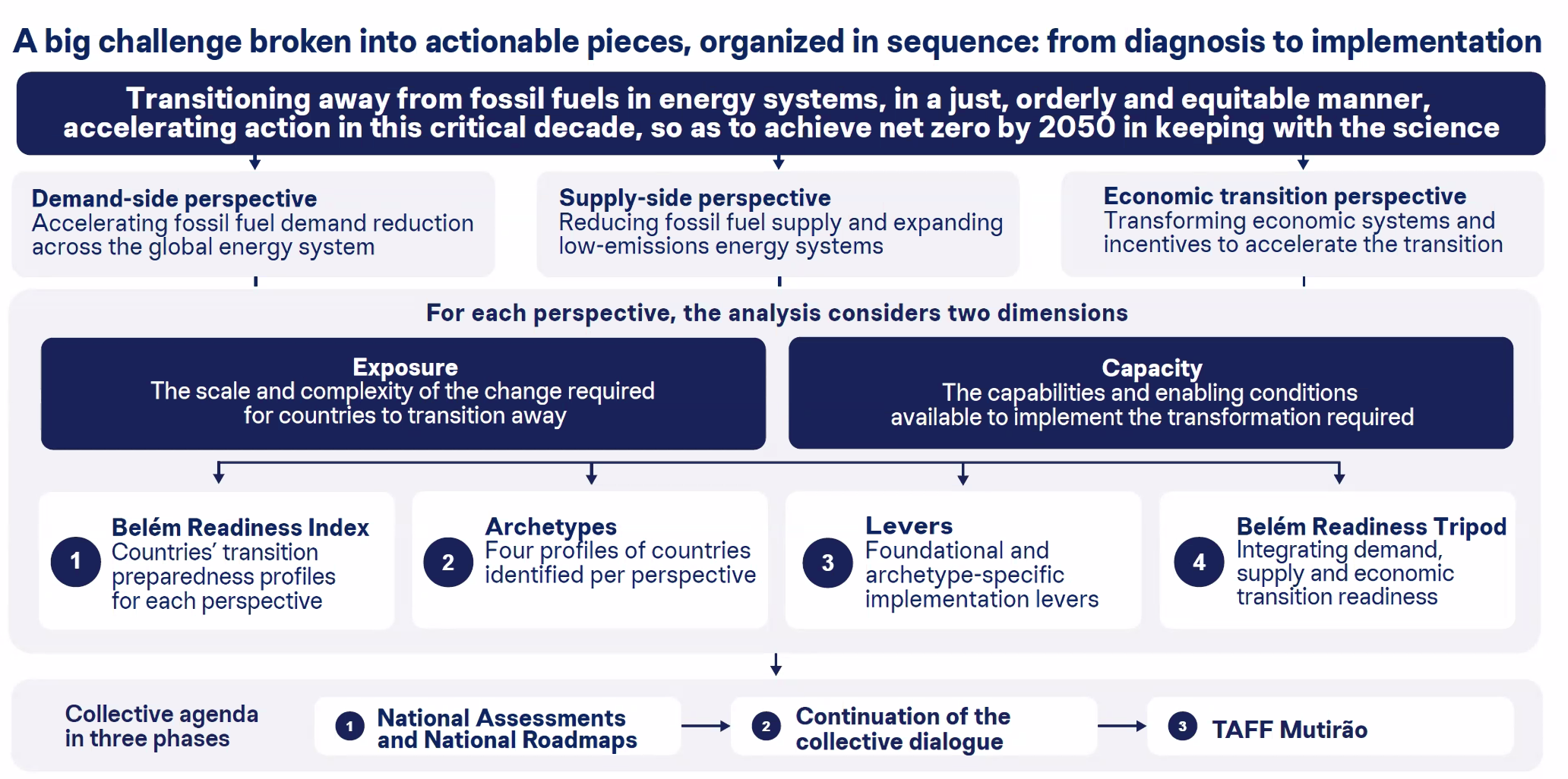
The phase and archetype graphic presented to journalists and civil society at the press briefing. Credit: COP30 presidency
Toni's own gloss at that briefing was that each stage was designed to be "extremely pragmatic and easy for countries to take a look at it".
What three independent experts say — and the planning consequence of each
Consensus across the reactions: the signal survives the diplomatic loss; the obligation does not come with it.
Dr Natalie Jones, senior policy adviser at the International Institute for Sustainable Development (IISD), told Carbon Brief the roadmap sends an "important political signal that the transition away from fossil fuels remains firmly on the international agenda". She added:
"It also gives governments practical guidance to plan that transition in ways that reflect their national circumstances, strengthen energy security and protect livelihoods."
Consequence for planning: energy security and social protection belong inside the transition case, not in the opposition file. Teams that write them as caveats will find their roadmaps rejected in cabinet reviews.
Avantika Goswami, climate policy expert at the Centre for Science and Environment in New Delhi, India, described the document as a "unique and consultative method of multilateralism". She told Carbon Brief:
"[The roadmap] is one that is put forth by a developing country, via a consultative process that invited submissions from all parties and civil society.
"The analytical framework proposed captures the complexity of the fossil-fuel transition. Countries must now use it to chart out pathways in line with their historical responsibility and current capacity."
Consequence: benchmarking will be peer-based and narrative-driven. Expect comparability questions from investors and lenders about which archetype a government claims, and what it has excluded.
Ploy Achakulwisut, a former UN adviser on fossil fuels, wrote on LinkedIn that she was "deeply impressed" by the architecture, including the readiness index:
"[The index] provides a method for identifying countries that face similar transition conditions and for understanding how different exposure-capacity ‘archetypes’ can generate distinct implementation needs and opportunities.
"The latter can ‘support more targeted international cooperation’, helping the international community to align finance, technology, capacity-building, and technical assistance with country-specific needs and existing capabilities."
Consequence: pooled-finance and technical-assistance windows will be designed for country clusters, so project developers and industrials should track cohort membership as a funding signal.
How the roadmap will be handled at COP31
Expect the fossil-fuel argument to be reframed through electrification. The roadmap lands just a week before the next round of UN climate talks opens in Antalya, Turkey. COP31 co-presidents Turkey and Australia have built the summit around lifting the share of global final energy consumption met by electricity from almost 24% in 2023 to 35% by 2035 — branded by promoters as the "35-by-35" Global Electrification Pledge and packaged by the presidency with targets on waste growth and resilient cities.
At the briefing, André Aranha Corrêa do Lago described that electrification goal as "complementary" to the roadmap's aims. Carbon Brief understands some parties see the emphasis as a device to avoid re-running Belém's marathon argument. Both Corrêa do Lago and Toni declined to speculate on uptake at COP31; Toni told journalists they were "hoping for the best". Pressed on how the roadmap might land with countries that fought its inclusion, Corrêa do Lago avoided naming them and said:
"Let’s remind ourselves we already have a consensus [on transitioning away from fossil fuels, agreed at COP28] and we already have the instruments."
Jones sets a tougher test: after the roadmap, she says, the "task now is to build on that signal with action", telling Carbon Brief:
"At COP31, more governments should announce national fossil-fuel transition roadmaps and explain how these will inform their national climate plans. The conference should also [formally] recognise the global roadmap and establish a route for its findings to inform the second global stocktake.
"For vulnerable countries dependent on fossil-fuel revenues, credible plans must be matched by international finance and support to diversify their economies and sustain public services. This roadmap can help turn a shared commitment into practical progress."
Where the extra-UN process is already producing machinery
The voluntary track is not a paper exercise — it now has workstreams, metrics and a second meeting date. That first conference was held in Santa Marta, Colombia from 24-29 April 2026; the Netherlands' co-host summary recorded 57 countries, 13 stakeholder groups and more than 1,500 participants, and noted that the convened governments account for roughly 30% of global energy demand and about 20% of global energy supply. Carbon Brief's report from the closing session put those economies at about one-third of global GDP and described new work on harmful fossil-fuel subsidies and carbon-intensive trade.
Three workstreams emerged — designing national and regional roadmaps, restructuring finance and subsidy incentives, and connecting fossil-fuel trade with clean-energy markets — alongside five deliverables, including a second conference in early 2027 co-hosted by Ireland and Tuvalu, with the conference report fed to the COP30 presidency to inform the roadmap. For companies, the transferable point is that norm-setting is migrating from the Paris negotiating text into club-based processes with faster turnover and less public visibility, which raises the value of monitoring ministerial communiqués and not only COP decisions.
Case in point: France turns a diagnosis into dated targets
A state can run the roadmap's logic alone, without waiting for the UN. France published a national roadmap at the Santa Marta conference with fixed end dates: coal by 2030, oil by 2045 and fossil gas for energy purposes by 2050, according to the ecology ministry's English-language document and reporting by France24. The rationale is dependency arithmetic rather than virtue signalling: French official material puts fossil fuels at about 60% of final energy consumption, while the World Resources Institute notes nearly 95% of them are imported. That is the roadmap's development framing — "as much a development question as a climate one" — rendered as procurement, budget and industrial policy, and a template for how an archetype read becomes dated obligations.
Operational checklist: eight actions for compliance and ESG teams
- Build a dependency baseline for each operating jurisdiction: direct fuel use, electricity exposure, import dependence and fiscal linkage — the variables the readiness index is designed around.
- Assign an archetype analogue to each country portfolio and log the evidence; investors will increasingly ask which archetype a host government claims and which levers it has ruled out.
- Calendar the hooks: the 2028 institutions-and-signals checkpoint, the COP33 conclusion of the second global stocktake, the 2028-2030 NDCs window, then 2031-2033 scaling.
- Stress-test assets against phase 2. If "physical transformation of energy systems" is the 2028-2030 focus, long-lived combustion assets, captive industrial boilers and fuel-linked logistics contracts are the exposure to quantify.
- Convert the electrification target into capex. A move from almost 24% to 35% by 2035 implies grid, process-electrification and charging investment sequencing; align your transition plan's capital schedule with it.
- Track the club processes: Santa Marta workstreams, the 2027 conference, subsidy-reform and border trade initiatives, which often land as regulation before COP language does.
- Do not merge two different "roadmaps". The Baku-to-Belém Roadmap to 1.3T is the COP30-era finance deliverable; the fossil-fuel roadmap is a readiness-and-levers instrument. Conflating them produces broken board reporting.
- Feed the diagnosis into disclosure. Where national plans are thin, company-level transition plans become the de facto signal — keep them consistent with the archetype logic you present externally.
Five misreadings that generate bad strategy
- "Voluntary means irrelevant." It means no sanction — but the phases are timed to bind to the Paris Agreement stocktake and NDCs cycle, which is where regulation is born.
- "The readiness index is a league table." It is a "voluntary self-assessment tool" for clustering needs, not a ranking designed to name and shame.
- "2033 is the global end date for fossil fuels." The text sets 2031-2033 as the scaling phase converging 10 years after COP28; it does not schedule a worldwide cessation.
- "Electrification replaces the roadmap." Corrêa do Lago's word was "complementary"; the demand-share target and the dependency diagnosis are different instruments.
- "Life outside the UN means no accountability." The presidency has committed to feeding process outcomes back into the COP, and co-hosts are already publishing participant lists, workstreams and deliverables.
FAQ: what readers ask before COP31
Does Brazil's roadmap oblige any country to do anything?
No. Countries are not obligated to respond to its findings, and the roadmap was deliberately kept out of the UN negotiated outcome after two weeks of deadlock at COP30.
What is the Belém readiness index used for?
It is the diagnosis layer: a voluntary self-assessment tool that calculates a country's fossil-fuel dependency and its transition capacity, then places it among four archetypes so the matching levers can be selected.
Why is 2033 the milestone?
It is 10 years after COP28 in Dubai asked all countries to contribute to transitioning away from fossil fuels, and the roadmap's third phase, 2031-2033, is designed to scale efforts by that date.
Who supports the process, and who does not?
85 countries sought roadmap language in the COP30 decision; a claimed bloc of 84 countries opposed it, though Carbon Brief's check of the informal list suggests fewer. Producer states remain the hardest constraint on any formalisation.
What should a company watch first?
The 2028 signal-and-institutions phase — long-term policy signals, disclosure expectations and subsidy reform arrive before the physical transformation window of 2028-2030 does.
Bottom line for GreencarbonWorld readers: the roadmap's contribution is not ambition but method. Anyone planning capital, compliance or policy engagement for the next decade now has a public template — diagnose, classify, choose levers, respect the dates — and a set of checkpoints that governments will be measured against whether or not they ever sign anything.
Sources and further reading
- COP30 Presidency — Roadmap on Transitioning Away from Fossil Fuels (official page)
- UNFCCC — COP31 Presidency announces electrification, waste and resilient-cities targets
- Government of the Netherlands — Santa Marta conference concludes with five key deliverables
- Carbon Brief — Santa Marta: key outcomes from the first summit on transitioning away from fossil fuels
- French Ministry of Ecology — France's roadmap to transitioning away from fossil fuels (PDF)
- France 24 — France unveils plan to phase out coal, oil and gas by 2030, 2045 and 2050
- World Resources Institute — Why long-term climate strategies are the economic planning tool governments need
- SEforALL — the COP31 35-by-35 Global Electrification Pledge
- UNFCCC — Baku to Belém Roadmap to 1.3T report