
CE-25A and the Battery Math: Why Pure-Electric Aircraft Land in Flight Schools and Island Routes First
In the past few days, a few photographs said to show COMAC's CE-25A electric demonstrator have pushed "pure-electric aircraft" back into public view. The direct answer: battery-electric flight is not waiting for its first lift-off — small certified types already fly in commercial service — but a scheduled 100-seat airliner is far away, because stored energy per kilogram, thermal-runaway containment, reserve power and megawatt ground charging all still fail at airline scale.
For green-technology buyers, that reframes the question. The interesting issue is no longer whether an aircraft can fly on batteries, but which operating profile a battery propulsion system can serve today with an acceptable cost, safety and infrastructure case.
What counts as a pure-electric aircraft — and what does not
This article uses a narrow definition: a battery-electric (pure-electric) aircraft stores its energy on board in batteries and takes its thrust from electric motors. Hybrid-electric aeroplanes that burn fuel to generate electricity, and hydrogen fuel-cell aeroplanes that generate electricity chemically, are counted separately: they share parts of the electric propulsion chain, but their energy-storage problem is different.
The distinction also explains why the longest-endurance electric aircraft today are not carrying passengers at all. Solar-electric unmanned platforms stay aloft because the wing keeps refilling the store, which is exactly the logic examined in our report on what a 100-hour stratospheric solar flight can and cannot deliver. An airliner cannot arrive with its energy bill still being paid by the sun.
What remains genuinely distant is the everyday scene: sitting more than 100 passengers into a battery airliner that returns to major cities on a timetable. Moving from a demonstrator to that scene is far more complicated than simply building a bigger aircraft.
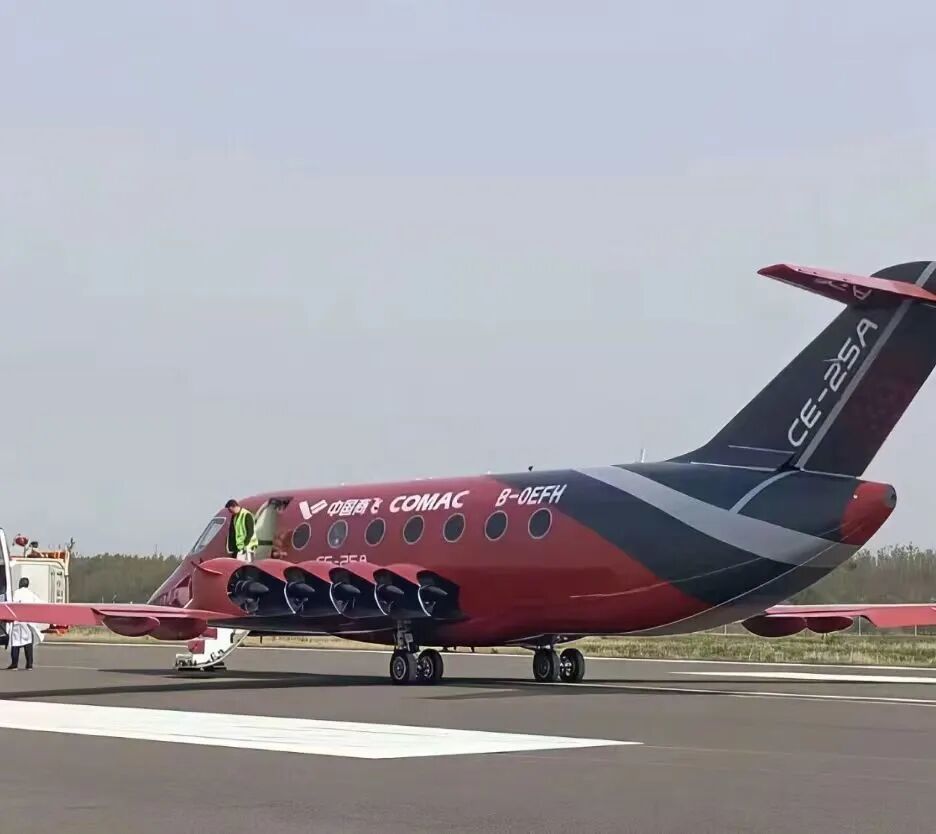
Caption: Photographs of the COMAC CE-25A demonstrator circulated recently; the aircraft's actual flight status still awaits formal disclosure.
Where the technology came from: 1881, 1973 and the long interval between
The lineage starts in France with Gaston Tissandier. In his 1886 book "La Navigation Aérienne" he recorded that in early 1881 experiments with electric boats gave him the idea of applying the electric motor to air navigation, and that in that same year he exhibited a model electric airship at the Paris electrical exhibition. On 8 October 1883 he and his brother Albert flew an electric airship — documented early conception and practice that predates the Wright brothers.
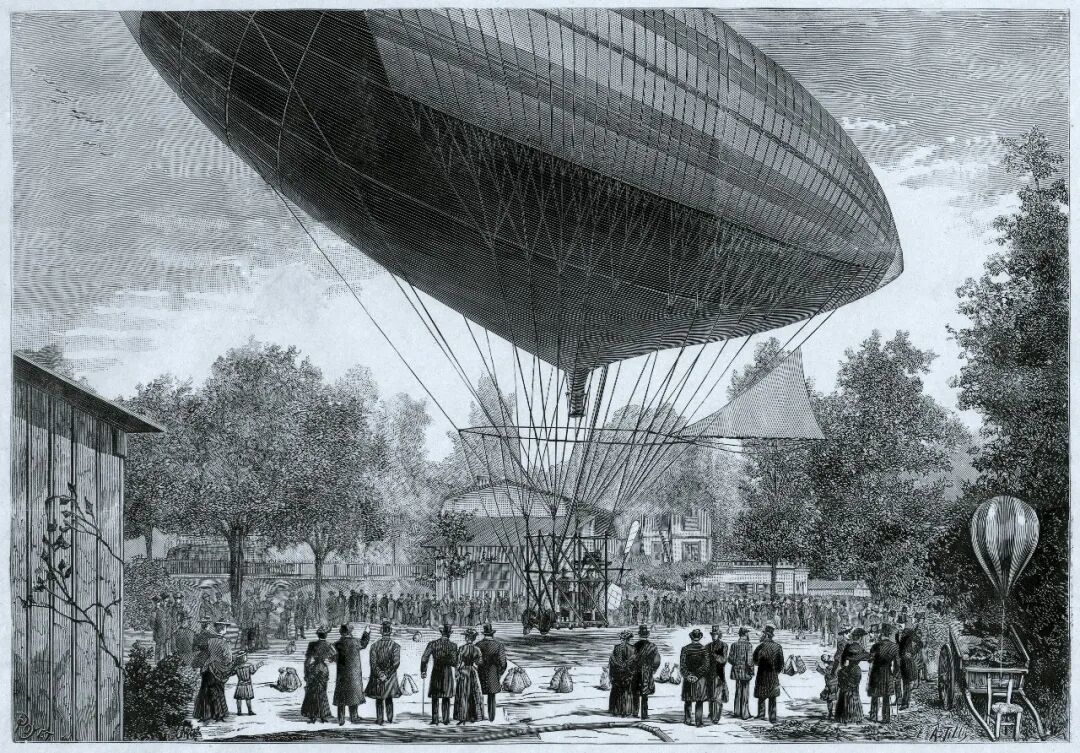
Caption: A contemporary woodcut showing the Tissandier brothers' electric airship departing from Auteuil, Paris, on 8 October 1883.
Airships rise on buoyancy, however, which has little in common with a wing-generated lift aircraft carrying a battery mass penalty.
The accepted starting point for crewed, battery-powered fixed-wing flight is 21 October 1973, when the MB-E1 — developed by engineer Fred Milititsch with Boudrica — made its first flight in Austria on nickel-cadmium batteries lasting about 9 minutes; according to Fédération Aéronautique Internationale records, later flights ran about 15 minutes.
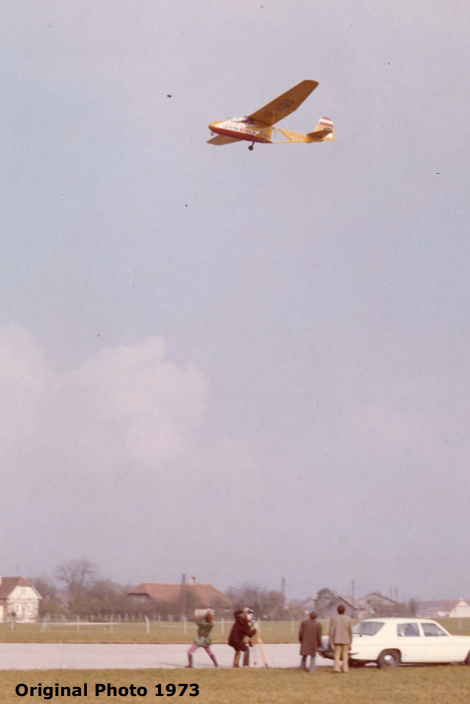
Caption: The MB-E1 electric aircraft of 1973, which flew on nickel-cadmium batteries for about 9 minutes.
In other words, more than half a century ago humans already proved that a battery can carry a person into the air. The decades since have not been spent proving the concept, but making it useful.
Which small types have already crossed the certification line
Europe opened the practical route on light aircraft. In 2015 Airbus flew its pure-electric demonstrator E-Fan across the English Channel; on 10 July 2015 it touched down at Calais after the crossing.
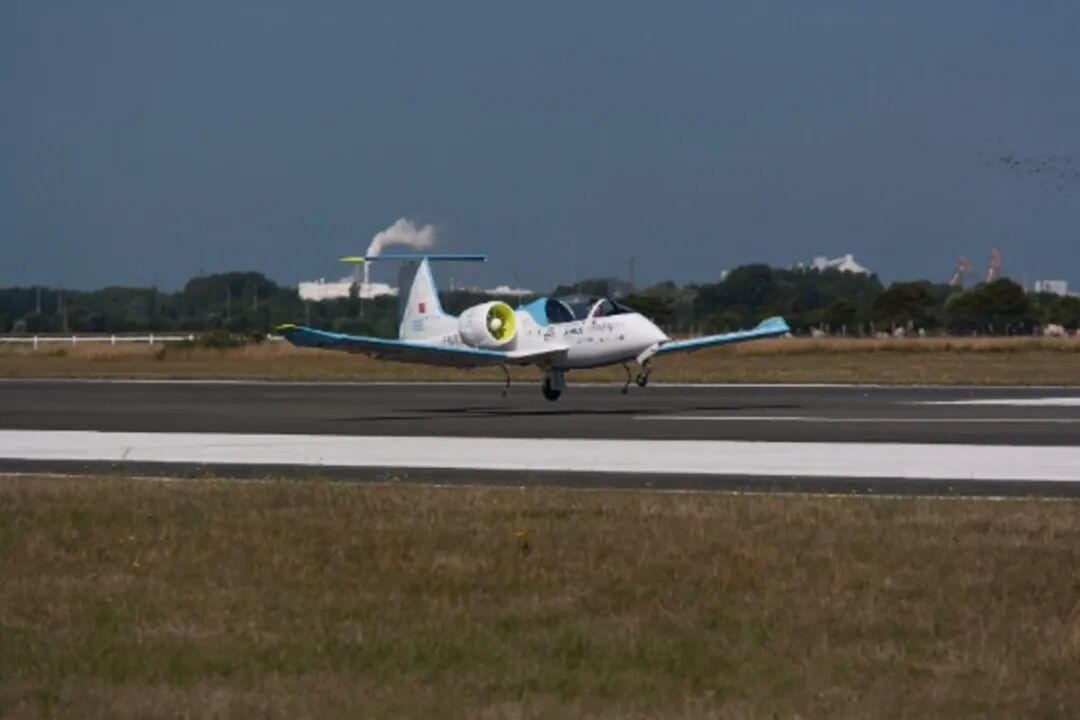
Caption: On 10 July 2015, the E-Fan pure-electric demonstrator landed at Calais after crossing the English Channel.
In June 2020, Slovenia's Pipistrel received a type certificate from the European Union Aviation Safety Agency (EASA) for its two-seat Velis Electro, used mainly in flight training; the manufacturer publishes an endurance figure of a maximum of about 50 minutes, with the visual flight rules reserve held separately.
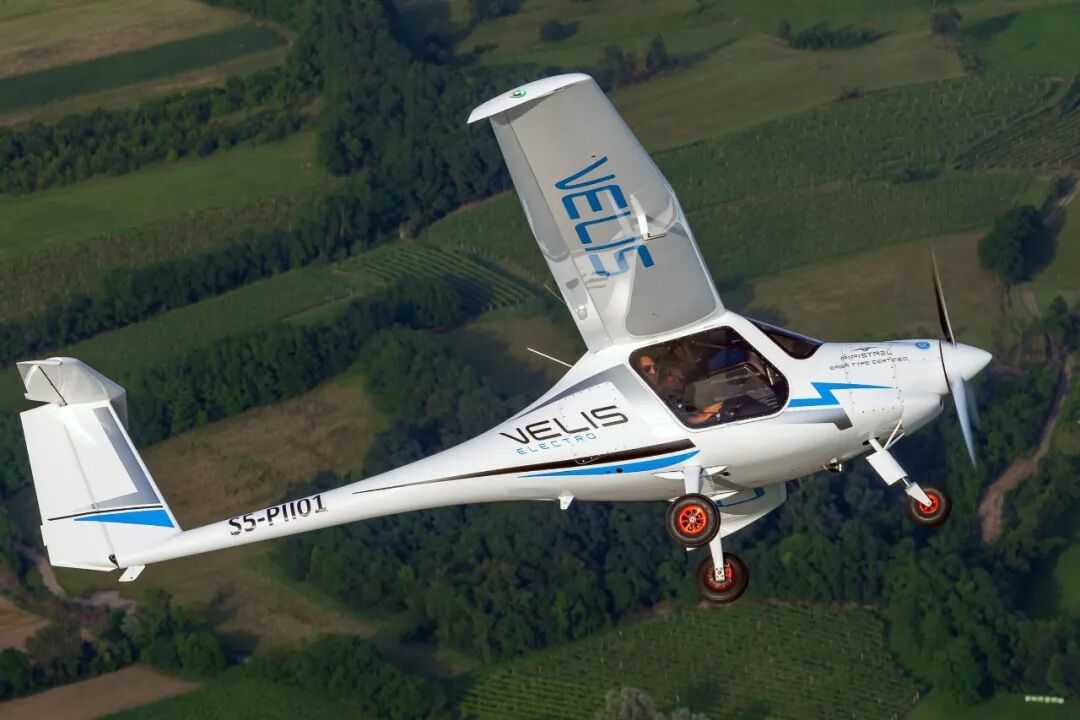
Caption: The Velis Electro two-seat pure-electric aircraft, which took EASA type certification in June 2020 for mainly training use.
For a two-seat aircraft flying circuits near its own airport, that is already workable. As a substitute for an ordinary airliner it is obviously not.
North America pushed into short-haul air transport. Canada's Harbour Air and magniX converted a DHC-2 "Beaver" floatplane to electric power and flew it in 2019; Eviation's Alice, aimed at the nine-seat commuter market, completed an 8-minute first flight on 27 September 2022 at Moses Lake in the United States. One chose retrofit, the other a clean-sheet design, but a first flight only shows that the technology advanced — it does not show that scheduled passenger operation has been achieved.
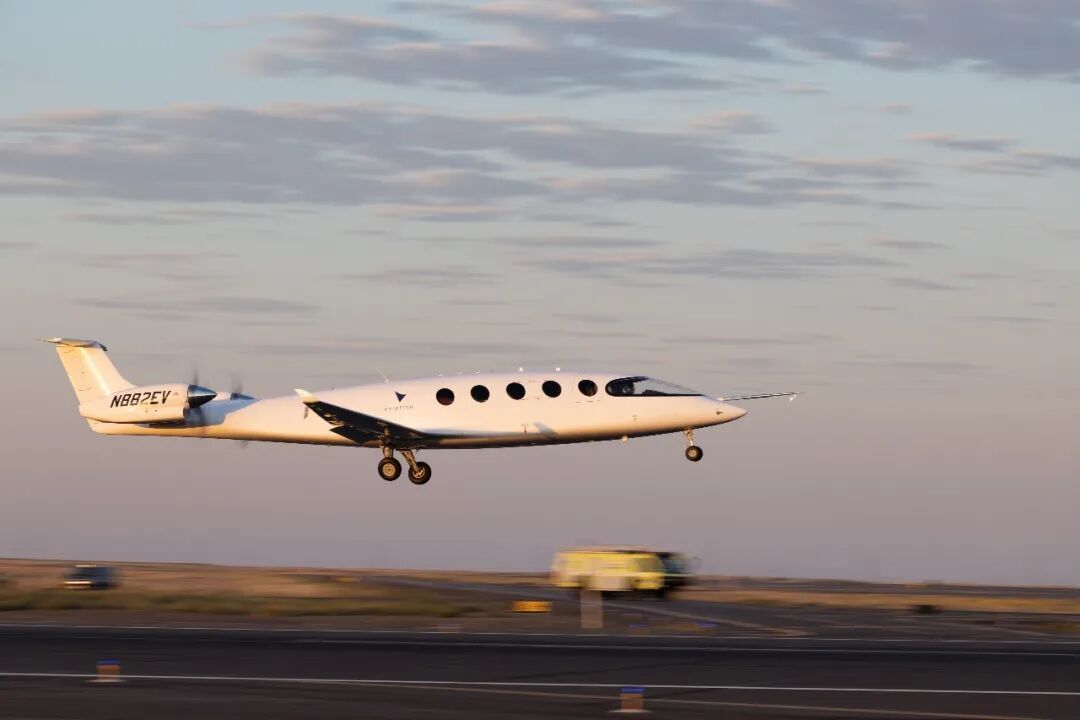
Caption: Eviation's Alice electric demonstrator made its first flight of about 8 minutes at Moses Lake, United States, on 27 September 2022.
The 10-tonne class: Heart's X1 and the projects that stopped
Larger attempts followed. In 2024 Heart Aerospace presented the X1, a 32-metre wingspan full-scale demonstrator for its ES-30 programme; the 30-seat cabin, 200 km pure-electric range and 400 km hybrid range disclosed at the time were proposed specifications for the planned ES-30, not passenger capability already verified on the X1.
Heart Aerospace's August 2026 announcement states that its X1 demonstrator has a take-off weight of more than 25,000 lb, about 11.3 tonnes, and flew 27 minutes on battery power alone.
In September the company published a 36-seat ES-36 production concept: a target pure-electric range of about 200 km, with longer legs supported by gas-turbine electricity generation, and entry into service planned for 2031.
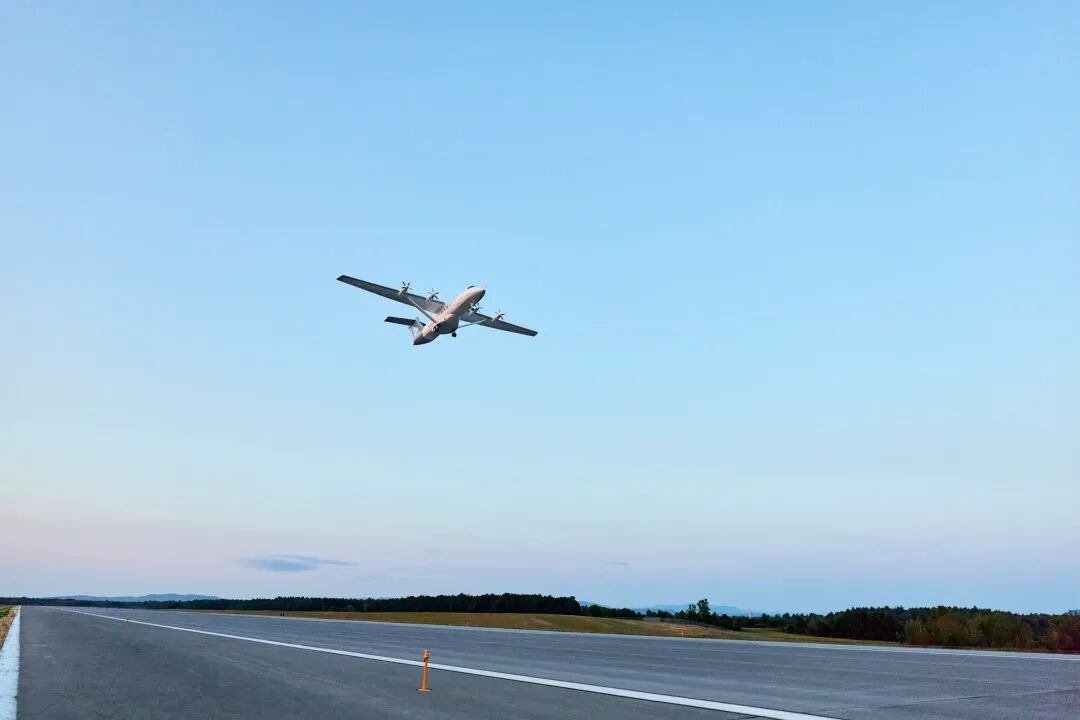
Caption: The Heart X1 demonstrator lifting off during its first flight in August 2026; ES-30 and ES-36 production figures cannot be applied to it.
Not every programme ran to the end. NASA's X-57 was meant to validate distributed electric propulsion, but the project was closed in 2024 without ever flying.
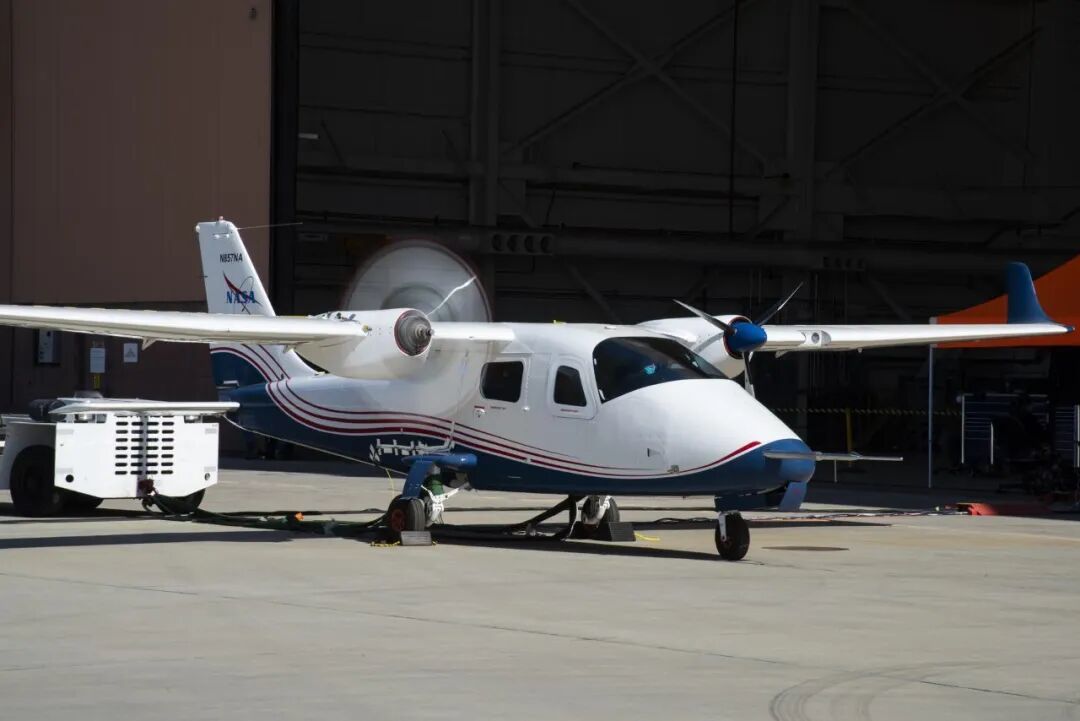
Caption: On 15 April 2021, NASA's X-57 Maxwell pure-electric research aircraft underwent high-voltage ground testing at the Armstrong Flight Research Center in California.
NASA attributed the decision to experimental hardware problems, supply of key components and the remaining project time. The programme left behind battery and electrical-system research, and a warning that a motor that spins and an aircraft that meets safe flight conditions are separated by a great deal of engineering work.
China's ladder: from light-sport types to a 19-seat concept
China's progress is best read aircraft by aircraft. The Ruixiang RX1E, developed by Yang Fengtian's team at Shenyang Aerospace University, first flew in 2013 and in 2015 obtained a type design approval and production certificate as a two-seat electric light-sport aircraft.
The four-seat RX4E was awarded a type certificate by the Civil Aviation Administration of China (CAAC) on 29 December 2024, having completed its airworthiness review under the CCAR-23 normal-category requirements.
In early 2024, AVIC General Aircraft completed the first flight of its AG60E two-seat electric demonstrator. The RX4E has a maximum take-off weight of 1,260 kg, a total battery capacity of 70 kWh and a published maximum endurance of 1.5 hours. In September 2025 the first RX4E rolled off final assembly in Yanqing, Beijing.
Those steps mean small electric aircraft have reached manufacturing and actual application, mainly training and sightseeing. A headline maximum endurance should not be read as a sellable block time with full payload and an alternate-flight reserve.
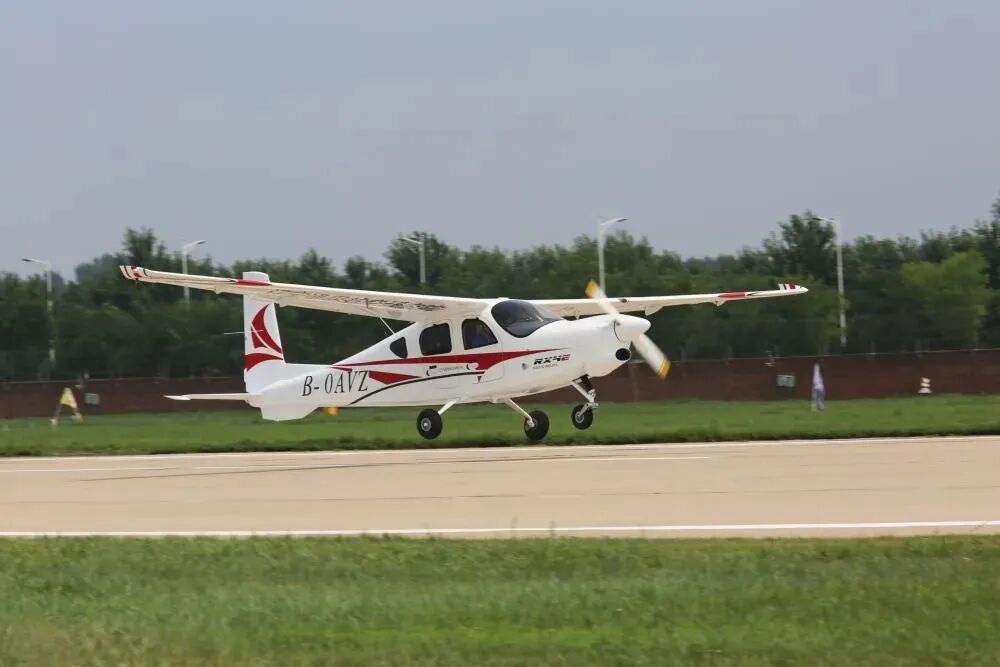
Caption: The RX4E four-seat pure-electric aircraft developed by Shenyang Aerospace University, which received its CAAC type certificate on 29 December 2024. (Photo: Shenyang Aerospace University official website.)
COMAC is exploring a larger airframe: the CE-25A was exhibited at the China International Import Expo in 2023, with a published 19-seat layout, a design range of 400—500 km, a maximum cruise speed of about 400 km/h, and wing-integrated ducted-fan distributed electric propulsion.
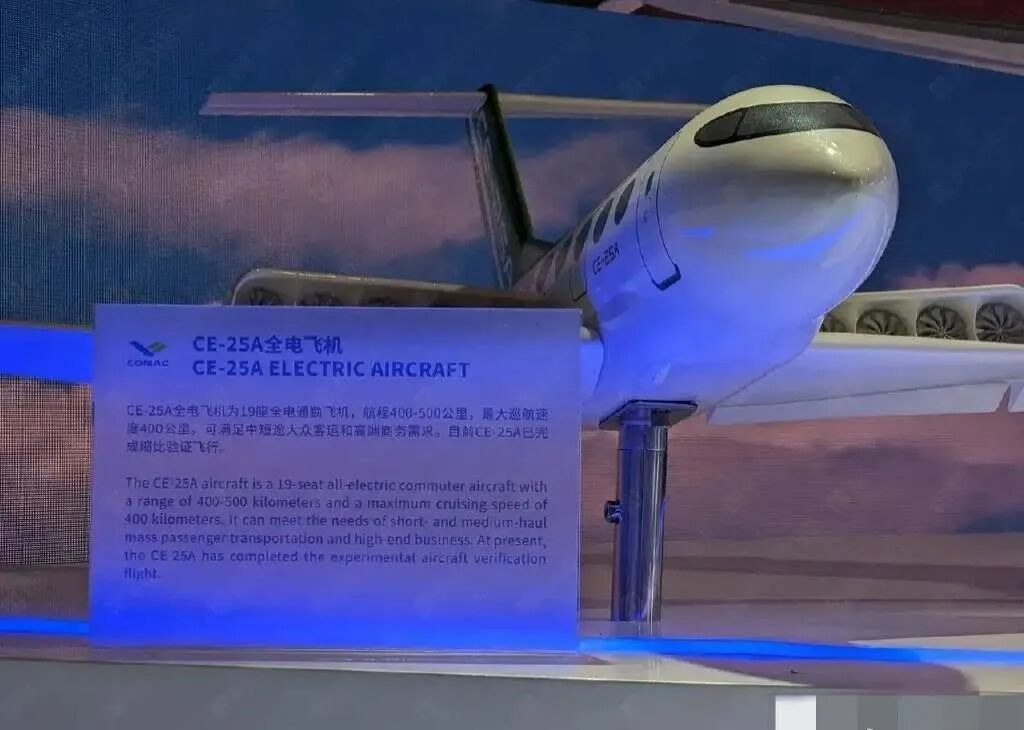
A 2025 paper in the journal Chinese Engineering Science states that the programme had completed "scaled-model validation flight". In the same year, COMAC's North Research Center issued a tender for structural test analysis of the CE-25A No.0 airframe. Those records confirm the project and its verification work exist; whether the aircraft in the recent photographs has flown still requires formal disclosure.
The 19-seat class matters because it maps onto real small commuter demand. Yet 400—500 km remains a design target: passenger load, reserve electricity and how far the aircraft still flies after years of battery ageing all remain to be demonstrated.
Why energy density is still the first barrier
The decisive number is stored energy per kilogram. The International Council on Clean Transportation put it plainly in its 2022 analysis of electric aircraft: fossil jet fuel has a specific energy "nearly 50 times higher (12,000 Wh/kg)" than lithium-ion cells. A 2025 review of battery technology for sustainable aviation reaches the same conclusion, noting that jet fuel's roughly 12,000 Wh/kg sits orders of magnitude above the best lithium-ion figures achieved so far.
Electric motors and power electronics do recover part of that gap, since drivetrain efficiency is several times that of a turbine, but the residual difference is still an order of magnitude. Worse, fuel becomes lighter as it burns while a battery keeps its mass to landing.
Carrying more energy therefore buys range by taking space from passengers and baggage, and the aircraft hauls that weight the whole way. Battery announcements from CATL and other producers, together with their aviation verification work, do show movement; but headline energy density usually refers to the cell, and once protection, cooling and management hardware are added, the weight actually saved depends on the whole system.
The second gate: reserves and thermal runaway
An aircraft cannot be planned on the basis of "just enough to reach the destination". Weather deteriorates, holding patterns and diversions appear, a go-around may follow the approach, and the battery must still deliver full power even when most of its charge is gone. Preventing thermal runaway and keeping high-voltage systems reliable are not relaxed because range improved.
Regulators have now written that down. EASA's special conditions and its Means of Compliance on thermal runaway, published in June 2023, set expectations for battery architecture, thermal management, runaway detection and propagation prevention. Industry follow-through is measurable: in testing reported in February 2026 by Aerospace Testing International, H55 became the first company to complete EASA battery certification tests in which an aviation propulsion module contained a thermal runaway event without propagation. That is laboratory work moved onto a flight-grade article — the kind of evidence that certifying a 19-seat or 100-seat battery aircraft will require at much larger pack sizes.
The third gate: electricity on the apron
Even a certified aircraft needs somewhere to recharge. A 2025 review of airport electrification published in ScienceDirect states that existing electric-aircraft charging systems operate at power levels below 1 MW, and that fast-charging methods for large electric aircraft are not yet established. Planning analysis for U.S. vertiports, drawing on National Renewable Energy Laboratory work prepared for the Federal Aviation Administration, sizes a single pad at a megawatt or more of charging capacity, and warns that the substation, feeder and protection upgrades behind it can take years — while demand charges punish operators who bring every dispenser up at once to protect a schedule.
That infrastructure burden is a components question as much as a grid one, which is why high-current connectors, their standards and their service data matter: see our GreenTech discussion of whether high-current electrification links need standards or only better service data.
Airlines then run the arithmetic: how often the battery must be replaced, how long the aircraft waits while charging, and what that does to the cost of a rotation. Money saved on electricity can be spent again on batteries and on waiting.
Case check: what the certified types already prove
| Segment | Reference aircraft | Verified today | Binding constraint |
|---|---|---|---|
| Two-seat training | Pipistrel Velis Electro (EASA, June 2020) | Certified, in fleet use; endurance maximum of about 50 minutes | Pattern work only; battery cycle cost and weather reserve |
| Four-seat light sport | RX4E (CAAC, 29 December 2024) | 1,260 kg, 70 kWh, 1.5 hours maximum | Training and sightseeing, not scheduled service |
| Commuter, 9—19 seats | Alice; COMAC CE-25A | 8-minute first flight; scaled-model validation flight | Reserve energy, thermal-runaway evidence, apron charging |
| Regional, 30—36 seats | Heart X1, ES-30, ES-36 | 27 minutes on batteries at about 11.3 tonnes | Hybrid range extender needed for the 2031 targets |
| 100-seat class | None | No credible programme | Energy-density gap of roughly an order of magnitude |
The economics on the smallest rung are already favourable. Pipistrel's own data for the Velis Electro puts cabin noise at about 60 dBA, which is what makes noise-sensitive routes realistic; and a 2023 Textron eAviation filing in a U.S. Federal Aviation Administration rulemaking docket estimated roughly a 75% reduction in cost per flight-training hour relative to a Cessna 172. Both are training-market claims, not evidence that regional fares will fall.
How much carbon is actually in play
Battery-electric propulsion is being judged as a climate tool, so the scale needs stating. CE Delft's 2025 climate impact analysis of electric aviation puts aviation at about 2.4% of global CO2 emissions in 2019 on a tank-to-wake basis, and attributes roughly 19% of the sector's emissions to short-haul operations. Meanwhile the IEA's Global Energy Review 2025 records aviation emissions rising by about 5.5% in 2024 amid record passenger demand, against a total of 37.8 Gt of energy-related CO2.
Two conclusions follow. Battery-electric aircraft address a minority slice of aviation emissions, so their near-term climate case rests on displacing avgas and jet fuel in training fleets, on quieter approaches, and on building the electric airworthiness framework that larger types will need. And because the longest stages dominate emissions, hybrid configurations with onboard generation — the logic behind the ES-36 — and sustainable aviation fuels remain the working answers for everything beyond a few hundred kilometres.
Where pure-electric aircraft will actually land first
The realistic sequence is training and short local flying first, then commuter and regional routes if the reserve and infrastructure questions close. Island pairs, and places where the ground detour is long and passenger volume cannot fill a large aircraft, suit battery propulsion far better than trunk routes. Where a convenient high-speed rail service already exists, swapping fuel for batteries is unlikely to win passengers back to the airport.
No one can give a reliable year for routine 100-seat-class pure-electric service; the honest reading is that no such aircraft is on the table. Each step on the smaller airframes is what makes the road ahead legible.
Action recommendations for technology and sustainability leads
- Screen routes by stage length first: below roughly 200 km on the ground, battery-electric is a live technical conversation; anything longer should be scoped as hybrid or fuel-based abatement.
- Price the turnaround, not the flight: charge time, battery replacement intervals and spare-module logistics usually dominate the cost model more than the electricity tariff.
- Ask for system-level energy density, in Wh/kg for the installed pack with cooling, containment and wiring, and ask what that figure is after the published cycle life.
- Convert reserve requirements into a weight budget: mission energy plus holding, diversion and go-around margins, then check what payload is left.
- Run the airport's electrical feasibility in parallel with the aircraft business case: substation capacity, utility lead time and demand-charge exposure are project-critical, not site details.
- Treat noise rather than CO2 as the first monetisable benefit on urban and training operations, where a roughly 60 dBA propulsion system changes curfew and slot economics.
- Use early certified types as data partnerships — crew training, maintenance patterns and battery degradation curves are the reusable output, not the route network.
Common misconceptions to avoid
- Reading a first flight as the start of ticket sales: Alice flew about 8 minutes and the X1 flew 27 minutes; neither is a scheduled service.
- Reading a demonstrator's mass as an airliner's capability — the 30-seat and 36-seat figures belong to ES-30 and ES-36 proposals, not to the X1.
- Reading a published maximum endurance as sellable block time, or a design range of 400—500 km as verified service range.
- Assuming one battery energy-density threshold unlocks the whole market: a two-seat trainer already works, while the 100-seat requirement is far higher.
- Scaling by analogy with cars: aviation weights, redundancy, reserve and certification rules do not behave like road range figures.
FAQ: the questions readers actually ask
Are pure-electric aircraft already legal to operate?
Yes, in the small categories. The Velis Electro has held EASA type certification since June 2020, and the RX4E received its CAAC type certificate on 29 December 2024. Both are used for training and similar operations, not scheduled passenger service.
How far can a battery airliner fly today?
For certified types, tens of minutes of flying: a maximum of about 50 minutes for the Velis Electro and 1.5 hours maximum for the RX4E. For larger designs, range remains a target rather than a demonstrated capability — Heart's ES-30 and ES-36 concepts aim at about 200 km pure-electric, and COMAC's CE-25A design figure is 400—500 km.
Why can't we simply fit a bigger battery?
Because jet fuel stores nearly 50 times more energy per kilogram than lithium-ion cells, the added pack eats payload, and that mass is still on board at landing. Solid-state and lithium-sulphur routes look promising, but laboratory figures have to survive cooling, containment, cycle life and repeated service on an aircraft.
What is the biggest non-technical obstacle?
Airport power. Today's electric-aircraft charging systems run below 1 MW, while a commuter or regional battery aircraft needs substantially more, plus utility upgrades that can take years to deliver.
Should a fleet or airport plan wait for 100-seat battery aircraft?
No. There is no credible 100-seat-class pure-electric programme, and aviation emissions are concentrated in long stages. Plan around hybrid-regional, fuel-efficient and sustainable-fuel options, and treat electric types as opportunities in training, island and short-haul niches.
Outlook: a trend judgement
Read as green technology rather than as spectacle, the CE-25A photographs mark a shift from paper studies to structural and system testing on a full-size airframe — real progress on the engineering path, and still short of a certificate or a timetable. The barrier that decides everything else — stored energy that shrinks as it is used without shedding kilograms — is a materials and system-integration problem measured in years of certification evidence, not in one announcement.
Battery-electric aircraft have left the ground. What the industry is waiting for is an aircraft that carries its full passenger and baggage load, keeps the margin needed for an unexpected diversion, arrives safely today and departs again tomorrow.
Sources referenced
- ICCT, "What to expect when expecting electric airplanes" (July 2022): https://theicct.org/aviation-global-expecting-electric-jul22/
- EASA guidance material on thermal runaway for propulsion batteries: https://www.easa.europa.eu/en/downloads/140391/en
- CE Delft, "Climate Change Impact Analysis of Electric Aviation" (2025): https://ce.nl/wp-content/uploads/2025/02/CE_Delft_240152_Climate_Change_Impact_Analysis_of_Electric_Aviation_Def_.pdf
- IEA, Global Energy Review 2025 — CO2 emissions: https://www.iea.org/reports/global-energy-review-2025/co2-emissions
- Lindberg et al., "Electrifying aviation: Innovations and challenges in airport energy systems" (2025): https://www.sciencedirect.com/science/article/pii/S2666792425000162
- Pattanayak et al., "Battery technology for sustainable aviation: a review" (2025): https://www.sciencedirect.com/science/article/pii/S0306261925010864
- Pipistrel Velis Electro product data: https://www.pipistrel-aircraft.com/products/velis-electro/
- Textron eAviation submission in FAA docket FAA-2023-0284 (2023): https://downloads.regulations.gov/FAA-2023-0284-0003/attachment_1.pdf
- NREL, "Overview of Potential Hazards in Electric Aircraft Charging", prepared for the U.S. FAA (2023): https://docs.nlr.gov/docs/fy24osti/83429.pdf
- Aerospace Testing International, H55 completes EASA battery certification tests (February 2026): https://www.aerospacetestinginternational.com/news/h55-becomes-first-firm-to-complete-easa-battery-certification-tests-for-electric-aircraft.html