
Solar Panels as Rain Gauges: What the Fraunhofer IDMT Result Proves, and What It Does Not
Yes — a PV module can be read as a rainfall sensor, but only in light rain so far. Fraunhofer IDMT bonded structure-borne sound sensors to solar panels, inferred rainfall from drop vibrations on a low-power microcontroller, and reported a mean absolute deviation of 1.88 mm/h for intensities between 2 and 5 mm/h. Credible as a screening-grade signal; not yet a stand-in for a certified gauge.
Every organisation that needs dense rainfall data meets the same obstacle. The instruments themselves are affordable; siting, civil works, power and periodic upkeep are not. That is why a dual-use asset appeals — a solar panel you already own, already mounted, already energised — to teams that would never justify a new weather station.
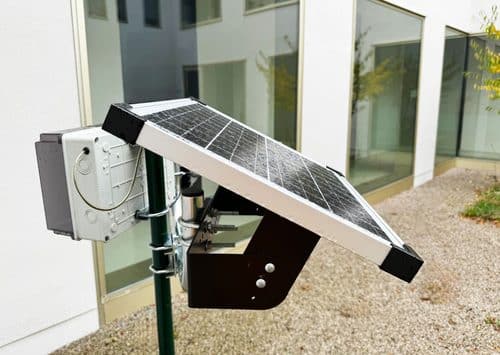
The test setup for precipitation measurement in the courtyard of the Fraunhofer IDMT (image: Fraunhofer IDMT)
What is the sensing chain, and why does the mounting surface matter?
The demonstration came from a research group in Germany: solar modules, read as acoustic surfaces, can be used to estimate rainfall. Scientists from the Fraunhofer Institute for Digital Media Technology (IDMT) in Ilmenau fixed structure-borne sound sensors onto PV glass so that each raindrop impact registers as a vibration. The build splits into three layers, and each layer carries a different cost.
- Sensing layer: the module glass becomes the transducer surface. A raindrop is treated as a mechanical event rather than an optical one, so no orifice, float or tipping bucket is introduced.
- Edge layer: inference runs on the node itself, via a machine learning algorithm on an energy-efficient microcontroller, and only compact measurement data travels wirelessly. That single decision is what keeps radio duty cycle and node power small.
- Aggregation layer: Pan Acoustics, the project partner based in Wolfenbüttel, supplied the sensor-node hardware and the wireless transmission technology; Fraunhofer IDMT then collects and analyses readings from several locations centrally, which is where a more detailed picture of local rainfall emerges. With no moving parts in the sensing chain, maintenance needs may be lower.
How good is 1.88 mm/h, honestly?
Validation started in the laboratory, with a rain simulator exercising different rainfall rates, drop sizes and photovoltaic modules. From there the team installed three outdoor measurement systems: the IDMT courtyard, Pan Acoustics, and the weather garden of the Technical University of Ilmenau. Across light rain between 2 and 5 mm/h the deviation from reference measurements averaged 1.88 mm/h. Fraunhofer's own reading is that this satisfies Class C of the World Meteorological Organization (WMO) accuracy classification for low rainfall intensities, which permits a maximum deviation of 2 mm/h.
Buyers should hold two readings of that number at once.
First, the error is a large fraction of the value being measured. By simple arithmetic, 1.88 mm/h against a 2 mm/h event is a very wide relative error, while against 5 mm/h it falls to roughly 38%. Treat the output as spatial and trend information — useful for filling gaps between reference sites — not as a figure you can close a water balance with or attach to a permit report.
Second, the incumbent instrument is not clean in this band either. A typical mechanical gauge resolves about 0.2 mm per tip; at 2 mm/h that is one discrete event roughly every six minutes, as rainfall-intensity methodology work in MDPI's journal Water points out. A vibration-based node observes every impact, so its real advantage is event density and sampling continuity, not absolute accuracy. The honest comparison is dense-but-soft versus sparse-but-hard, and the right choice depends on which decision the data supports.
Why does heavy rain break it, and what is actually missing?
Heavy rain is where the claim stops. The team still lacks sufficient training and test data at high rainfall intensities, so accuracy under those conditions has not been established. "We have proven the feasibility of our approach for light rain," said Jakob Bergner, group leader for Smart Acoustic Solutions at IDMT and scientific head of the project.
The missing ingredient is a dataset, not the physics — and that distinction shapes timelines, because datasets are bought with field seasons rather than engineering breakthroughs. As analysis rather than a published finding: once rates climb, impacts overlap, water sheets down the glass, and the acoustic signature stops being one-drop-one-event. Meanwhile conventional gauges fail differently. A 2023 review of tipping-bucket instruments in MDPI's journal Sensors documents systematic underestimation, including inflow allocated to a bucket already mid-tip, and notes that dense gauge networks are rarely realised because of monitoring cost, maintenance and installation difficulty. Neither technology is neutral at storm intensity; procurement should ask which error its operation can absorb.
What does the node cost, and where is the carbon argument?
No bill of materials, price or lifecycle carbon figure has been published for the prototype, so the table below reads the cost structure rather than the invoice.
| Cost line | Conventional gauge station | PV-mounted vibration node |
|---|---|---|
| New civil asset | Mast, foundation, clearance zone | Reuses an existing module surface |
| Power | Battery or small PV kit per site | Edge inference on the node; no pumping or heating load |
| Backhaul | Cellular or cable per site | Wireless link reported at four kilometers urban and over 35 kilometers rural line-of-sight |
| Moving parts | Bucket needs levelling, clearing, recalibration | None, so servicing intervals stretch |
| Data payload | Tip counts, quantised | Compressed features from a local model |
| Storm performance | Documented underestimation at high intensity | Unproven above the light-rain band |
The emissions logic is a displacement argument, and it is directional. What a co-located node avoids is not a power plant; it is the embodied carbon and labour of building a gauge station, plus the site visits that keep one level, clear and calibrated. That is the same accounting problem we examined under strict conditions for unpowered monitoring fleets, where the return showed up in energy, CO2 and labour hours only when missing packets were treated as a monitored fault rather than as silence: what a battery-free sensor fleet actually returned in energy, CO2 and labour hours. Anyone claiming a larger climate benefit from this prototype is extrapolating beyond the published record.
Where could it be deployed, and what disqualifies it?
The stated ambition is to support conventional rain-gauge systems rather than replace them. Candidate uses include urban digital twins, municipal control rooms and flood monitoring, and according to Fraunhofer, operators of municipal infrastructures and firefighting brigades have expressed interest in a rainfall tool. In field trials the radio reached four kilometers in urban settings and over 35 kilometers in rural line-of-sight mode, with every node processing its own data before transmission — an architecture that suits distributed, low-duty monitoring rather than a single authoritative gauge.
Four conditions disqualify a site quickly. There is no PV asset within reach of the network. The module inventory is heterogeneous and unlabelled, since drop-size response was tested across different photovoltaic modules and training does not transfer silently between lamination, frame and tilt. The decision requires storm-intensity numbers, because that band is unproven. And the evidence base covers rainfall rates and drop sizes only — mixed precipitation, snow and hail sit outside it.
Is this the same story as raindrops generating electricity?
No, and conflating the two is a common procurement mistake. Sensing turns a drop into information; energy harvesting tries to turn it into power. Reported hybrid and graphene-coated concepts — including a Spanish team's thin film said to reach an open-circuit peak around 110 volts from a single drop at a low power density of roughly 4 milliwatts per square centimetre — aim at battery-free micro-power for IoT endpoints, not at generation. Both lines share one commercial logic: monetise the surface you already own. Specify them separately, and never let a harvesting demo be pitched as a power asset.
Frequently asked questions
Is the solar-panel gauge a certified rain gauge?
No. Fraunhofer reports WMO Class C behaviour for low rainfall intensities in the light-rain band only, and the project produced a prototype that is not yet marketable.
Why mount sensors on a PV module instead of a purpose-built gauge?
Because the module supplies surface, exposure and an energised site you have already paid for — the cheapest available way to raise measurement density in the sparse-network problem the gauge literature describes.
How far is it from lab to shelf?
Project lokalRAIN ran between October 2024 and June 2026 under Germany's Central Innovation Program for SMEs (ZIM). Remaining work covers the housing of the sensor and its electronics, quality assurance of the system, and heavy-rain data collection across varied environments.
Can it be trusted for flood warnings?
Not alone. Flood-relevant intensities are precisely the unproven range, so the defensible role today is supplementary local rainfall data alongside reference instruments.
A prioritised checklist before you pilot this
- Secure a reference gauge first. The 1.88 mm/h result only exists because reference measurements were co-located; without one you cannot judge the node or defend the data.
- Define the intensity band you are actually buying. If decisions hinge on rain above the light-rain band, stop: no supplier can be held to that specification today.
- Verify your own link budget. Reproduce the four kilometers urban and over 35 kilometers rural claims on your terrain before assuming repeater-free coverage.
- Inventory module types and orientations. Log glass, frame, tilt and age per candidate array; training transfer across those variables is unproven.
- Write the fault contract now. A missing packet must be a monitored fault with an owner, not an empty cell on a dashboard.
- Price the exit. Apply the same exit-cost test you would use on any monitoring stack: who holds the model, the labelled data and the calibration history if the supplier walks (see the exit-cost test discussion on traceable handoffs).
Trend judgement
The interesting shift is not that a solar panel can feel rain. It is that energy assets are quietly becoming measurement assets, and the competitive question moves from hardware to labelled datasets. Watch for two signals: an open heavy-rain corpus attached to a sensor product, and a vendor willing to publish deviation against reference gauges by intensity band instead of quoting one average. Absent both, dual-use sensing stays a density play — genuinely useful, cheap, and honest only about light rain.
References
- Fraunhofer IDMT — lokalRAIN project page
- Fraunhofer IDMT press release on acoustic precipitation measurement (2 April 2025)
- Segovia-Cardozo et al., "Tipping Bucket Rain Gauges in Hydrological Research: Measurement Uncertainties, Calibration and Error Reduction", Sensors (MDPI), 2023
- Dunkerley, D., "Recording Rainfall Intensity: Has an Optimum Method Been Found?", Water (MDPI), 2023
- Thorndahl, S. et al., "Weather radar rainfall data in urban hydrology", Hydrology and Earth System Sciences, 2017
- 国际新能源网 — report on a hybrid solar panel harvesting energy from raindrops
Written by Charlotte Ramirez, GreencarbonWorld GreenTech desk. Corrections and data requests: info@greencarbonworld.com