
GreenTech Case Review: Can the Renesas RL78/G21 Buy Your Appliance Board Enough Standby Headroom Before 2027?
By Iris Vaughan, GreencarbonWorld GreenTech desk — a build-side post-mortem of the October 28, 2026 RL78 launch, read against the standby-power ceilings that now bind household appliance engineering.
Short answer: the RL78/G21 is a 16-bit microcontroller whose operating current of 34.4 µA/MHz is roughly half that of the leading RL78/G13 parts, so it releases control-path power into an appliance's standby allowance instead of spending it — the allowance that European rules cap at 0.5 W from 9 May 2025 and tighten to 0.3 W in off mode from 9 May 2027. Alongside it, Renesas expanded RL78/G23 touch options that fold richer panels into the same controller, which is where the more tangible sustainability and cost effect sits.
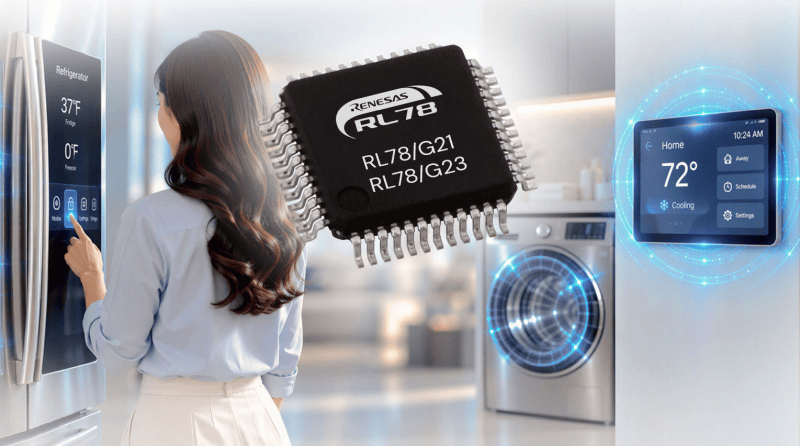
What exactly did the RL78 release change?
Conclusion first: two moves, one on power and one on integration, with pin-level continuity preserved between them.
On power, Renesas reports an operating current of 34.4 µA/MHz for the RL78/G21, half the level of the leading RL78/G13 MCUs, positioning the device for ultra-low-power system control in air conditioners, refrigerators, washing machines and microwave ovens. On integration, the RL78/G23 lineup gained capacitive-touch channels for human-machine interfaces: versus the existing R7F100G devices, the new R7F104G MCUs raise the channel count to 24 in the 44-pin version and to 25 in the 48-pin version. Both families sit in a single release announced on 28 October 2026.
| Parameter | Value | Why a GreenTech reader should care |
|---|---|---|
| Architecture | 16-bit | Mid-point between 8-bit cost and 32-bit headroom; enough for motor-adjacent and sensor logic |
| Operating current | 34.4 µA/MHz | Directly scales the always-on control path inside a capped standby budget |
| Code flash | 128 KB or 256 KB | Room for a firmware generation of touch plus communication stacks |
| Data flash | 4 KB | Retains cycle counters, fault logs and calibration data without a memory add-on |
| High-speed on-chip oscillator | ±1.0% accuracy | Removes an external crystal in many control tasks, cutting a component and a leakage path |
| ESD tolerance | ±4-kV HBM | Manufacturing and assembly robustness margin — not a substitute for system-level immunity testing |
| Communication | UARTA interface | Expansion path for connectivity without a second silicon vendor |
| Compatibility | Pin- and function-compatible with RL78/G13 and RL78/G23 | Upgrade with minimal redesign, preserving certified layouts |
Why the run-current figure matters less directly than it looks
Conclusion first: in a real appliance the microcontroller is a small slice of the standby wattage; the value of halving it is the headroom it frees, not the watts it deletes.
Work the arithmetic. Run current scales with clock frequency: 34.4 µA/MHz against an implied 68.8 µA/MHz comparison point means roughly 11 mW versus 23 mW for 10 MHz of continuous activity at 3.3 V (GreencarbonWorld calculation, vendor-supplied currents only). A 0.5 W allowance can therefore be exhausted many times over by a mains-side supply, a standby transformer, an LED or a wireless module before the MCU gets a vote. Anyone presenting this silicon as a "0.2 W saving" is misreading the datasheet.
The honest mechanisms are three. First, duty cycle: a lower current per MHz lets the always-on sensing path wake more often, scan more channels and return to sleep faster, which is the lever that actually reduces average draw. Second, oscillator accuracy at ±1.0% permits trimming a crystal — fewer parts, fewer leakage paths, less board area. Third, integration: 24 or 25 touch channels inside the controller remove a dedicated touch ASIC and the inter-chip link that must also stay alive. As Renesas puts it on the product page, the RL78/G21 "has the lowest run current rate in the RL78 family" — a family-relative claim, and a more useful one than an absolute wattage claim.
Case replay: a control board that is already pinned at the regulatory ceiling
Conclusion first: the pressure is not coming from a theoretical future; it is visible on today's energy labels, which is why the 2027 step matters more than the 2025 one.
Take a commercially available front-loading washing machine sold into the European market with an A energy-efficiency class: the model data published on LG's German product page lists 45.0 kWh per 100 wash cycles in Eco 40-60, 0.5 W power consumption in the off state and 0.5 W in the not-switched-off state. Those two 0.5 W figures are the number to study. They sit exactly on the ceiling set by Commission Regulation (EU) 2023/826, which since 9 May 2025 caps off mode and plain standby at 0.50 W (0.80 W where a low-power status display is provided), then tightens off mode to 0.30 W from 9 May 2027, with networked standby between 2 W and 7 W depending on product category (European Commission, Standby, networked standby and Off mode). A 40% cut in an allowance that a shipping product already fills is the real brief on a design engineer's desk.
Layer on the demand-side context: white goods — washing machines, room air conditioners, water heaters — account for roughly 40% of non-cooking household electricity consumption in the large regional dataset published in Scientific Data (Nature, 2023), while the US Lawrence Berkeley National Laboratory standby programme notes that individual products usually draw under 0.5 W in standby yet together amount to 5–10% of residential electricity use (standby.lbl.gov). That is exactly the profile of a control-path problem: small per device, material across a fleet of a few hundred million units.
Read as a migration, the exercise runs in five steps and produces three reusable lessons. The steps: (1) inventory the always-on path — touch scan, RTC, status LED, any radio keep-alive; (2) measure average, not peak, current over a 24-hour duty profile; (3) check whether the target device is pin- and function-compatible, since the release is compatible with RL78/G13 and RL78/G23 and therefore preserves an already-certified footprint; (4) reflow the same board with the new part rather than respinning it; (5) re-test system-level immunity and the standby measurement, because the enclosure and supply did not change but the compliance number must still be demonstrated.
The lessons worth carrying to the next programme: component-level power figures only translate into product-level benefit through duty cycle; compatibility is a sustainability asset, because reusing a certified PCB and its tooling avoids embodied carbon and 6–9 months of re-qualification that a full redesign would create; and the touch-channel headroom is where BOM consolidation shows up fastest, since it removes a chip, a connector trace and a second power domain.
What the touch-channel expansion does to the bill of materials
Conclusion first: this is the more immediately bankable part of the release for appliance makers adding panels rather than adding features elsewhere.
| Device group | Package | Touch channels | Design consequence |
|---|---|---|---|
| R7F100G (existing) | 44-pin | fewer than the new part | Extra channels tend to push designers to a touch controller IC |
| R7F104G (new) | 44-pin | 24 | Full keypad plus slider and gesture zones on one die |
| R7F100G (existing) | 48-pin | fewer than the new part | Same consolidation pressure at a larger footprint |
| R7F104G (new) | 48-pin | 25 | Supports richer HMIs without a second interface chip |
Every separate touch controller eliminated is one less part to source, one less quiescent current in the standby path and one less line item in end-of-life material tracking. The saving is quantifiable in your own BOM rather than in our estimates: pull the touch-controller unit price and its standby contribution from your current schematic, and compare it against the $0.77 starting price Renesas lists for the new RL78/G23 devices. If the delta is negative, the consolidation argument is settled before anyone debates power.
Cost, availability and the 16-bit positioning question
Conclusion first: both families are shipping now at prices that sit below the cost of the sub-systems they absorb.
The new RL78/G21 and RL78/G23 MCUs are available from Renesas Electronics, with starting prices of $0.56 and $0.77 respectively. The competitive question a GreenTech reader will ask next is why not simply buy a 32-bit part. Renesas holds the No. 1 global market share in 16-bit MCUs, according to its 28 October 2026 announcement (Business Wire), and the reasoning is set out by Yoshitaka Takahashi, Principal Engineer in the company's product marketing group, in a blog published the same day: as appliances become "increasingly connected and feature-rich", he writes, the systems that drive them "require high power efficiency and reliable operation at optimized costs" (Renesas blog, 28 October 2026). Read against the memory map above — 128 KB or 256 KB of code flash plus 4 KB of data flash — the fit is deliberate: a control loop, a touch front end and a UARTA link, not an operating system.
Four misreadings that make this datasheet harder to use than it is
- "±4-kV ESD means my panel passes ESD testing." It does not. The ±4-kV figure is a human-body-model rating at device level. Product immunity is judged under IEC 61000-4-2, whose Level 2 is ±4 kV contact discharge and Level 4 is ±8 kV contact / ±15 kV air (IEC 61000-4-2 test levels). Higher silicon tolerance buys design margin for handling during assembly, not a certificate.
- "Half the current means half the appliance's standby draw." The mains-side supply, standby transformer and any radio dominate; the MCU is one contributor whose effect scales with how often it wakes.
- "Pin compatibility means zero engineering work." Footprints transfer; firmware, oscillator configuration, touch tuning and the regulatory measurement do not. Plan a re-test even when the board is unchanged.
- "This is only an appliance story." The same always-on logic applies to battery-powered sensors and industrial controls, where standby consumption drives battery life and maintenance intervals.
FAQ: the four questions a sustainability or engineering lead asks first
Does adopting the RL78/G21 help me meet the 2027 off-mode limit?
It contributes headroom in the control path, and the pin- and function-compatible upgrade path means the change can land inside an existing certified design. Compliance itself still depends on the supply, the display and the radio, which together decide whether you clear 0.30 W.
Which number should my team actually benchmark?
Average current over a full 24-hour duty profile, measured at the product terminals — not the 34.4 µA/MHz run figure, which is a normalised per-megahertz value under vendor test conditions.
Why do 24 and 25 touch channels matter more than they sound?
They determine whether a richer interface is one chip or two. The R7F104G devices reach 24 channels in the 44-pin version and 25 in the 48-pin version versus the existing R7F100G, which is what converts a panel upgrade into a consolidation exercise.
Is the 16-bit choice a limitation for connected appliances?
Not for control. It becomes a limitation only when the product needs an operating system, a rich display or on-device inference — workloads that belong to a different core, sitting next to a controller that keeps running the safe-state logic.
Action checklist for the next product cycle
- Freeze a standby budget per always-on sub-function (sensing, display, connectivity) before any silicon decision, and test it against the 0.30 W off-mode step dated 9 May 2027.
- Map every existing RL78/G13 and RL78/G23 design in the portfolio as a candidate for the compatible upgrade, and score them by re-qualification effort avoided rather than by unit price.
- Recalculate average control-path current across a realistic duty profile at 128 KB and 256 KB flash options, since code size drives which variant your touch and UARTA stacks fit into.
- Re-run IEC 61000-4-2 system testing after any HMI change; treat the ±4-kV device rating as assembly protection, alongside — not instead of — protection components at the panel.
- Track oscillator substitution: validating the ±1.0% on-chip oscillator against your timing budget removes a crystal and its standby leakage from the material list.
- Record the change in your product carbon and materials accounting as a component-elimination item, which is the part a buyer or auditor can verify on the BOM.
GreenTech desk note: GreencarbonWorld publishes these build-side reviews for engineering and ESG teams evaluating technology paths that reach production. If you want the standby-budget worksheet behind this piece, write to the desk at info@greencarbonworld.com.
Reference sources
- European Commission — Ecodesign requirements for off mode, standby and networked standby (Regulation (EU) 2023/826 limits and 2025 / 2027 steps): https://energy-efficient-products.ec.europa.eu/product-list/standby-networked-standby-and-mode_en
- Government of the Netherlands, business.gov.nl — application date of the stricter standby requirements (9 May 2027): https://business.gov.nl/amendments/stricter-requirements-standby-energy-consumption-applicances/
- Lawrence Berkeley National Laboratory — Standby power programme, 5–10% of residential electricity use: https://standby.lbl.gov/
- Nature Scientific Data — white goods and their share of non-cooking household electricity consumption: https://www.nature.com/articles/s41597-023-02358-x
- LG Electronics DE — product datasheet showing 45.0 kWh per 100 cycles and 0.5 W off / 0.5 W not-switched-off: https://www.lg.com/de/waeschepflege/waschgeraete-bundles/f4wr7092.rt90v9w/
- Renesas Electronics — RL78/G21 product page (lowest run current in the RL78 family): https://www.renesas.com/en/products/rl78-g21
- Renesas blog, Yoshitaka Takahashi (28 October 2026) — why 16-bit MCUs still matter: https://www.renesas.com/en/blogs/why-16-bit-mcus-still-matter-smart-home-appliance-and-industrial-applications
- Business Wire (28 October 2026) — RL78/G21 launch and 16-bit market-share note: https://www.businesswire.com/news/home/20261028688857/en/Renesas-Expands-RL78-Family-with-Ultra-Low-Power-16-Bit-RL78G21-MCU-Optimized-for-Smart-Appliance-System-Control
- Wikipedia — IEC 61000-4-2 test levels table: https://en.wikipedia.org/wiki/IEC_61000-4-2