
GreenTech Pilot Guide: Wiring-Free Cell Monitoring With DK-NFLNK Near-Field RF
Dukosi has opened commercial sampling of DK-NFLNK, a contactless intra-battery link that carries cell voltage and temperature data over one bus antenna using near-field RF, taking the copper harness and its connectors out of the pack. For a GreenTech reader the decision is not whether wireless looks elegant on a bench. It is whether your existing module can absorb a new link layer, and whether the data it produces pays for itself before the EU Battery Passport deadline.
BUDAPEST, Hungary – at the Pretzl Connect 2026 press event, Dukosi, based in Edinburgh, said commercial sampling has started for DK-NFLNK, a contactless intra-battery communication solution intended to remove wiring harnesses and raise battery safety. Near-field radio links replace physical cabling inside Li-ion packs and provide synchronous communication compatible with DKCMS monitoring systems.
What leaves the pack, and what stays untouched?
Conclusion first: the wires go, the module geometry stays. Instead of copper cabling, voltage and temperature data are transmitted wirelessly over one bus antenna using near-field RF. That removes failure points from the battery architecture, aids real-time thermal monitoring through data collected from Dukosi’s DKCMS chips, and supports data tracking useful for the battery passport. On the integration side, the system connects the node chip to the analog front ends through a serial interface, enabling wireless capability without changing the module hardware structure.
That serial handoff is the line to read first in any sample agreement. It decides whether contactless monitoring is a board-level change you can run on a current production module, or a full re-programme disguised as a component swap.
Why does a 10 ppm connector figure drive an architecture change?
Joseph Notaro, president of Dukosi in Budapest, stated: “Connector failure rates in a conventional wiring harness are around 10 parts per million,” followed by “In the automotive and industrial arenas where you’re looking at parts-per-billion-level reliability, that failure rate is simply too high and an unacceptable risk of failure.”
Wired networks can also create galvanic coupling between high-voltage circuits and low-voltage controls, while adding labor and weight. Notaro said: “With contactless technology, we decouple the high-voltage circuits and get rid of the physical connectors, which makes the system safer, higher quality, and more reliable over its entire operating life,”
| Decision factor | Copper harness today | DK-NFLNK contactless link |
|---|---|---|
| Failure points | Connector failure rates are around 10 parts per million | Removes physical connectors |
| Isolation | Risks galvanic coupling between high-voltage circuits and low-voltage controls | Decouples high-voltage circuits |
| Assembly | Adds labor and weight | Eliminates wiring harnesses; node chip attaches to existing front ends |
| Thermal latency | Older designs used two or three temperature sensors across the whole module | Cell-level synchronous sampling inside the enclosure |
 Joseph Notaro (Source: Dukosi)
What does synchronous cell measurement actually buy?
Dukosi’s architecture centers on C-SynQ, a protocol that sends near-field radio signals along one bus antenna wire. Those signals work at the cell level and remain inside the enclosure, giving noise immunity without requiring line of sight.
Notaro said: “Smarter battery management starts with better data, and better data starts at the individual cell,” adding: “When you’re deciding available power or charge limits, you want every cell being measured at the same time under the same conditions. That’s the technical equivalent of taking a high-speed photo of every cell at the same time.”
Notaro continued: “The weakest cell dictates the state of charge and the overall performance of the pack. If you don’t measure the cells in synchronization, then measurement errors creep in, and you’re forced to add in design margins, which in turn limit performance.”
Translated into engineering terms: asynchronous sampling forces you to size the pack around worst-case uncertainty rather than worst-case cell. The margin you delete is the margin you were paying for twice, once in silicon and once in lost dispatchable energy.
How much earlier does a thermal warning arrive?
For Li-ion battery safety, the goal is preventing thermal runaway. A short circuit in a single cell can start an exothermic reaction that spreads to neighboring cells. Older pack designs used only two or three temperature sensors across the whole module and therefore did not monitor individual cells.
Notaro said: “In the traditional layouts with very sparse temperature sensing, the heat from a failing cell can take 10 to 15 minutes to get to an external sensor,” and “With sensing capability on every cell, temperature excursions are detected almost immediately, well before the heat has a chance to propagate to the adjacent cells.”
With cell-level monitoring, software can run outlier-detection algorithms, comparing thermal profiles across cells and flagging minor deviations before they become problems.
Notaro said: “Some manufacturers try to cut costs by getting rid of the sensors and just assuming the cells are all the same,” adding: “Every chemical manufacturing process has variation. You can’t have a battery pack that’s that uniform and then ignore the cell-level monitoring without increasing your operating risk.”
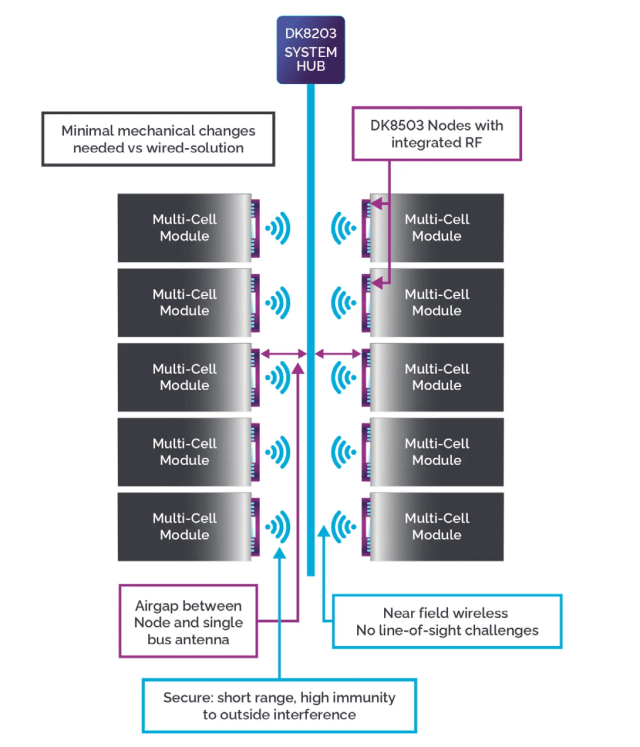 DK-NFLNK System Diagram (Source: Dukosi)
Is the cost-pressure question regional?
During the briefing, EE Times asked whether battery manufacturers in China approach monitoring and safety differently from companies in other regions, particularly whether their strategies are mainly cost-driven.
Notaro replied that China has two distinct tiers of customers:
- one that prioritizes safety and total system value
- another strictly focused on short-term component costs
He stressed that this split is not unique to China, because carmakers worldwide divide between safety-conscious and cost-driven mindsets. He added that the massive volume of EVs in China gives domestic manufacturers extensive operational data, accelerating their ability to refine battery quality over time.
What is the business case in usable energy and dollars?
Measurement precision directly influences usable energy capacity. The Dukosi Cell Monitoring System, known as DKCMS and built around the DK8102 Cell Monitor chip and DK8202 System Hub, targets the system measurement errors that traditionally degrade usable battery capacity. Notaro said: “By providing consistent cell-level data, operators can reduce safety buffers and increase usable energy by 6% to 12%,” and “You are not altering cell chemistry or adding weight; you are simply extracting energy previously locked away by measurement margins.”
For utility-scale energy storage, that efficiency gain produces a direct financial impact. In a 200-MW installation, additional revenue of $8 million can be generated from the extra capacity, or capex can be reduced by $2 million by needing fewer cells.
Test those numbers against today’s hardware prices rather than accepting them in the abstract. BloombergNEF’s December 2025 price survey put the average lithium-ion pack at $108/kWh and stationary-storage packs at $70/kWh, the cheapest segment and 45% below 2024 (BloombergNEF). GreencarbonWorld’s arithmetic on the vendor’s own figure: a $2 million capex reduction at $70/kWh is roughly 28,600 kWh of pack you no longer buy, ship and eventually recycle – which is the upstream, value-chain emissions argument to put in a Scope 3 purchased-goods file, not a slogan.
The uncomfortable corollary, and our analysis rather than the vendor’s: as cells get cheaper, buying your way out of a margin problem gets cheaper too. Monitoring has to earn its place on safety, warranty and compliance data, with recovered energy as the bonus line.
How does on-chip data map to the EU Battery Passport?
Dukosi’s monitoring technology may also support collection of operational data relevant to the EU Battery Passport. The Regulation (EU) 2023/1542 of the European Parliament and of the Council requires that “From 18 February 2027 each LMT battery, each industrial battery with a capacity greater than 2 kWh, and each electric vehicle battery placed on the market or put into service shall have an electronic record (‘battery passport’).” From Feb. 18, 2027, batteries covered by the EU Batteries Regulation will require an electronic record containing information about identification, composition, performance, and health. The DKCMS chips include onboard non-volatile memory and a unique silicon identifier attached to each cell.
Notaro said: “Every cell has its own digital passport on chip, which records the maximum temperature it’s ever seen, its voltage history, and total charge cycles,” adding: “When the battery has finished its life in the car, the recyclers and integrators simply read the chip to determine the health of the cell, which allows them to sort it efficiently for either grid use or recycling.”
One detail that procurement teams keep missing: the passport is the last obligation in a sequence, not the first. Article 7 of the same regulation phases in carbon-footprint rules ahead of it, with performance-class labelling scheduled from 18 August 2026 and a maximum life-cycle threshold to follow (batteryregulation.eu). Measured temperature, voltage and cycle history is therefore primary evidence for a footprint declaration that would otherwise be modelled from averages.
How do you pilot it on a legacy line?
Chip-on-cell represents a move toward smart cell architectures, but Dukosi said DK-NFLNK is an upgrade path for manufacturers still using traditional module design.
- Step 1 – audit the harness before the radio. Pull warranty, rework and field-return tickets by failure mode. If connector-driven tickets are already negligible in your application, the safety case is weak and you should justify the change on data grounds instead.
- Step 2 – baseline your error budget. Record how much design margin currently sits between nameplate and dispatched energy. Without that number you cannot verify claims of 6% to 12% usable energy in your own pack.
- Step 3 – prove the serial handoff on one module. Confirm the node chip talks to your existing analog front ends, and that firmware, calibration and tooling chains survive the change.
- Step 4 – measure warning latency, not data volume. Inject a controlled thermal disturbance and compare detection time against your sparse-sensor layout. Latency improvement, not record count, is what insurers ask about.
- Step 5 – fix the schema before the deadline. Map on-chip fields to passport and footprint data requirements while the design is still open; retro-fitting a data contract after SOP is where projects stall.
Notaro concluded: “DK-NFLNK and our full cell monitoring system are built on the same C-SynQ communication platform, giving battery manufacturers a real migration path,” and “The engineers can upgrade their architecture today and move to full chip-on-cell monitoring in future product cycles.”
Dukosi’s monitoring technologies are now in commercial testing across several sectors. Nordic Marine Power received DNV maritime approval for its PowerStack system using Dukosi monitoring, and Yichuan Intelligent Technology incorporated the system into marine vessels in China.
Which pitfalls ruin monitoring upgrades?
- Reading sampling availability as production readiness. Commercial sampling is the start of qualification, not the end.
- Collecting cell data you cannot store, timestamp or hand to a third party at end of life.
- Assuming connector standardization answers the architecture question; a tidy catalogue does not remove coupling and isolation risk.
- Accepting datasheet promises where suppliers should publish decay curves and field-return statistics.
- Deleting sensors to save cents, then pricing the residual risk as if it were zero.
FAQ: what engineers ask us first
Does contactless monitoring change cell chemistry or pack weight?
No. The vendor’s position is explicit: you are not altering cell chemistry or adding weight, you are extracting energy previously locked away by measurement margins. The change is in the link layer and the software behind it.
Do I need new modules to evaluate DK-NFLNK?
Not for the sample stage. Because the node chip connects to the analog front ends through a serial interface, a traditional 12-cell style module can carry the link while the enclosure, busbar layout and mechanical design stay as they are.
Is near-field RF reliable next to high-voltage hardware?
Dukosi says the signals remain inside the enclosure and give noise immunity without line of sight. Treat that as a claim to qualify in your own environment: EMC, vibration, temperature cycling and production tolerances are still your test plan.
Who can read the cell data after the vehicle is scrapped?
That is the point of onboard non-volatile memory and a unique silicon identifier: recyclers and integrators read the chip rather than run destructive tests, which is what makes sorting for grid use versus recycling practical at scale.
What does this have to do with carbon accounting?
Three things, all measurable: less cell content per delivered kWh, longer predictable life before replacement, and primary data that replaces modelled averages in footprint declarations.
Priority list before you sign a sample agreement
- Quantify current connector failure tickets and the labor minutes per pack.
- Quantify design margin now hiding usable energy.
- Run one module-level latency test against sparse sensing.
- Confirm the serial interface fits your analog front ends.
- Lock the data schema to the 2027 passport and earlier footprint milestones.
As production scales globally, the industry’s scarce asset stops being pack volume and becomes provable history: what each cell saw, when it saw it and what is left. A wiring-free link is only interesting if it lowers failure risk, releases margin you already paid for, and produces records that survive the original owner. If it does all three, pilot it on your own module, on your own clock, before the compliance date turns good engineering into paperwork.
Sources referenced
- EUR-Lex, Regulation (EU) 2023/1542 of the European Parliament and of the Council on batteries and waste batteries.
- BloombergNEF, lithium-ion battery pack price survey, December 2025.
- batteryregulation.eu, carbon footprint declaration dates under Article 7.
- Dukosi, DK-NFLNK product documentation and Pretzl Connect 2026 briefing.