
GreenTech Deep Dive: How AI Is Rewriting Climate Forecasting, Grid Control and the Compute Bill
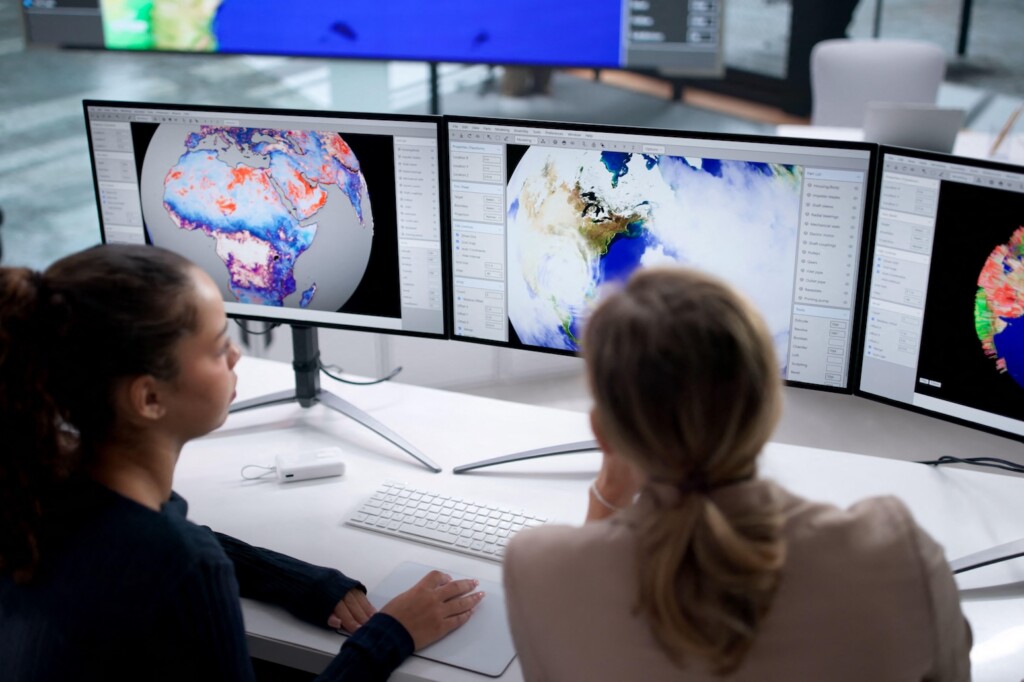
Model output on the screens of an operational forecasting centre. Credit: Andriy Popov / Alamy Stock Photo
For the people who specify, finance and operate green technology, machine learning in climate science has stopped being a laboratory story and become a procurement question. Which tasks does an AI system now perform better than the tool it replaces, at what running cost, and under which conditions does it fail silently? Answers gathered from researchers working on forecasting, satellite analytics, grid optimisation and scenario design suggest a clear split: fast, measurable gains wherever observations are dense and lead times are short; stubborn limits wherever the object of interest is a future state that nobody has measured yet. The same answers also expose three second-order issues that any implementation plan has to price in — energy demand, verification and the uneven geography of data.
The evidence base for that reading is unusually direct. Carbon Brief spoke to 10 experts whose work spans climate-related fields, from developing climate forecasts to analysing changes in the energy grid: Dr Doug McNeall of the UK Met Office; Prof William Collins of the University of East Anglia; Dr Stefano Materia and Dr Amirpasha Mozaffari of the Barcelona Supercomputing Centre; Dr Clare Eayrs of New York University; Prof Cristiana Stan, vice-chair of the World Climate Research Programme; Prof Priya Donti of the Massachusetts Institute of Technology; Dr Carlos Rodriguez-Pardo; Dr David Rolnick; and Prof Detlef van Vuuren of the PBL Netherlands Environmental Assessment Agency. Their responses map onto seven questions a technology buyer would ask:
- What does AI add to weather and climate forecasting, and where does it break down?
- Which other research functions are already production-grade?
- How is AI entering policy analysis and energy-system operation?
- What is likely to change over the coming years?
- What do non-specialists routinely get wrong?
- Does AI narrow or widen the gaps in climate information?
- Which risks remain unmanaged?
1. Short-range prediction is the first genuinely operational win
Dr Doug McNeall, science lead in data-driven climate modelling, UK Met Office
The most consequential recent development, in his account, is the emergence of AI weather-prediction models: systems that learn from large volumes of weather data to predict the next few hours ahead, then repeatedly feed those predictions back into themselves to build forecasts reaching two weeks into the future. They have demonstrated that accurate prediction is possible while needing far less computing power than existing numerical models, the equation-based systems that simulate the atmosphere and ocean directly.
The limitation is built into the training set. Those models were developed for relatively short timescales, where observational data — temperature, rainfall, sea ice extent — are plentiful and where performance can be evaluated quickly and rigorously. Climate prediction is a fundamentally different task, because useful climate information requires projections of future climates that lie outside the observational record. McNeall's preferred route is therefore not a purely data-driven one: use AI to emulate or accelerate existing models. That blended approach could make climate risk information far more accessible and affordable to produce, while retaining the physical understanding that underpins confidence in projections.
For cost modelling, that "far less computing power" claim has recently been quantified. A 2026 assessment published in Weather, the journal of the Royal Meteorological Society, compiled operating data for seven mainstream data-driven forecast models and compared them with physics-based systems of comparable forecast skill: assuming one year of operational use, the data-driven models consumed between 21 and 1,273 times less energy. Training is power-hungry, but efficient inference offsets it comparatively quickly — the same logic that separates a climate emulator from a frontier model.
Prof William Collins, professor of AI for climate science, University of East Anglia
"We're seeing a really exciting renaissance in both weather and climate science," he says, adding that machine learning — algorithms that let computers learn from data and make predictions without being explicitly programmed — "has had an enormous impact on numerical weather prediction." The strongest institutional proof: the European Center for Mid-Range Weather Forecasts now deploys an AI forecast system alongside the traditional forecast system as part of official communication of weather predictions to the European community. ECMWF's own bulletin dates that step precisely — the ensemble version of its Artificial Intelligence Forecasting System entered operations on 1 July 2025 to run side by side with the physics-based Integrated Forecasting System, a dual-run pattern worth copying by anyone designing an internal validation protocol. In Collins's judgement, AI systems are now absolutely competitive with the world's leading numerical weather prediction.
The obstacle that remains is epistemic, not computational. Much of machine learning involves learning from data, while climate represents a future for which we do not have data. "We're literally trying to predict the future. We don't have observations of it. So, where does the data come from to inform the models? That is, at the moment, the central challenge that the climate community is attempting to overcome."
Dr Amirpasha Mozaffari, researcher in Earth artificial intelligence, Barcelona Supercomputing Centre
His diagnostic is the one most relevant to adaptation budgets: AI forecast models perform well on typical weather, yet underperform physics-based models on record-breaking and unprecedented extremes — precisely the events that matter most for adaptation. Benchmark work published in 2026 in Science Advances reached a comparable verdict for several classes of extremes. Whether that is solved by hybrid models combining AI with traditional schemes, by physical constraints written into the network from the laws of physics, or by new ways of evaluating models on what they have not seen is, he says, the central open problem for the field.
Where each model class stands today
| Decision criterion | AI / data-driven models | Physics-based models |
|---|---|---|
| Skill on routine conditions | Competitive with the best operational systems | Mature reference standard |
| Record-breaking and novel extremes | Tends to underperform | Currently stronger |
| Energy per forecast cycle | Far lower — 21 to 1,273 times less annual energy in one 2026 assessment | Supercomputer-bound |
| Future-climate states beyond records | Needs emulation of physical models | Grounded in physical laws |
| Adoption speed | Months | Decades |
2. Earth observation: pixels converted into near-real-time abatement signals
Dr Stefano Materia, researcher in climate variability and change, Barcelona Supercomputing Centre
The proliferation of Earth-observation satellites has created a massive influx of geospatial data — imagery showing deforestation or sea ice melt, for example — and AI is being used to translate raw pixel data into actionable climate intelligence. Materia singles out two examples. Methane is a potent greenhouse gas whose leaks are largely invisible and hard to track; algorithms now automatically scan hyperspectral imagery, drawing on data across the electromagnetic spectrum, to pinpoint specific industrial methane leaks globally and alert operators in near real time. In parallel, machine-learning models process thousands of satellite images daily to detect illegal logging, track land-use changes and monitor glacier retreat long before humans could manually review the footage.
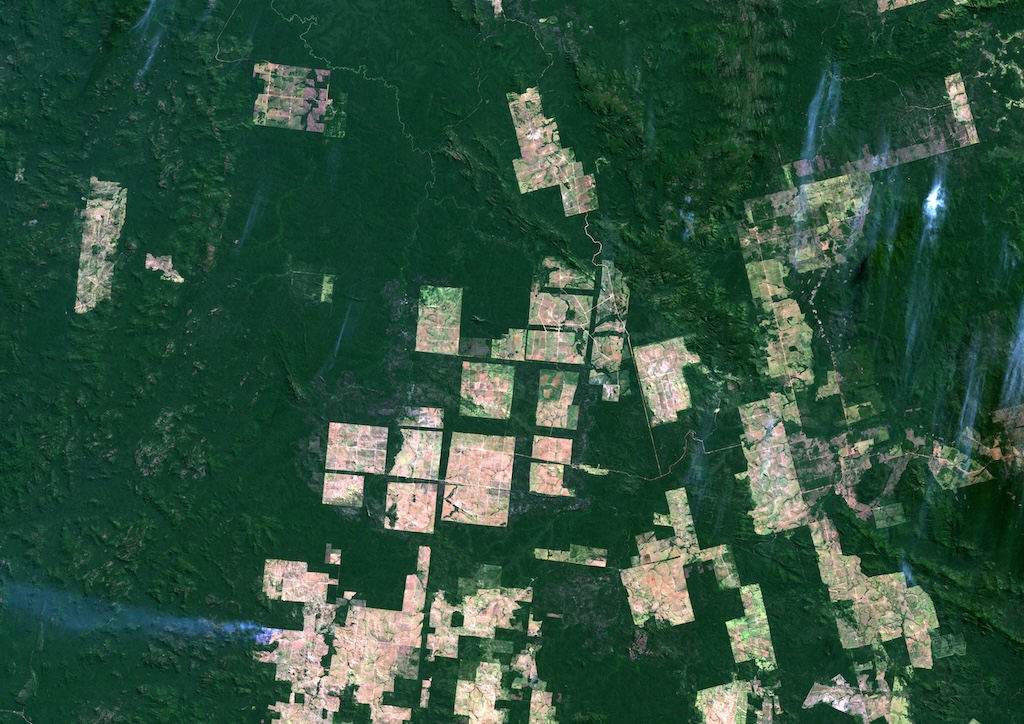
Satellite view of deforestation in Para, Brazil. Credit: Universal Images Group North America LLC / Alamy Stock Photo
Case check. The commercial logic of satellite-plus-AI methane work has hardened since those interviews. MethaneSAT, an $88 million satellite, reported in March 2025 that it had measured roughly 1,300 tonnes of oil-and-gas methane emitted per hour across the areas surveyed — about $200,000 worth of natural gas lost every hour — and its first global assessment of the sector, released in 2026, found emissions higher than inventory-based expectations. For an operator, detection and revenue point the same way: leaked gas is unpaid gas, and repair economics improve as soon as a leak can be located without a manual site visit. That is the rare green-technology case with a payback measured in months rather than in compliance cycles.
3. Sea ice: machine learning spread across an entire modelling workflow
Dr Clare Eayrs, polar research scientist, Environmental Fluid Dynamics Lab, New York University
In sea-ice research, she notes, machine learning is now used across the whole modelling workflow. The most mature application is extracting more information from observations: mapping fine-scale sea ice deformation from ship radar, or classifying snow layers in micropenetrometer profiles that measure the hardness or softness of successive snow layers. Forecasting is the most visible application — Ice Net, a sea-ice forecasting system, was an early demonstration that a deep-learning system could outperform a leading physical model in seasonal Arctic forecasts, and machine-learning systems are now used to predict sea ice concentration, thickness and drift.
The binding constraint here is the length of the record, not the algorithm. Much of what is known about Antarctic sea ice comes from the satellite era, which begins in 1979 — a short record for a system with strong decadal variability. A great deal about earlier conditions sits in ship logs, whaling records, expedition photographs and early aerial and pre-1979 satellite imagery, and machine learning is well suited to extracting it. Lengthening the observational record, she argues, would improve almost everything else researchers do, including the training and testing of AI systems themselves.
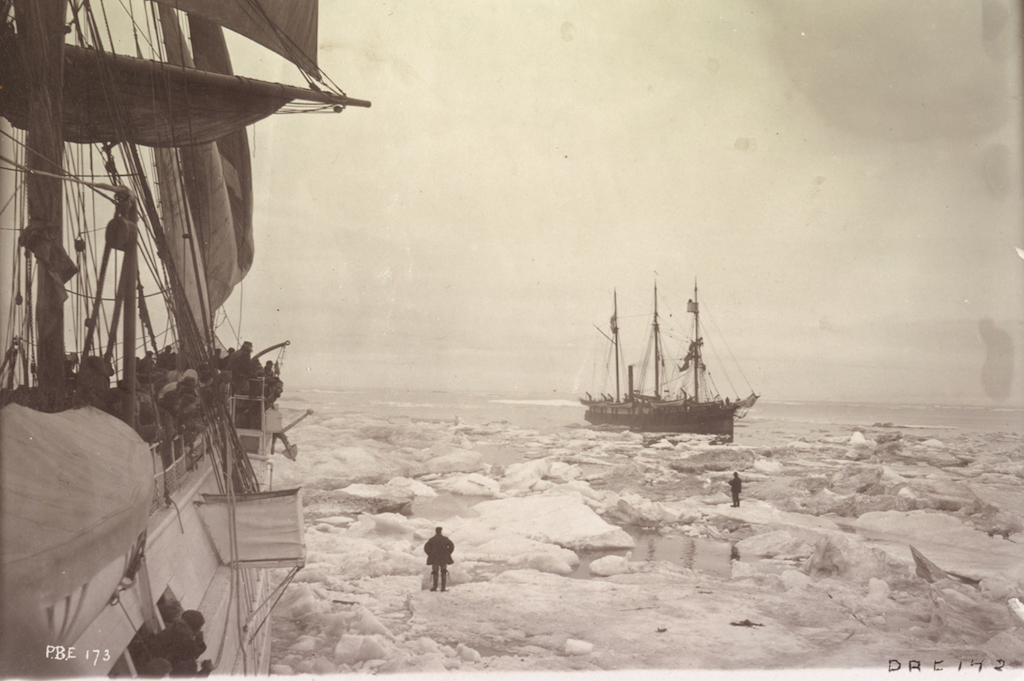
The whaling vessel "The Bear" worked out of the ice pack — the kind of archive now being mined for pre-satellite sea-ice data. Credit: New Bedford Whaling Museum
4. Benchmarks before hype: how trust is being engineered into the stack
Prof Cristiana Stan, vice-chair of the World Climate Research Programme (WCRP)
AI now appears across all major parts of the WCRP. The weather prediction model intercomparison project, an initiative to build a centralised database of physics-based, machine-learning and hybrid model forecasts, includes physics-based numerical weather prediction models alongside hybrid and AI weather prediction models. Because it is focused on operational models, it offers a direct comparison between state-of-the-art systems, is intended to accelerate the deployment of the next generation of operational models, and contributes to the metrics needed to assess the relative strengths and weaknesses of each. Downscaling — refining coarse-resolution model output into high resolution — is another area harnessing AI.
Dr William Collins
He points out that the Intergovernmental Panel on Climate Change (IPCC) is performing its seventh assessment report (AR7), and that this time, for the very first time, there is a model intercomparison project just for models using AI for weather and climate forecasting. He reads that as a real milestone, an exciting proof of principle or proof of concept, and the harbinger of many more developments. Timing matters for end-users: the AR7 cycle is scheduled to conclude with a Synthesis Report released by late 2029, so today's AI benchmark evidence will be judged against a hard assessment deadline.
Dr Amirpasha Mozaffari
Two practical changes reshape vendor selection. A few years ago it took two or three years for a new architecture to make its way from the machine-learning community into weather and climate work; today it is a matter of months — diffusion models, foundation models and generative ensembles have all arrived in the field almost as soon as they appeared elsewhere. That speed opens up things previously out of reach. He also notes that the cost of running a global forecast has dropped by orders of magnitude, which in principle changes who can produce weather and climate information at all.
5. Grids and policy cycles: the applications with the shortest payback
Prof Priya Donti, assistant professor at the Massachusetts Institute of Technology and co-founder of Climate Change AI
As more solar, wind and other renewable energy enters the power grid, she explains, operators need to rethink how the various sources are actually managed. AI is used in a few distinct ways. One is simply getting better predictions of solar and wind power production, to reduce uncertainty and allow planning with a little more foresight. Another major use is helping to optimise and control the components already sitting on power grids — power generators, batteries, flexible loads such as industrial loads, the batteries in electric vehicles, and heating and cooling systems.
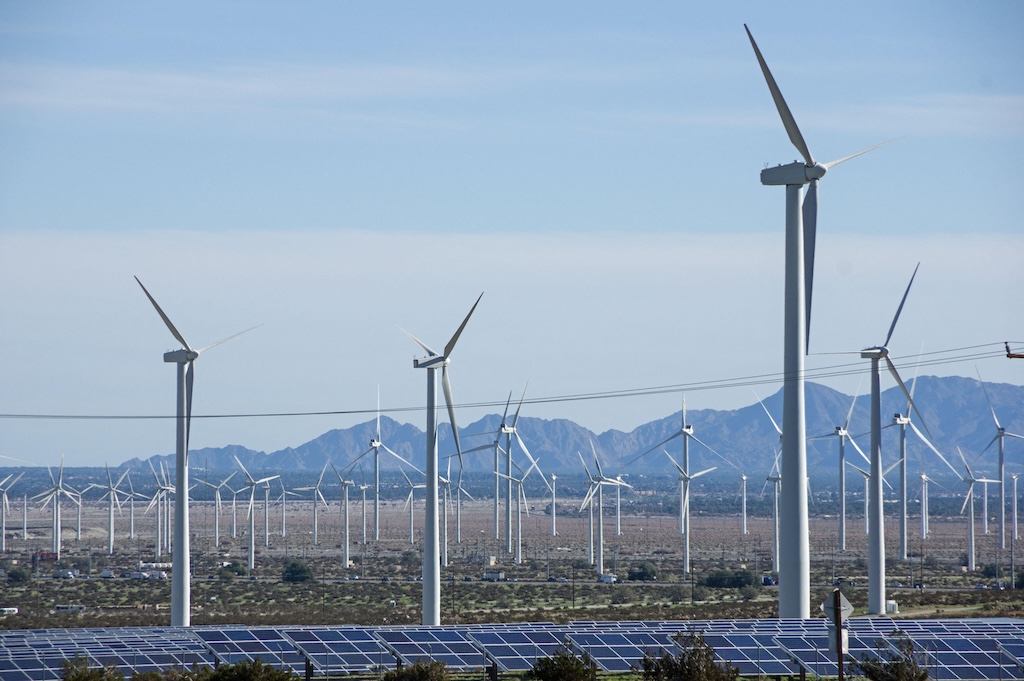
Wind turbines and solar panels in California. Credit: Tom Grundy / Alamy Stock Photo
Implementation reading: control and dispatch applications monetise assets that are already installed, which is why they typically carry the shortest business case. They also carry the highest governance burden, since dispatch decisions touch market rules and grid codes — human sign-off, audit trails and a defined fallback to conventional control should be specified before deployment, not after.
Dr Carlos Rodriguez-Pardo, postdoctoral researcher at Politecnico di Milano, affiliated scientist at the European Institute on Economics and the Environment and at the Euro-Mediterranean Center on Climate Change
AI is already useful at every stage of the climate policy cycle. The first stage is measurement: understanding what is happening, what has been tried and who is exposed. Machine learning helps process satellite imagery to estimate emissions, improve air quality monitoring, harmonise fragmented policy databases and map a scientific literature that has grown far beyond what any human team could read. The second stage is modelling futures: the models used to explore climate and economic scenarios are computationally very expensive, so AI-based emulators that reproduce their behaviour at a small fraction of the cost are transforming what can be done — instead of a handful of scenarios, researchers can explore thousands and quantify uncertainties that were previously out of reach. Reinforcement learning, in which a programme learns to make decisions through trial and error, also allows study of how multiple actors such as countries or electricity producers compete and cooperate under different policy designs, revealing strategies that classical analysis misses. The third stage is evaluation, where causal machine learning extends the toolkit used to answer whether a policy actually worked — a different and much harder question than predicting what happens next.
| Policy-cycle stage | Technique | What a firm can do with it |
|---|---|---|
| First stage — measurement | Imagery analysis, air-quality inference, database harmonisation, literature mapping | Scope 3 and exposure baselines built from data rather than proxies |
| Second stage — modelling futures | Emulators of expensive scenario models; multi-actor reinforcement learning | Thousand-run sensitivity testing of price, fuel-mix and regulation paths |
| Third stage — evaluation | Causal machine learning | Attributing measured outcomes to specific interventions for disclosure |
6. The compute bill: pricing AI's own footprint honestly
Dr David Rolnick
The most common misconception, he says, is to equate AI with the large generative models built by big technology companies — an association reinforced by tools such as ChatGPT, Claude and Gemini, which are large language models rather than climate instruments. That is not mostly what is useful in AI for tackling climate change. Concerns about energy use and the wider societal impacts that follow from it, including water use, are very real; but the massive requirements belong to large-scale generative and agentic systems, not to the kinds of AI systems actually deployed against climate change.
Prof Priya Donti
She thinks the general public treats AI as one specific thing — large language models, chatbots and similar tools — and that people making allocation decisions about who funds scientists may hold a mismatched understanding of what needs to happen, which means the right science doesn't necessarily get funded.
There is nonetheless a separate, legitimate number to watch. The International Energy Agency's Energy and AI analysis projects that global data centre electricity consumption will more than double to around 945 TWh by 2030, growing by roughly 15% a year and reaching about 3% of world power demand. The operational implication for a green-technology buyer is to treat AI analytics like any other digital service with a measured footprint: record kilowatt-hours and CO2e per forecast run or per model update, prefer inference-efficient architectures, and site workloads on grids with rising renewable supply. A climate emulator running for an hour and a frontier training job are not the same line item, and should not be reported as if they were.
7. Who owns the model: inequality as a design variable
Dr Amirpasha Mozzafari
His warning is structural. Frontier models are built almost exclusively in the global north, trained on data that is densest where observations are richest and validated against benchmarks that reflect the same regions. Cheap inference does not fix that on its own: being able to run someone else's model is not the same as having a say in what it is trained on, how it is evaluated, or whether it serves your decisions. Without deliberate effort to share data infrastructure, adopt evaluation metrics that centre on people's wellbeing, and genuinely co-produce knowledge, AI risks automating and amplifying the existing divide in the global climate information system rather than closing it.
Dr Carlos Rodriguez-Pardo
The opposite outcome is also on the table. Done well, developing AI-based Earth system models could dramatically lower barriers to entry: a small research group, or an agency in a data-poor region, could adapt a pre-trained model on modest hardware rather than building bespoke systems from scratch. That matters because the data is thinnest and the resolution gap is largest exactly where vulnerability to climate change is highest.
Dr David Rolnick, associate professor in the school of computer science at McGill University and cofounder of Climate Change AI
Climate action should fundamentally be about democratisation of action and equitable response, in mitigation as in adaptation. The consolidation of large-scale AI can work counter to those goals, by concentrating power in certain geographies and stakeholders and by defining action according to their goals. When technology is built inside specific institutions, those institutions do not necessarily understand the needs of the majority of the world's population or of local stakeholders in other geographies.
Governance is beginning to respond: in October 2025 an extraordinary session of the World Meteorological Congress endorsed integrating AI into WMO's global observation and forecasting framework, even as the organisation continues to flag large gaps in basic observations. Standards for model training and evaluation are becoming part of the multilateral system, not only a vendor question.
8. Failure modes: trust, "truthy" answers and diverted attention
Dr Clare Eayrs
The biggest challenge, she says, is trust. Good performance is necessary, but it is not enough: independent evaluation, physical credibility, process-based validation, robustness and some degree of interpretability are also required. The risk she worries about most is that apparent success could be read as a reason to invest less in observations. AI is not a substitute for observation, physical understanding or careful evaluation — and especially for Antarctic sea ice, where observations of sea ice and snow thickness remain sparse and understanding of snow-ice processes remains limited, what is needed is more targeted observations, not fewer, plus far better documentation of them and their uncertainties.
Dr William Collins
The challenge is always making sure you are getting the right answer for the right reason, and the risk is a plausible answer that is "truthy", but not the truth. Ask a computer for an answer and it will give you one; it will always obey, and it will always be good at answering. The question is whether that answer is valid.
Dr David Rolnick
He puts first and foremost the risk that AI diverges attention from other forms of climate action — a budget and narrative effect rather than a technical one.
9. Trend judgement: what changes by the late 2020s
Prof Cristiana Stan
The WCRP has established a task team to address precisely this forward question. Its focus areas cover modelling and projections, data and observations, impacts and services, engagement with the private sector supporting development and integration of AI and machine learning into climate research and applications, and the scientific rigour and trustworthiness of AI and machine learning methods.
Dr William Collins
He thinks the IPCC's eighth assessment, likely due in the late 2020s, may itself largely be written using large language models — the job of the people writing the report is to synthesise, and one could argue whether that needs to be done by people. His criterion for usefulness stays sharp: AI should be telling us the known unknowns, not the known knowns, because uncertainty is what tells you where science should be heading. Institutions are formalising this: in September 2026, the IPCC established an "informal group" to "provide timely guidance on the responsible use of AI and emerging digital technologies in IPCC processes". He adds that AI will also be an integral part of the eighth Coupled Model Intercomparison Project, with machine-learning codes running alongside traditional climate models.
Dr Stefano Materia
In his view, including AI in climate and land-vegetation modelling represents a paradigm shift. Rather than replacing physical models entirely, hybrid modelling merges the mathematical rigour and physical consistency of traditional process-based Earth system models with the pattern-recognition power and speed of machine learning. That approach should overcome computational bottlenecks, replace unresolved subgrid processes too small for a model's grid cells, and improve the terrestrial biosphere — finally narrowing uncertainties on the terrestrial carbon sink and pinpointing emergent constraints and non-linear tipping points.
Reading these trajectories together, the likely shape of the market by the end of the decade is: AI as an emulator layer inside physics-grounded systems rather than a replacement for them; value migrating from model runs to the measurement networks that make runs trustworthy; and reliability decided by benchmark projects and guidance documents rather than by headline model releases. Because the marginal cost of climate information is falling by orders of magnitude, budgets that once bought compute will increasingly have to buy sensors, verification and local capacity.
FAQ: what practitioners ask before signing
Should a company build its own AI climate model or consume one?
Consume, unless your core product is analytics. Operational providers already publish dual-run AI and physics-based forecasts, and the cost of running a global forecast has dropped by orders of magnitude, making licensed data feeds cheap. Building in-house is only justified when you hold proprietary observations that no provider ingests.
Are AI forecasts reliable enough for adaptation planning?
For routine conditions and short lead times, yes — they are competitive with the best numerical systems. For record-breaking extremes, they currently underperform physics-based models, so adaptation design should keep physical models as the reference and use AI for ensembles, downscaling and screening.
Doesn't the energy use of AI cancel out the climate benefit?
It depends entirely on which AI. The heavy electricity and water demand attaches to large-scale generative and agentic systems; data-driven forecast models were estimated to use 21 to 1,273 times less energy over a year than physics-based equivalents. Measure kWh and CO2e per run before accepting either argument.
Where is the fastest payback today?
Two places: satellite-based methane detection, because located leaks are repairable and the lost gas has market value; and grid forecasting plus dispatch control of batteries and flexible loads, because both monetise installed assets.
Can AI output go straight into regulated disclosures?
Not without a documented evaluation trail. Independent evaluation, physical credibility, process-based validation, robustness and interpretability are the criteria researchers set for trust, and disclosure teams should require the same before signing off on model-derived figures.
Action recommendations for GreenTech and sustainability teams
- Start where observations are dense: pick use cases with short lead times, plentiful historical data and fast verification — generation forecasting, asset control, leak detection.
- Run a dual-track evaluation for one full cycle before retiring a physics-based or engineering model, mirroring the operational dual-run now standard at forecast centres.
- Put energy in the specification: request kWh and CO2e per inference run from vendors and log it alongside other digital services.
- Fund the sensor layer: model skill cannot exceed data quality, so budget for measurement, documentation of uncertainties and local data ownership.
- Write governance into dispatch and control projects: human sign-off, audit trails and defined fallback modes.
- Track standards instead of hype — benchmark intercomparison projects and responsible-use guidance are what will determine insurability and auditability of AI-derived climate numbers.
Nothing in this account supports the two lazy positions that dominate the debate: that AI is a climate solution by default, or that it is simply another emissions source wearing a lab coat. The technology is strongest when it sits inside a measurement-rich, physics-checked system and weakest when it is asked to extrapolate into conditions nobody has recorded. For a green-technology programme, the strategic conclusion is therefore narrow and actionable — buy the cheap inference, keep the physical models in the loop, and treat observations, evaluation and local data ownership as the parts of the stack that competitors will find hardest to copy.