
UNEP 1.5C overshoot: a ClimatePolicy field guide to return pathways, NDC gaps and compliance steps before 2030
Two decades of pledges have changed the verb that practitioners now have to work with. For regulators, compliance leads and carbon-accounting teams, the operative question is no longer how to keep warming below 1.5C, but how deep the overshoot is allowed to run and how fast the curve can be bent back. The UN Environment Programme (UNEP) has put that reframe on an official footing — and it lands in target recalibration, disclosure drafting and supply-chain clauses far more than in conference communiqués.
 Aerial view of a coal port in Virginia, US. Credit: Nathan Wenger / Alamy Stock Photo
1. Read the reframe first: “inevitable, then returnable”
In its sobering annual assessment of the global emissions gap, UNEP states that exceeding the Paris Agreement’s 1.5C limit is imminent and unavoidable: a temporary breach is now inevitable after decades of insufficient climate action, and the window to prevent it has been lost. This year’s report, titled The point of return, says the task now is to minimise the size and scale of a temperature overshoot and to establish a credible return path to 1.5C by the end of the century.
Even the lowest possible overshoot scenario would first see global warming peak at around 1.7-1.8C in the middle of the century before declining. The report stresses that this pathway is still aligned with the long-term temperature goal of the Paris Agreement — but only if global emissions fall 18% by 2030 and 45% by 2035, while ramping up removals of carbon dioxide (CO2) from the atmosphere. Country pledges today, even if fully implemented, deliver 5-8% by 2030 and 11-15 % by 2035, relative to 2025 levels.
The report nonetheless identifies ample opportunity to accelerate action, concluding that countries can still limit peak warming, shorten the duration of overshoot and keep the goals of the Paris Agreement within reach. For a policy team, that sentence — not the word “inevitable” — is where the work begins.
The political framing was set on the day of release: in the UN statement issued with the report on 21 October 2026 (press.un.org, SG/SM/23340; also carried on unep.org), the UN Secretary-General argued that the overshoot above 1.5 degrees must be made as small and as short as possible, and that doing so “demands an overshoot of ambition”. Governance-wise this is a real shift: ambition is now judged against a return path, not only against a 2030 number.
For series context, Carbon Brief has detailed coverage of previous reports in 2014, 2015, 2016, 2017, 2018, 2019, 2020, 2021, 2022, 2023, 2024 and 2025.
2. Step one: fix the baseline before you touch a target
Emissions in 2025 were comparable to those of 2024. Global greenhouse gas emissions totalled 58.4bn tonnes of CO2 equivalent (GtCO2e) — roughly 0.16GtCO2e below 2024 levels, though with high uncertainty. Because the figures are provisional, the report says it is not possible to conclude on the overall direction of emissions in 2025.
Direction is easier to see across the long arc. The growth rate over 1990-2015 averaged 1.7% per year, while emissions have increased by an average of 0.8% per year since 2016.
The chart below covers human-driven emissions from 1990 to 2025, split by fossil-fuel CO2, methane, nitrous oxide, fluorinated gases and CO2 from land-use change.
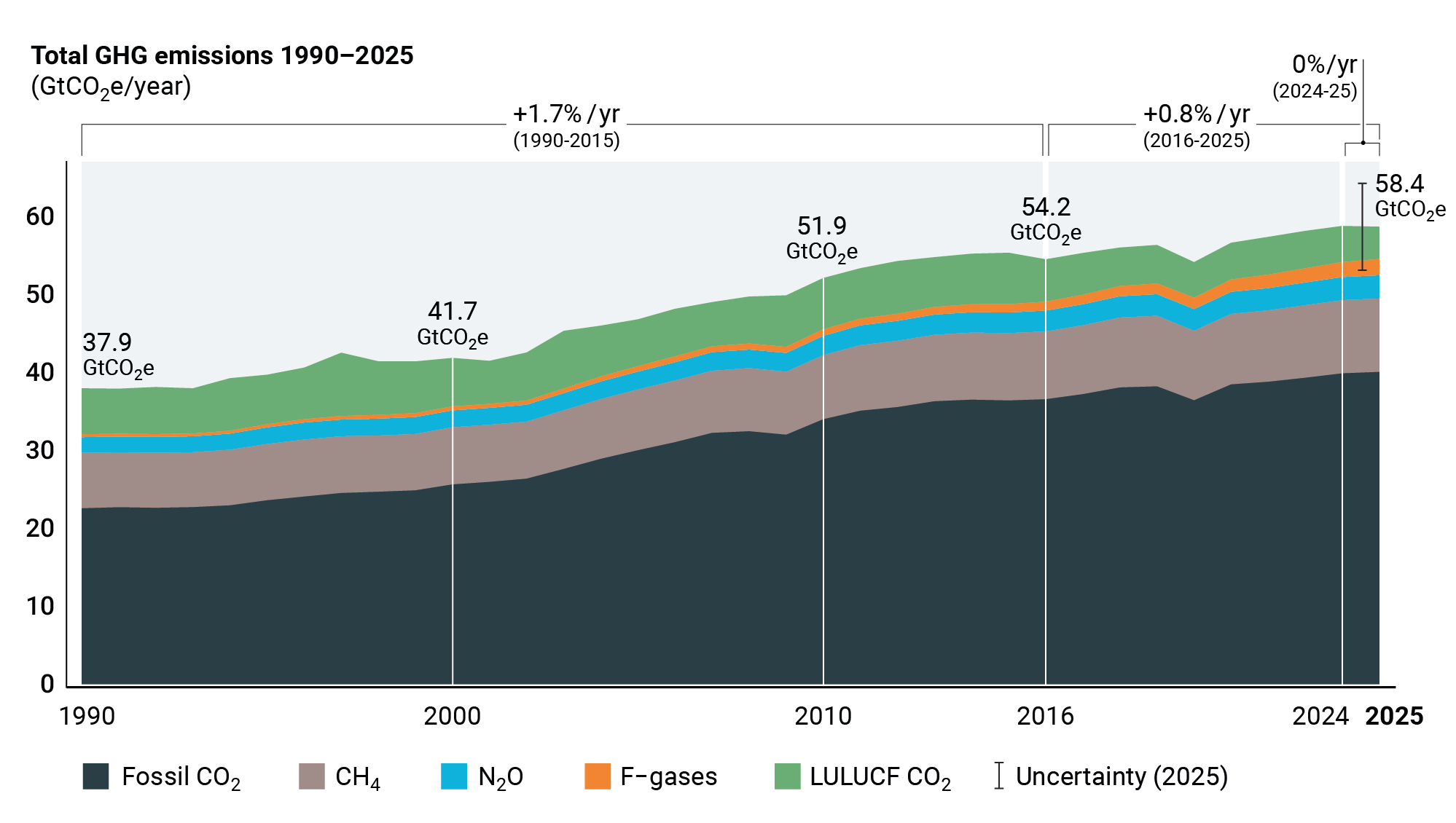 Chart: UNEP emissions gap report (2026)
Year on year, fossil-fuel emissions rose only slightly, by between 0.4-1.1%. Nitrous oxide and fluorinated gases grew faster, but because those gases comprise such a small share of the total, their contribution to the overall trend is relatively less significant. Methane emissions held steady. A reduction in CO2 emissions from land use, land-use change and forestry (LULUCF) slightly overcompensates for the rise in fossil-fuel CO2 and other gases.
That LULUCF decline was partially driven by fewer wildfire emissions, particularly in Africa, South America and parts of south-east Asia — decreases the report says were likely connected to the ceasing of El Niño conditions. The ongoing super El Niño is expected to push LULUCF emissions up again in 2026, a reminder that land-sector accounting can reverse without any change in policy.
On country attribution, the analysis excludes LULUCF because national inventories lag. Among the six largest emitters, only the US recorded a notable increase: emissions grew by 133m tonnes of CO2e (MtCO2e) in 2025 on higher electricity demand and a rebound of coal power, combined with a colder winter and higher gas prices. China, the EU, India, Russia and Indonesia were relatively flat.
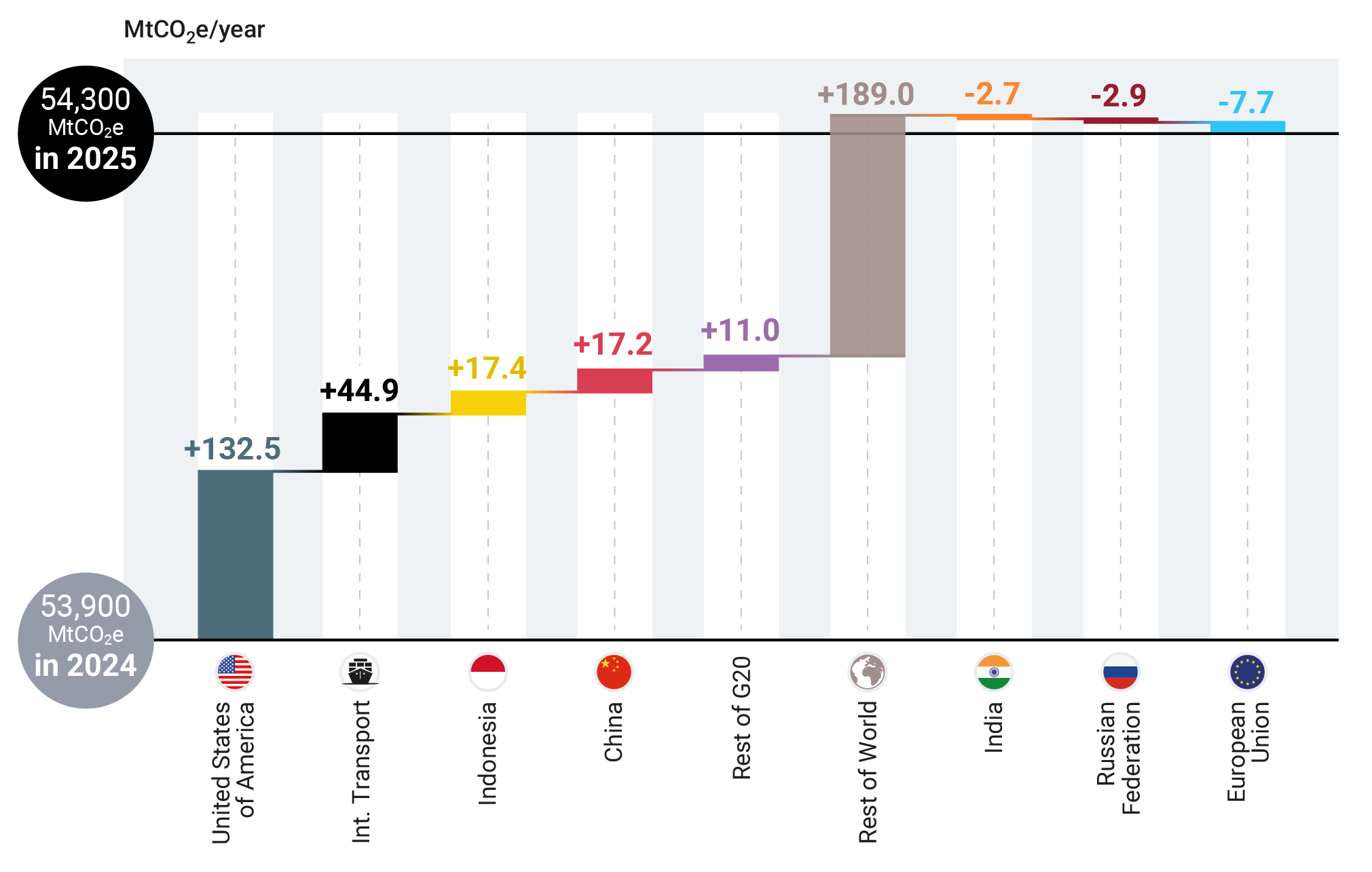 Chart: UNEP emissions gap report (2026)
Across most sectors, progress towards decarbonisation has been modest, with the clearest decreases in power and transport, driven by solar deployment and electric vehicles. The report is blunt about the limits: “There are emerging signs of transport sector electrification and decarbonisation, but at rates and levels that are not yet sufficient to drive emissions reductions at the global level.” International aviation and shipping continue to grow transport emissions.
On the artificial-intelligence question the report is deliberately precise: electricity demand from data centres is projected to double by 2030, yet data centres at present account for less than 1% of total emissions. The IEA’s Energy and AI tracking (iea.org) places data-centre consumption on a path from about 485 TWh in 2025 to roughly 950 TWh in 2030, near 3% of global electricity. Read together, the two figures give a practical rule: the compute build-out is a grid-planning and power-procurement exposure now, and only later a material line item in a corporate carbon ledger.
3. Step two: work the NDC pipeline, because it defines your 2035 policy environment
All countries were meant to submit new UN climate pledges for 2035 — the third nationally determined contributions (NDCs) under the Paris Agreement — by February 2025. 95% of nations missed that deadline. Many arrived instead at the UN climate summit in New York in September 2025 and at the COP30 climate summit in Brazil in November 2025.
By the end of COP30, 122, or 63%, of countries had produced their third NDCs; the report records 124 by 1 September 2026, with pledges covering 75% of global emissions. That is more than double the number available to the 2025 edition, providing a more robust basis for assessing collective progress and ambition toward 2035.
Coverage is only half the audit. Although the first global stocktake asked for targets covering all greenhouse gases, only eight countries included such gas targets for the first time, taking the total number of parties with them to 155. Third NDCs increasingly use more robust and verifiable target formulations, such as standardised baselines, but they have not meaningfully broadened the scope of sectors and gases covered by the targets.
Numbers first, then consequences: full implementation of the third NDCs would lower global emissions in 2035 by 3.5GtCO2e compared with 2030-only targets, which is far from the global reductions needed to get on track to achieving the long-term temperature goal of the Paris Agreement — the cuts are, in the report’s phrasing, far from what is needed. Relative to the 2025 edition, projected 2035 emissions under the third NDCs are about 3GtCO2e higher, driven by the formal withdrawal of the US from the Paris Agreement and by harmonising projections with the latest historical emissions data.
Watch how the gap moves, not just where it lands. The global implementation gap for 2030 — the difference between projected emissions under current policies and emissions if countries implemented their NDCs in full — has narrowed year on year, but mainly because the US withdrew from the Paris Agreement. In the report’s own logic, that is policy changes, not policy progress. With the 2030 and 2035 implementation gaps of similar size, the evidence suggests enhanced collective ambition of 2035 NDCs is weak. Some 14 of the 17 G20 nations, counting the EU as one, have submitted 2035 emissions targets, yet most G20 emissions trajectories remain misaligned with their net-zero targets: all G20 members except Japan, the EU and UK would need to accelerate their emission reduction rates based on current policies to reach net zero.
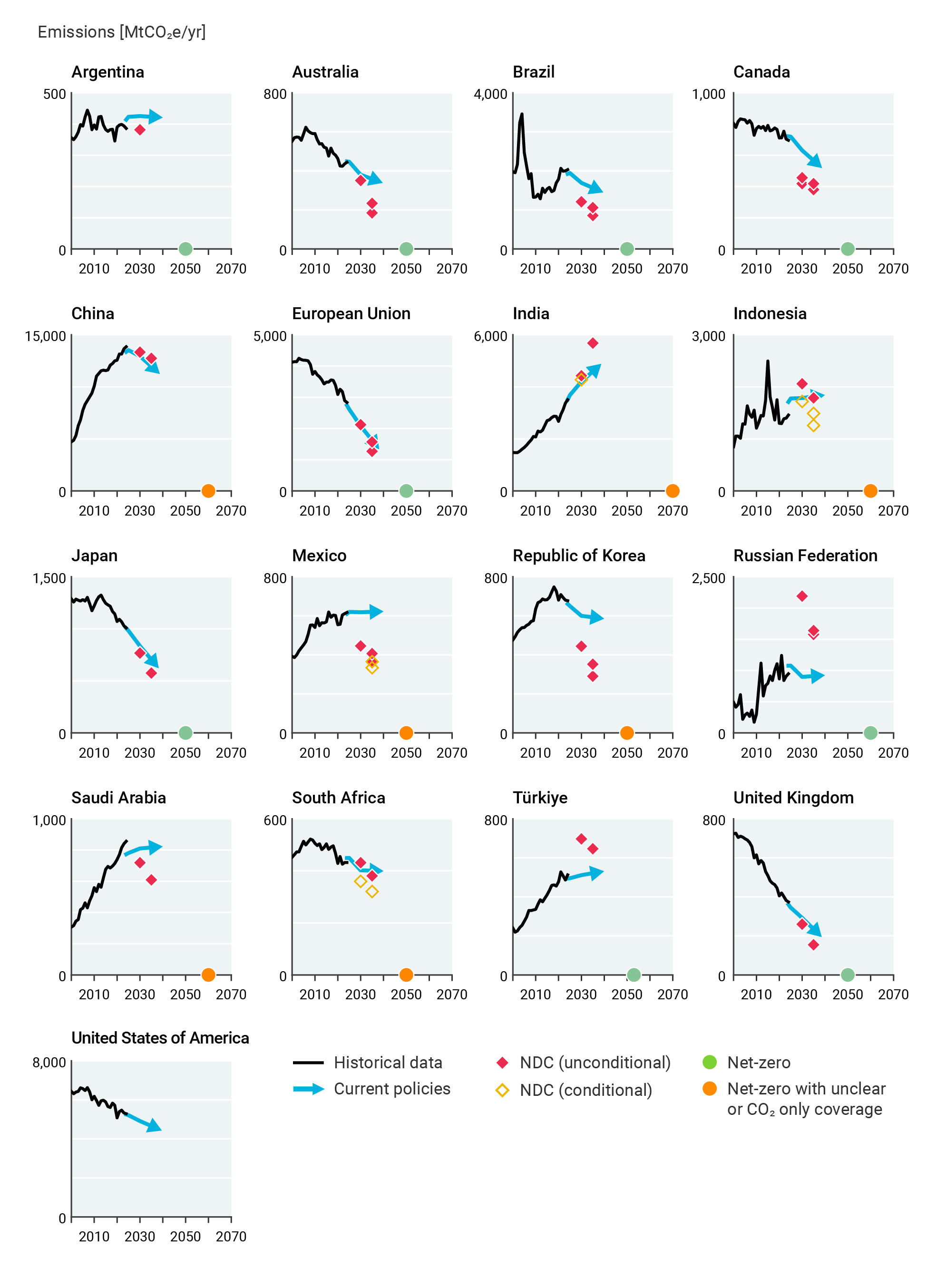 Chart: UNEP emissions gap report (2026)
Practical due diligence on each host-country NDC:
- Gases covered — is it CO2-only or all greenhouse gases, and which fluorinated or agricultural gases are excluded?
- Baseline type — absolute, intensity, or a standardised baseline; and whether the base year already embeds the reductions you claim.
- Sectoral reach — does the pledge touch power, industry, transport, buildings, waste or land use in your operating jurisdictions?
- Conditionality — is your host pledge unconditional, or dependent on external finance that may never arrive?
- Alignment test — does the current-policy trajectory beat or lose to the net-zero date the same government announced?
4. Step three: decode the scenario architecture — three NDC pathways, two extensions, two reference tracks
The emissions gap measures the distance between projected emissions if all NDCs are met and what the Paris long-term temperature goal requires. It is still large, but its meaning depends entirely on which scenario set is being quoted. The report’s three core NDC scenarios are:
- A current policy scenario, projecting emissions only from policies adopted and implemented as of November 2025.
- An unconditional NDCs scenario, assuming full implementation of the most recent NDCs that do not depend on external support, with a cut-off date of 1 September 2026.
- A conditional NDCs scenario, adding NDCs that depend on external support such as climate finance from wealthier countries, on the same cut-off date.
Two scenario extensions push past 2035:
- Current policies continuing — follows current policies to 2035 and assumes a continuation of similar efforts thereafter.
- Conditional NDCs plus all net-zero pledges — the most optimistic scenario included, running the conditional NDC scenario to 2035 and then all net-zero or other long-term low emissions development strategies thereafter, excluding that of the US.
Earlier editions compared these against pathways holding warming below 2C and 1.8C, or 1.5C with no more than 0.1C of overshoot, drawn from the scenario database behind the Intergovernmental Panel on Climate Change’s (IPCC) sixth assessment (AR6). Those scenarios were developed around 2015-20 and assumed the world would pursue immediate cuts from about 2020. Emissions instead kept rising — they are currently around 80% above the level that would have been needed by 2030 to limit warming to 1.5C with no or low overshoot. Because of decades of insufficient emission reductions, that possibility has now been lost; the right-hand panel of the chart below shows what the authors call the unbridgeable gap to those older 1.5C pathways.
The 2026 report therefore draws on a new generation of pathways in which ambitious mitigation action starts from 2025:
- A below 2C scenario, consistent with keeping warming below 2C throughout the 21st century with at least a 66% chance.
- A lowest 1.5C overshoot scenario, holding warming to 1.7-1.8C throughout the century with a 66% chance and returning it to 1.5C by 2100 with a 50% chance.
These updated scenarios reflect the failure to cut global emissions to date. The overshoot pathway minimise[s] both the magnitude and duration of overshoot above 1.5C while meeting a defined set of feasibility and sustainability guardrails — for example balancing the demands of bioenergy and large-scale carbon removal against biodiversity and food security needs.
The instruction to minimise is no longer scientific housekeeping only. It mirrors the diplomatic wording of the Global Mutirão package of measures agreed at the COP30 climate summit in Brazil in 2025, which acknowledged for the first time in a COP text that a 1.5C overshoot was likely and urged that both its extent and duration needed to be limit[ed] (unfccc.int, document FCCC/PA/CMA/2025/L.24). Expect that language to migrate into national plans, permitting tests and procurement criteria.
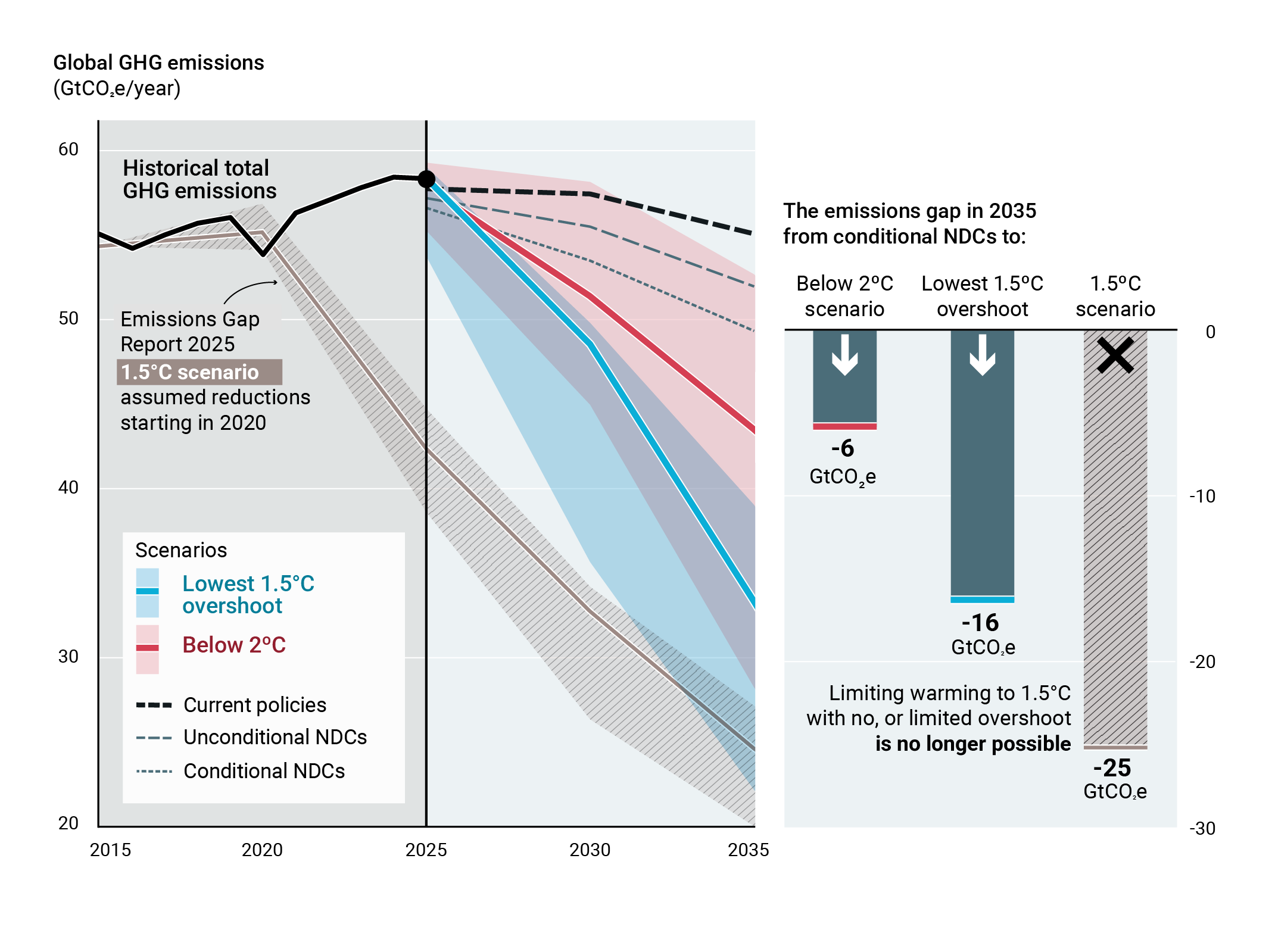 Left: projected emissions under the NDC scenarios and the two reference pathways to 2035. Right: the 2035 gap to the conditional NDCs. Chart: UNEP emissions gap report (2026)
Staying on the lowest 1.5C overshoot path requires immediate, deep, rapid and sustained reductions: global greenhouse gas emissions would need to fall 18% by 2030, 45% by 2035 and 69% by 2040 relative to 2025 levels, with global net-zero CO2 emissions reached around 2050. These benchmarks effectively replace the AR6 numbers of 43% by 2030 and 60% by 2035 relative to 2019 levels — figures still embedded in COP decisions and corporate pledges. With ongoing uncertainty around the timeline for the IPCC’s seventh assessment reports, the UNEP benchmarks are the working reference. For the 2C scenario, cuts of 11% by 2030, 24% by 2035 and 37% by 2040 relative to 2025 would suffice.
| Benchmark set | Reference year | 2030 cut | 2035 cut | Status for policy users |
|---|---|---|---|---|
| IPCC AR6, 1.5C with no or low overshoot | 2019 | 43% | 60% | Still cited in declarations; treated as outdated by UNEP |
| UNEP 2026 lowest 1.5C overshoot | 2025 | 18% | 45% | Live benchmark for a credible return path |
| UNEP 2026 below 2C | 2025 | 11% | 24% | Floor scenario for national plan review |
| Unconditional NDCs today | 2025 | 5-8% | 11-15 % | The policy reality teams must price against |
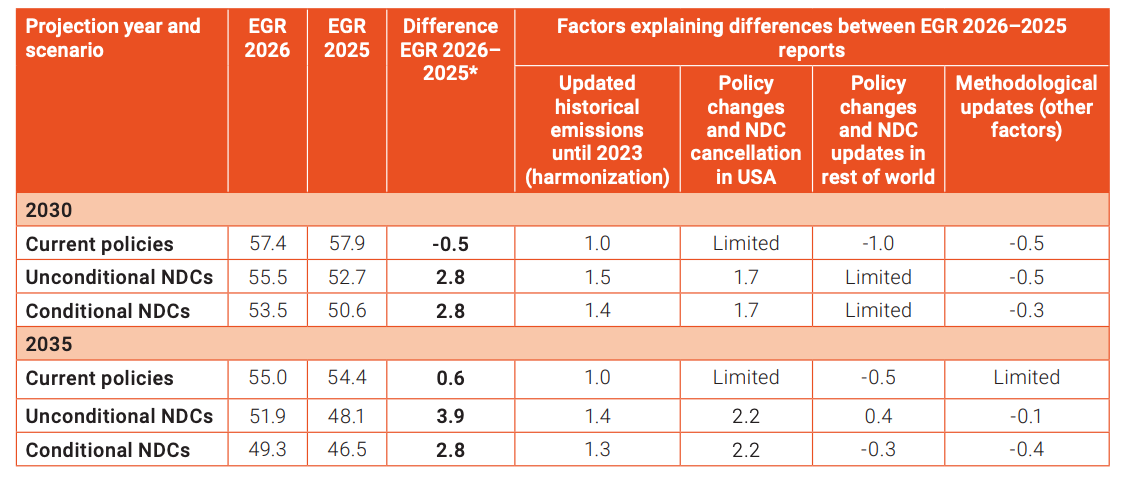 Chart: UNEP emissions gap report (2026)
Two cautions for anyone quoting these gaps. First, because the 1.5C and 2C reference scenarios have changed, the 2026 emissions gaps are not directly comparable with previous reports. Second, the annual rate implied by the return pathway is steep: putting the world on track for the lowest 1.5C scenario would require global emissions to fall 5.7% per year over the next decade — even more rapid than the 5% annual drop that a no-overshoot pathway would have demanded had cuts started in 2019.
That steepness makes the removals assumption the weakest link, and it is worth sizing. The third edition of the State of Carbon Dioxide Removal assessment, published in June 2026 by Oxford’s Smith School of Enterprise and the Environment with the Potsdam Institute (smithschool.ox.ac.uk), puts novel — non-forestry — removals at only about 2 million tonnes of CO2 per year in 2025, albeit growing around 40% annually, while total CDR of roughly 2.2 billion tonnes would need to reach some 8.75 billion tonnes by 2050, leaving a shortfall near 5 billion tonnes a year. In other words, the return leg of the overshoot pathway depends on a supply of verified removals that does not yet exist at scale. Treat removals as a supplement to cuts, never as a substitute, and apply the same scrutiny to permanence and accounting standards as you would to an offset claim.
5. Step four: convert temperature outcomes into compliance triggers
To link emission pathways to temperature, the report uses a simple climate model, or emulator, called FaIR. The outputs below are the numbers most often quoted in regulatory impact assessments:
- Current national policies: 2.8C of warming this century with a 66% chance, and a 10% chance of exceeding 3.4C.
- Unconditional NDCs implemented: 2.7C with a 66% chance.
- All NDCs fully implemented: 2.6C by 2100 with a 66% chance.
- Most optimistic case — NDCs plus net-zero targets: a 66% chance of limiting warming to 2.1C.
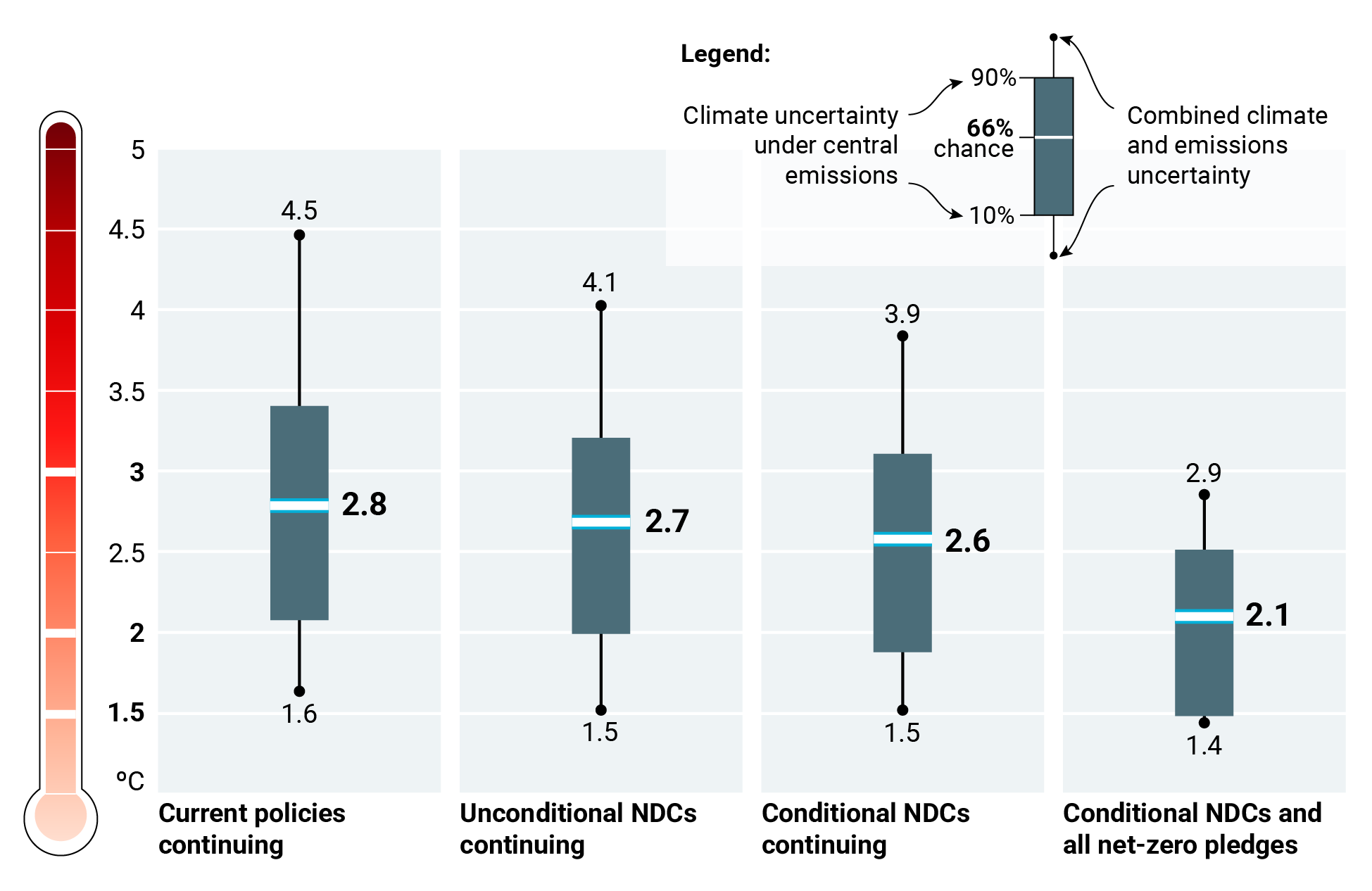 Boxes show the 10-90% range around central estimates; whiskers combine emissions and Earth-system uncertainty. Chart: UNEP emissions gap report (2026)
Central 2100 estimates for the NDC scenarios are about 0.2-0.3C higher than last year, again because projected emissions under the 2035 NDCs rose with the US withdrawal and higher historical emission estimates. Fully implementing all NDCs and net-zero pledges would still cut warming by 0.6C — yet that outcome remains 0.25C above the lowest 1.5C overshoot pathways. The report highlights the need both to close the implementation gap between current policies and existing NDCs and net-zero pledges, and to strengthen NDCs or exceed existing commitments.
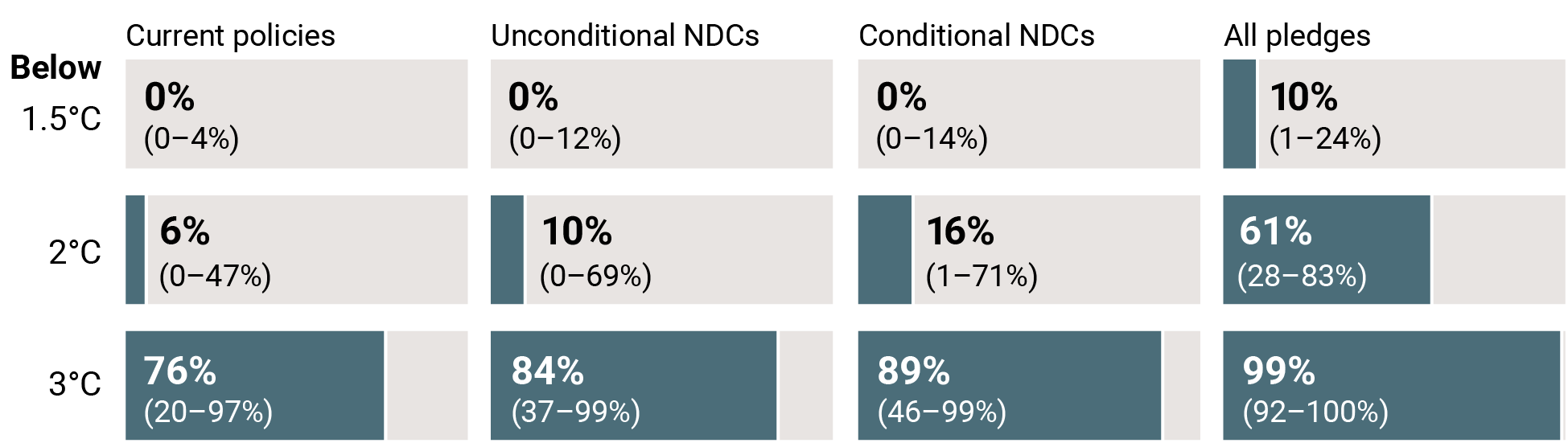 Likelihood of holding warming to 1.5C, 2C and 3C under current policies, unconditional NDCs, all NDCs, and NDCs plus net-zero pledges. Chart: UNEP emissions gap report (2026)
With immediate, deep, rapid and sustained emission cuts it would still be possible to cap peak warming at 1.7-1.8C with a 66% chance; combined with an ambitious and sustainable scale-up of CO2 removal, warming could be returned to 1.5C by the end of the century. Continued delay, however, would further worsen the climate outcomes still achievable. As the authors put it: “For every five years of delay in starting to cut emissions, around another 0.1C of warming will be locked in.” And: “Continued insufficient emission reductions over the next decades could make warming of 2C inevitable, putting the Paris Agreement at risk of failure.”
How to use this in a filing: map your asset exposure to the policy scenario you operate in rather than the aspirational one. A jurisdiction whose trajectory is misaligned with its net-zero date is a jurisdiction where regulation will tighten late and fast — the 0.1C-per-five-years rule of thumb is, in risk terms, a compounding penalty for waiting.
6. Step five: read the global stocktake scorecard as an early-warning system
The report also measures the world against the mitigation actions set out in the first global stocktake, agreed at the COP28 climate summit in Dubai in 2023. The global stocktake is the Paris mechanism that reviews collective progress, and each cycle is meant to trigger higher ambition.
Against the nine mitigation action areas agreed in that outcome, the verdict is “Uneven and insufficient”. Yet the report also flags several remarkable examples of progress that exceeded expectations. Deployment of renewable energy ran far ahead of the projections made in 2015 under then-current policies: overall renewable capacity growth was three times higher than expected, and as a result CO2 emissions related to energy generation increased 40% less than projected.
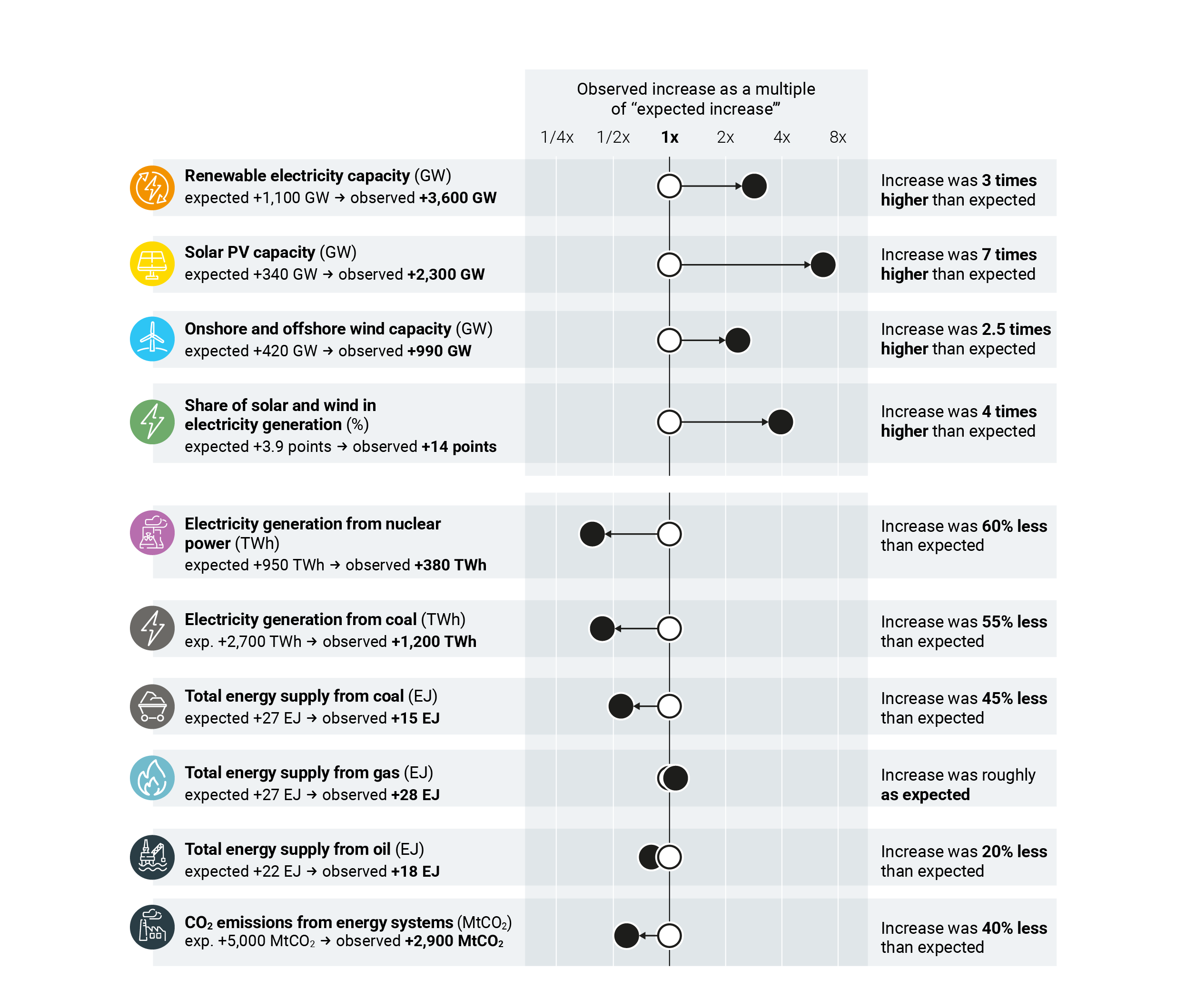 Source: UNEP emissions gap report (2026)
For planning purposes the pattern is instructive: the areas where policy already exists and technology curves bend are the ones that deliver, and the report’s conclusion that “only renewables are on track for 2030…though continued adoption and implementation of supportive policies will be required to sustain such growth” is a warning that a single outperforming sector cannot carry the rest. Other areas are lagging particularly far behind, which is precisely where carbon-pricing scope, mandates and phase-down rules tend to land next.
Common misconceptions to strip out of your next memo
- “Overshoot ends the Paris Agreement.” No: the 1.7-1.8C pathway remains still aligned with the long-term temperature goal of the Paris Agreement, provided the return leg is credible.
- “A flat year proves a peak.” The 2025 figures are provisional, so it is not possible to conclude on the overall direction of emissions in 2025.
- “A narrower implementation gap means better policy.” This year it reflects policy changes, not policy progress.
- “43% by 2030 off 2019 is still the corporate benchmark.” The reference year and the required rate have both changed.
- “Data centres are a top emissions driver.” They are below 1% of total emissions, though their electricity demand is projected to double.
- “Removals can fill the gap.” The return pathway assumes them; the market does not yet supply them at scale.
Case in point: a metals exporter selling into the EU
Consider a steel or aluminium producer shipping into the European Union. The bloc’s Carbon Border Adjustment Mechanism moved into its definitive regime on 1 January 2026, according to the European Commission’s CBAM guidance (taxation-customs.ec.europa.eu): importers act as authorised CBAM declarants and must report embedded emissions on verified actual data rather than the default values used during the transitional phase. Now layer the UNEP findings on top. Because 95% of countries missed the February 2025 NDC deadline, and because most G20 trajectories remain misaligned with net-zero targets, the price of carbon and the stringency of industrial policy will diverge sharply between jurisdictions through 2035. In practice that means a mill-level data chain — metering, allocation, verification lead times, contractual audit rights — becomes the commercial determinant of market access, not the group-level net-zero slogan. Teams that treat border measures as a reporting task tend to discover, one compliance cycle late, that the constraint is production data quality.
A 12-month action list
- Rebase your science target onto a 2025 reference year and test it against 18% by 2030 and 45% by 2035, not the AR6 pair.
- Inventory every operating jurisdiction’s third NDC: gases covered, baseline type, conditionality and sectoral reach.
- Separate the power-system exposure of data-centre and electrification load from your Scope 2 accounting, and model both.
- Stress-test capital plans at 2.6C and 2.8C policy outcomes, and disclose which scenario drove the assumptions.
- Price the land-use and climate-feedback volatility that provisional LULUCF swings can introduce into offset portfolios.
- Build verified removals volumes into procurement only as a supplement, with permanence criteria written into the contract.
- Pre-position for border measures: mill-level emission data, recognised verification, and audit clauses upstream.
- Track the nine global stocktake areas quarterly as a regulatory early-warning panel, not an annual summary.
- State explicitly in reports that your 1.5C claim now means “within an overshoot and return pathway”, and define the return logic.
- Assign an owner to each gap — implementation, ambition, and the residual emissions gap — with reporting deadlines.
FAQ
What does “overshoot” actually mean here?
A pathway in which global warming first exceeds the 1.5C limit and is then brought back down through techniques that remove carbon from the atmosphere. UNEP’s judgement is that overshoot is now inevitable after decades of insufficient climate action, so the governing variable becomes its magnitude and duration.
Why were the older 1.5C benchmarks dropped?
Because the AR6-era scenarios assumed cuts beginning around 2020, and emissions instead rose to about 80% above the 2030 level those pathways required. The report’s no or low overshoot reference therefore became unattainable, and the new generation of pathways starts from 2025.
What is the difference between the emissions gap and the implementation gap?
The emissions gap compares projected emissions with what the Paris long-term temperature goal requires. The implementation gap compares a country’s projected emissions under current policies with the emissions expected if it implemented its NDCs in full. The first measures ambition; the second measures execution.
Do companies still need to plan around 1.5C?
Yes — but the framing changes. The report states that countries can still limit peak warming, shorten the duration of overshoot and keep the goals of the Paris Agreement within reach, and that the peak pathway at 1.7-1.8C is still aligned with the long-term temperature goal of the Paris Agreement. A corporate 1.5C claim now needs to show how it contributes to the return leg, including where removals enter the plan.
What should a compliance team do first?
Rebase, then reconcile. Rebase targets to a 2025 reference year using 18% by 2030 and 45% by 2035; then reconcile what your host governments have pledged against what their current policies actually deliver — the difference is where new carbon-pricing, disclosure and border obligations will appear.
Bottom line for policy and compliance owners
The 1.5C conversation has moved from prevention to management: overshoot is the assumption, return is the obligation, and the five-year delay penalty is the clock. For GreencarbonWorld readers working in climate policy and carbon governance, the practical consequence is that the next 24 months of decisions — NDC implementation, stocktake follow-ups, border carbon measures and removals procurement — will be judged against a return pathway rather than a pledge. The teams that rebuild baselines now, verify their data chains early and separate ambition gaps from execution gaps will be the ones whose filings survive the shift; those that quote the old benchmarks will find themselves explaining a number that science has already retired.