
UK climate finance compared: £12.8bn outturn, the £11.6bn target and the new around £6bn three-year pledge
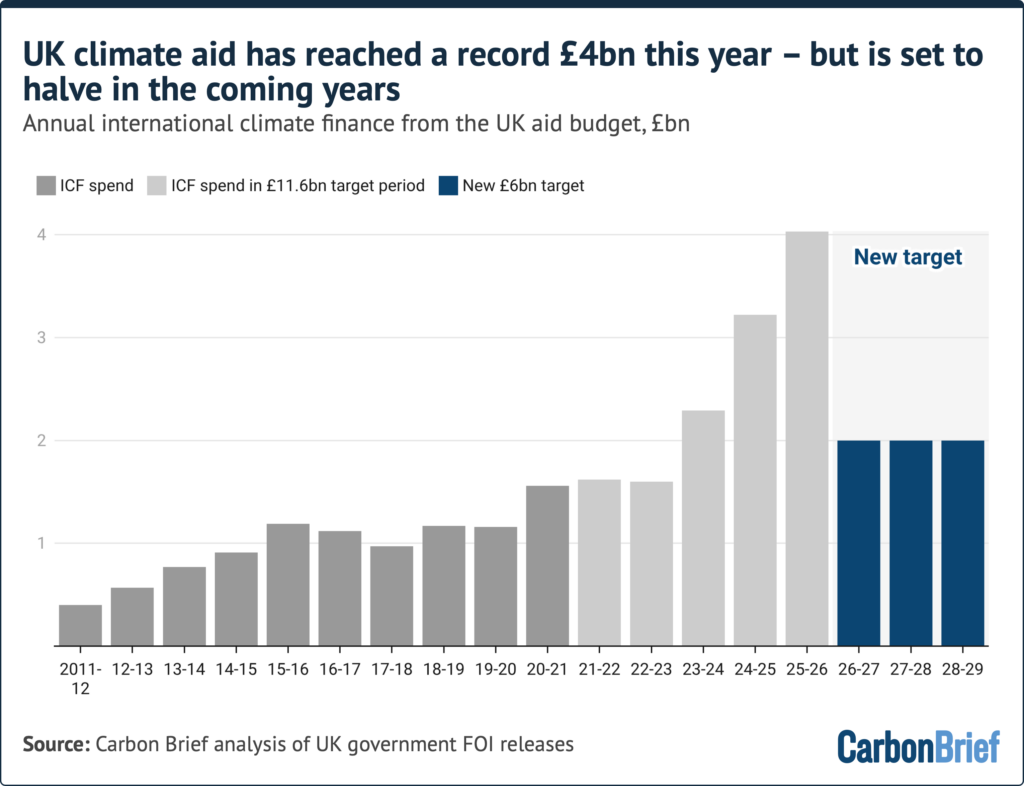
For anyone tracking donor-side policy, the interesting news in the latest release is not the headline total but the change of architecture behind it. Official figures obtained by Carbon Brief through freedom-of-information requests show £12.8bn of UK climate aid spent in support of developing countries since 2021 — including a record £4bn in 2025-26 and the same total logged this year, across roughly 500 aid projects over the past five years, reaching everything from solar projects in Mozambique to carbon offsets in the Amazon. On paper the £11.6bn pledge was cleared, though Carbon Brief's analysis attributes part of that outcome to “questionable accounting”. At the same time, the UK government has replaced the five-year model with a commitment of “around £6bn” over three years, plus £6.7bn drawn from outside the aid budget. This ClimatePolicy brief puts the two frameworks side by side, compares the delivery channels and the accounting logic behind them, and converts the differences into decision points for compliance, ESG and project-finance readers of GreencarbonWorld.
Framework A versus Framework B: what actually changed
The clearest way to read the dataset is as a comparison of two policy regimes. Framework A is the pledge made in 2019: spend £11.6bn of the aid budget on climate finance between 2021-22 and 2025-26, the UK's contribution to the international goal of mobilising $100bn a year between 2020 and 2025. Framework B is the decision announced by the Labour government in March 2026 to spend “around £6bn” of aid as climate finance over the next three financial years, alongside £6.7bn from outside the aid budget to “drive climate and nature outcomes”.
| Decision dimension | Framework A (2021-22 to 2025-26) | Framework B (from 2026-27) |
|---|---|---|
| Headline figure | £11.6bn over a five-year period; outturn £12.8bn | around £6bn, i.e. roughly £2bn a year |
| Dominant instrument | Grants, including direct cash transfers | Private investment, export credit, guarantees to development banks |
| Counting logic | Aid budget, widened by reclassifying £2.2bn as climate finance | Aid budget plus £6.7bn that was never counted before |
| Real-terms trajectory | £4bn peak, tenfold the 2011-12 starting point | Approximately half of the 2025-26 level, before inflation |
| Best suited to | Humanitarian resilience, phase-out of fossil-fuel dependence | Bankable infrastructure, carbon markets, “mobilising” private capital |
| Main exposure | Back-loading and weak year-by-year disclosure | Dependence on commercial risk appetite in low-income markets |
Two comparative readings matter most for users of the numbers. On timing, the UK's independent aid watchdog found in a rapid review of international climate finance published in February 2024 that 55% of the £11.6bn was still planned for the final two years of the commitment (icai.independent.gov.uk) — which made the record year of 2025-26 largely foreseeable and suggests spend was concentrated to clear a deadline rather than smoothed across programmes. On scale, the £4bn total is, before inflation, a tenfold increase on 2011-12, when the UK began providing climate finance; once the £2.2bn reclassification and price effects are stripped out, “around £6bn” over three years reads as a much sharper contraction than the nominal figures imply.
The global benchmark moves in the opposite direction. The OECD records that climate finance provided and mobilised by developed countries reached USD 132.8 billion in 2023 and USD 136.7 billion in 2024 (oecd.org), while the successor goal agreed at COP29 in Baku sets a floor of $300bn a year by 2035 and an aspirational $1.3tn (wri.org). Alongside other major donors such as the US, the UK has cut its aid budget sharply, straining its climate finance; measuring its two pledges against these external targets is the fairest way to judge whether the shortfall is a UK policy choice or a donor-country pattern.
Around 500 climate projects: three archetypes, three risk profiles
Between 2021-22 and 2025-26, the FOI data show at least 493 projects, funds and institutions receiving UK climate finance — in practice around 500 climate projects. Sorting them into three delivery archetypes is more useful for risk assessment than ranking them by size:
- Direct resilience spending: £45m to help Ukraine curb its reliance on fossil fuels, £40m in cash transfers for drought-affected Kenyans and £30m to provide flood resilience in Nepal. Highest attribution clarity, lowest leverage on private capital.
- Standards-building through multilateral programmes: £198m channelled by the UK into a World Bank-backed project helping Colombia, Cambodia and others create and sell “high-integrity” carbon offsets. Small public spend, aimed at shaping rules rather than delivering tonnes directly.
- Blended-finance vehicles: £229m to a group using foreign aid to attract private capital for projects in mainly low-income nations, including a solar farm in Uganda and a “sustainable aviation fuel” project in Pakistan. This is the archetype Framework B leans on hardest — and the most sensitive to interest rates, currency risk and insurance costs.
Corporate readers will find the second and third archetypes the most consequential: they shape the pipeline of credits, guarantees and project equity that offtakers and lenders will price in the next cycle.
Bilateral or multilateral: reach, traceability and reputational exposure
Most UK climate finance was delivered “multilaterally”, supporting large funds or institutions that work across several countries. More than 80% of the funding since 2021 is therefore recorded as helping “developing countries” generally, or whole regions such as “Africa”. Of the £2.1bn, or 17%, delivered “bilaterally” — where the UK directly supports climate projects in specific countries — the biggest beneficiaries are nations in east Africa and south Asia, and Around two-thirds goes to countries classified as “least developed”.
| Criterion | Multilateral route | Bilateral route |
|---|---|---|
| Coverage | Regional and thematic programmes, most of the £12.8bn | £2.1bn, country-named and easier to cite |
| Traceability for a third party | Depends on each fund's own reporting | Project-level, but tagging rules can dominate |
| Speed under fiscal stress | Absorbs cuts through “core” contributions | Cuts bite project by project |
| Reputational exposure | Delegated to fund governance | Directly attributed to the UK government |
The bilateral league table is where the accounting argument concentrates. Ethiopia was the top recipient of bilateral UK climate finance for many years, largely because of long-running projects supporting ecosystem restoration and drought resilience. Afghanistan overtook it across the £11.6bn period, with £256m of its aid labelled as climate-related, compared with Ethiopia's £226m; the UK does not provide aid via the Taliban, channelling it through partners such as UN agencies. Afghanistan faces floods and low electricity access, but the apparent surge in UK support is not driven by new climate initiatives — it follows a controversial accounting change under which 30% of aid for all humanitarian projects in that country is automatically tagged as climate finance. The shift also lifted other climate-vulnerable and war-torn nations into the top group: Somalia (£139m), Sudan (£136m) and Yemen (£130m) all appear among the largest “climate aid” recipients.
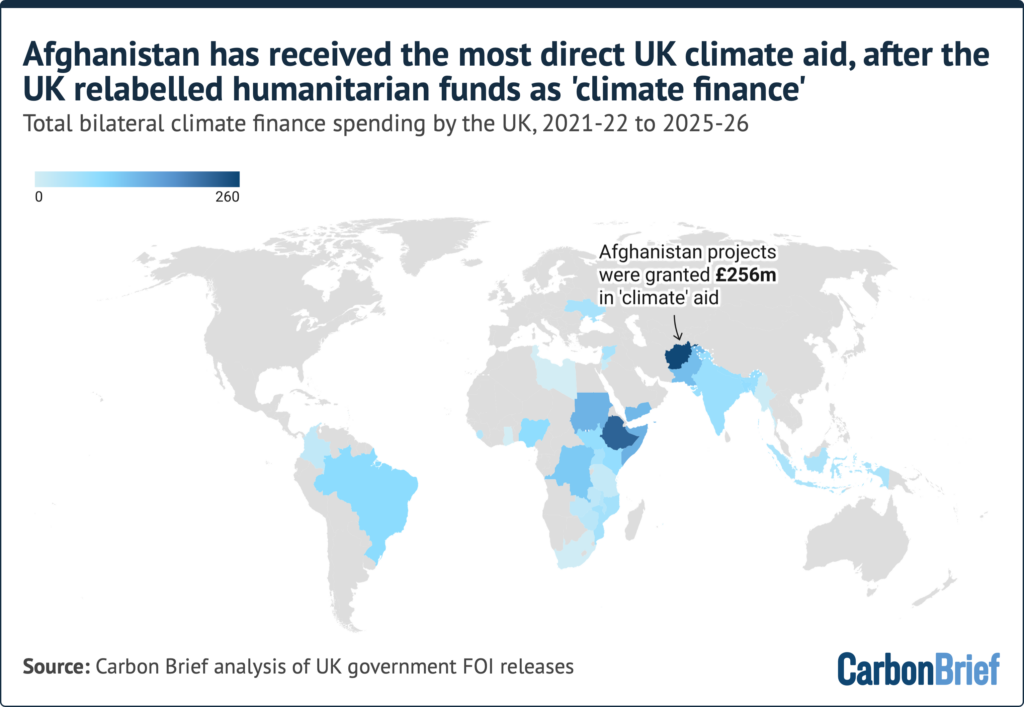
Where the UK put large sums into middle-income countries, the aim was typically “mobilising” private-sector investment rather than humanitarian outcomes — for example £83m to support Brazil's Amazon Fund, a carbon offsetting initiative, and £43m to boost UK investment in India's low-carbon infrastructure.
Who took the biggest slices: £1.5bn to the Green Climate Fund, almost £1.4bn to BII
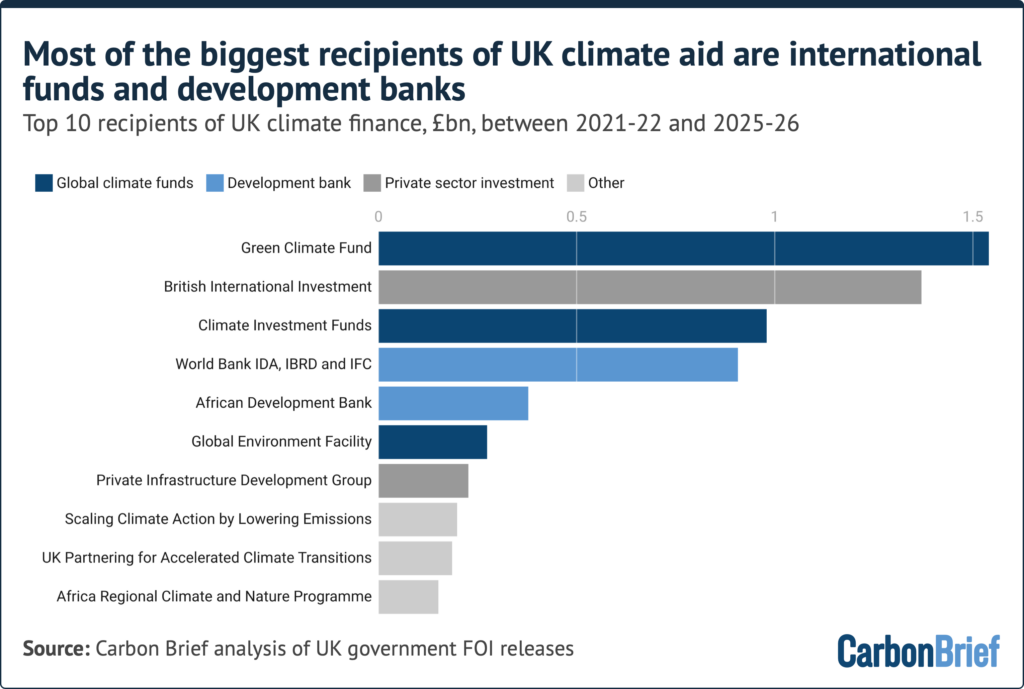
UK climate finance was concentrated in the largest chunks passed through international climate funds and other bodies, which then support projects in developing countries. Despite recently cutting its 2024-27 support for the Green Climate Fund, the UK still provided £1.5bn to this flagship UN fund, more than any other initiative. British International Investment, or BII — a publicly owned, for-profit company investing in developing-country businesses and partially supported with UK aid money — received almost £1.4bn. The UK has relied increasingly on BII to meet its climate-finance goals, partly reflecting the body's decision to prioritise clean-energy investments rather than fossil fuels. Other major recipients are multilateral development banks, particularly various arms of the World Bank and the African Development Bank, reflecting a decision to start counting “core” funding for these banks as climate finance. Campaigners, MPs, experts and the UK's aid watchdog have criticised these accounting changes, which boosted the significance of BII and MDBs; the House of Commons International Development Committee's September 2026 report on international climate finance amid a shrinking aid budget repeats the call for trackable annual reporting (publications.parliament.uk).
Three questions to ask before quoting the number
- Is it incremental? The £11.6bn target was met only because the government reclassified £2.2bn of existing foreign aid as climate finance, without spending any more.
- Is it tagged or targeted? A flat 30% share of humanitarian aid can count as climate finance, which is why the ranking of bilateral recipients moved without new programmes appearing.
- Which vintage am I reading? Figures go to the UN routinely but with a two-year delay, are not split by financial year, and have been revised repeatedly — this comparison rests on final figures supplied via FOI requests in recent months.
Common misconceptions
- “The pledge failed.” It did not: £12.8bn was provided over the five-year period against the £11.6bn goal.
- “Every pound is new money.” Reclassification worth £2.2bn sits inside the total.
- “Higher spending means more adaptation on the ground.” Channel mix and tagging rules, not cash alone, determine what a community receives.
- “Framework B simply doubles down on aid.” The £6.7bn committed from outside the aid budget is mainly investment, export credit and guarantees — instruments with different conditionality and different failure modes.
Decision checklist for compliance, ESG and project teams
- Re-baseline pipeline assumptions: a pledge averaging £2bn a year is roughly half the 2025-26 outturn, so grant-dependent partners need alternative financing.
- Separate grant programmes from blended vehicles in your stakeholder mapping — the latter survive cuts better but come with currency, offtake and insurance conditions.
- For buyers of carbon assets, note that public money here was aimed at “high-integrity” supply via World Bank-backed and Amazon Fund channels; the rules for internationally transferred credits under Article 6 of the Paris Agreement, administered by the UNFCCC's crediting mechanism, are the reference standard for quality claims (unfccc.int).
- Do not import donor accounting into your own disclosures: tagged humanitarian shares are not climate-specific spend, and mixing the two is the fastest route to a greenwashing challenge.
- Diary the disclosure calendar: the UK publishes international climate finance results annually on GOV.UK, with the 2026 edition scheduled for 4 November 2026 (gov.uk), and reports to the UN on a two-year delay.
- Treat UK allocations as a proxy for wider donor behaviour: CARE International analysis has concluded that other major climate-finance donors, including Germany and France, are also seeing flows fall after aid cuts (carbonbrief.org).
FAQ
Was the £11.6bn target met, and how?
Yes — because £12.8bn was provided over the five-year period. Carbon Brief's analysis, however, shows the goal was reached only after £2.2bn of existing aid was reclassified, a practice it describes as “questionable accounting”.
Why does around £6bn read as a cut?
It is framed as around £6bn over three years, or about £2bn annually — roughly half the £4bn achieved in 2025-26, before inflation is taken into account.
What is the £6.7bn from outside the aid budget?
Support that will take the form of private investments, export credit and guarantees to development banks, pledged alongside the £6bn in climate aid to “drive climate and nature outcomes”. The UK already provides such finance, but it was not previously counted towards climate-finance targets.
Why is Afghanistan the largest bilateral recipient?
Not because of new climate work: an accounting change automatically labelled 30% of UK humanitarian aid there as climate finance, giving £256m — ahead of Ethiopia's £226m — with money routed through UN agencies rather than the Taliban.
Who funds UK climate finance?
Four departments, with the Foreign, Commonwealth and Development Office (FCDO) providing three-quarters of the total, the remainder predominantly from the Department for Energy Security and Net Zero (DESNZ) and much smaller sums from the Department for Environment, Food and Rural Affairs (Defra) and the Department for Business, Innovation, Science and Trade (BIST).
How the figures were compiled
All international climate-finance data used here was obtained via FOI requests and assembled by Carbon Brief into a spreadsheet; the organisation has tracked this information periodically since 2017. BIST has separately released a dataset covering hundreds of climate-science projects in, or benefiting, developing countries that have been supported with UK climate funds. UK climate-finance figures are subject to regular revisions, so departments may still alter them in future releases — a further reason to record the vintage of any figure used in a filing or a report.
The takeaway for readers of this column is that the UK has not simply spent less; it has changed what “spending” means, moving from grant-based climate aid towards instruments whose reported value depends on private capital responding to guarantees and equity. Between the record £4bn year and the “around £6bn” pledge lies a set of definitional choices that any organisation relying on public climate finance — as funder, borrower, offtaker or auditor — should now read as carefully as it reads the totals.