
What a 6 GW ±800 kV HVDC Corridor Means for Clean Energy Buyers: The Barmer II to South Kalamb Playbook
When solar output in India's western desert cannot be exported, the bottleneck is usually the wire, not the panel. That is the practical meaning of the 6 GW ±800 kV link from Barmer to South Kalamb, booked by PowerGrid Corporation of India Limited (PGCIL) with GE Vernova in the fourth quarter of 2026. This guide reads the order the way a project team should: scope, technology choices, cost recovery and the traps that sink corridor-dependent renewables.
For developers, ESG teams and procurement leads, the headline number is less important than what it unlocks: renewable energy zones that have been running below their nameplate now get a scheduled, bankable route to demand.
Why export capacity, not new panels, is now the binding constraint
Start with the constraint itself. According to London-based energy analytics group Ember, transmission limits were responsible for close to two-thirds of all renewable energy curtailment recorded in India in the first quarter of 2026, or roughly 300 GWh. The rating agency ICRA reported in July 2026 that about one-third of the country's newly commissioned renewable capacity faces curtailment because of grid constraints, with solar losses most pronounced in Rajasthan and Gujarat.
Set that against the generation backdrop. Reuters reported in July 2025 that non-fossil sources passed half of India's power capacity mix on the way to a 500 GW target for 2030, and the government's Press Information Bureau confirmed in August 2026 that installed non-fossil capacity had crossed 300 GW. Panels are arriving faster than the lines that must carry them.
This is the problem the 800 kV link is built to solve. Acting as a dedicated bulk export lane, the 800 kV system will move 6 GW of power efficiently out of the renewable-rich Barmer region of Rajasthan and into the load centre at South Kalamb. Connecting remote generation zones to the national network also supplies the infrastructure required to hold power flows stable for millions of households and businesses. With Indian electricity demand still climbing, high-capacity links of this class are what keep the grid reliable and resilient while decarbonisation proceeds.
What the contract actually buys: a line-by-line scope audit
The short answer is single-vendor accountability from drawing board to energisation. The complete design for the ±800 kV, 6,000 MW (2×3000 MW) bipolar HVDC link between Barmer II and South Kalamb is being provided by GE Vernova, and the scope extends to building new converter stations, supplying all major equipment, and running site erection, testing and commissioning. End-to-end oversight of one link under one responsible vendor produces the synchronised approach that prioritises grid stability and system efficiency for large-scale renewable connections such as Barmer.
Tender material adds a detail that matters for planners. In the Central Transmission Utility of India Limited's bidding documents for the same scheme, each terminal station is specified as four 1,500 MW converter groups. The bipolar rating therefore decomposes into two 3,000 MW poles, so pole-level availability — not the 6 GW headline — is the unit in which a developer should contract, forecast and stress-test.
- Confirm which of the four converter groups at each end your allocation depends on, and how outages are scheduled.
- Ask whether testing and commissioning includes DC filter yards, switchgear and the AC-side interface studies, or stops at the valve hall.
- Check whether site erection covers civil works or only equipment installation — the gap between the two is a classic claim trigger.
- Establish spare-parts and service response terms for the converter transformers and valves before financial close.
| Scope layer | What to verify | Common failure mode |
|---|---|---|
| Converter stations | New build versus expansion; hall, yard and DC filter layout | Land and forest clearances lag the equipment slot booking |
| Major equipment | Converter transformer lead times, valve ratings, tap configurations | Long-lead items quoted at bid date, not at order date |
| Erection and testing | Interface responsibility matrix across line, station and AC network | Commissioning slips because the AC reinforcement is unfinished |
| System studies | Dynamic models, protection settings, contingency behaviour on pole loss | Renewable inverters tuned to models that no longer match the strengthened grid |
LCC valves, digital controls and why the technology choice matters
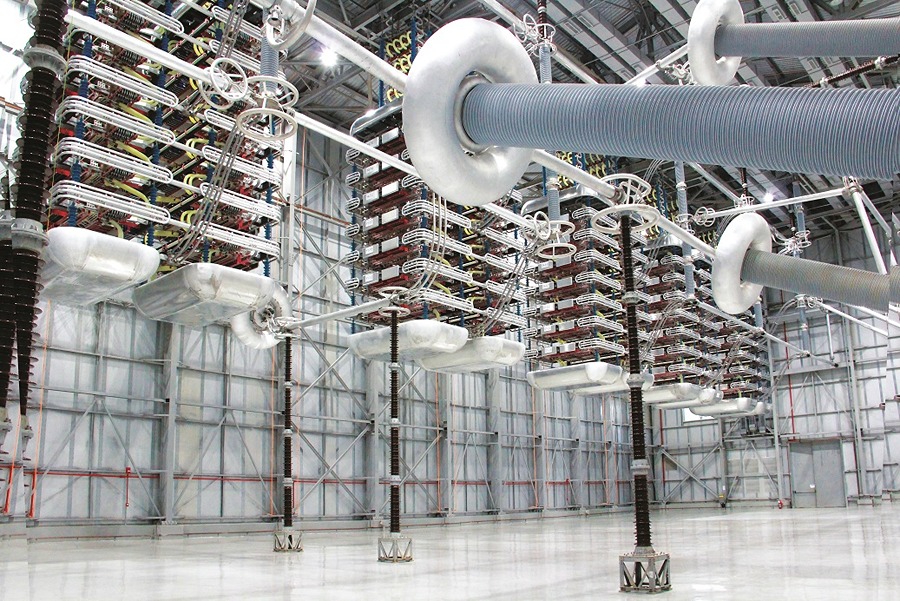
Technology selection is a cost-and-robustness decision, not a badge. The project will feature GE Vernova's most advanced LCC (line commutated converter) valve, manufactured at the Pallavaram factory in India, and will include the eLumina control system, which provides the digital intelligence needed to manage complex power flows so the grid can respond dynamically to changing conditions. Building the valves domestically shortens spare-part chains and deepens local service capability — a material factor when a 6 GW corridor becomes a single point of dependency for an entire renewable zone.
CIGRE's February 2025 ELECTRA brochure on hybrid LCC/VSC systems frames the trade-off clearly: LCC remains the economical workhorse for very large bulk transfers, while VSC adds controllability where the receiving AC network is weak or needs independent reactive support. For a 6,000 MW, roughly 1,000 km bipolar operating over an already strong inter-state network, LCC with advanced digital control is the lower-cost route; hybrid or VSC designs become attractive in the next wave of links serving offshore wind or inverter-dominated zones.
| Criterion | LCC (this project) | VSC | Hybrid LCC/VSC |
|---|---|---|---|
| Cost and losses at 6 GW scale | Lowest converter cost per MW | Higher converter cost, added flexibility | Split to balance both |
| Behaviour during AC faults | Commutation failure risk; needs a strong AC system | Independent of AC commutation | Reduced commutation risk |
| Reactive power support | Requires filter and capacitor banks | Four-quadrant control | Partial |
| Best fit | Bulk evacuation over long distances | Weak grids, offshore, city infeeds | Renewable-heavy future corridors |
Who pays, and how a corridor becomes a bankable number
Transmission in India is procured on a tariff-based competitive bidding model, and the developer of record earns regulated annual charges rather than a share of energy revenue. Business Standard and CNBC-TV18 reported that PGCIL secured the Barmer II scheme in September 2026 through a special purpose vehicle, with annual transmission charges of about ₹3,244.33 crore and a bipole of approximately 1,000 km running from Rajasthan towards South Kalamb in Maharashtra. The same scheme, ordered from GE Vernova in the fourth quarter of 2026, therefore sits inside a pipeline that India's National Electricity Plan (Transmission) sizes at ₹9.15 lakh crore through 2032.
Two buyer consequences follow. First, corridor cost is socialised through central transmission charges, so it will not appear in your power purchase agreement even though it determines whether you can sell. Second, availability, not energisation, is the real risk: a link that exists but is de-rated during station maintenance still strands generation. Teams comparing this model with how other markets finance and permit lines may find our coverage of how US policy is treating transmission a useful contrast in project risk allocation.
A seven-step playbook for teams depending on this corridor
- Map your project against the zone's evacuation timeline: which pole of the 2×3000 MW bipolar energises first, and when.
- Request the dynamic model and protection philosophy for the station your plant interconnects to, then re-run your inverter settings against it.
- Price curtailment explicitly in your financial model using published zone data rather than system-average assumptions.
- Contract for availability guarantees and outage coordination, not just nominal transfer capability.
- Align PPAs with corridor commissioning dates; a PPA signed ahead of export capacity is a paper asset.
- Size flexibility assets against the residual gap — HVDC moves energy, it does not shift it in time.
- Track localisation and long-lead supply commitments, since valve and transformer schedules set the real commissioning date.
Six pitfalls that quietly kill corridor-dependent projects
- Assuming the headline rating equals firm capacity. Pole outages, filter maintenance and thermal limits reduce what is actually deliverable.
- Treating the corridor as a storage substitute. Rajasthan's evacuation planning weighed HVDC against battery-based options for exactly this reason: the corridor solves distance, the evening ramp still needs flexibility.
- Ignoring the AC backend. Converter stations, not the DC line, are where commissioning schedules most often slip.
- Modelling curtailment on national averages. Losses concentrate in Rajasthan and Gujarat; your zone, not the country, sets your revenue.
- Signing PPAs before export availability is scheduled. Volume commitments outrunning transfer capacity invite penalties.
- Underestimating the supply chain. Converter transformers and valves are the industry's tightest long-lead items.
Corridors also do not end the flexibility debate. Our analysis of what India's solar surge means for coal, storage and cost control covers how thermal retirement, battery programmes and merit-order effects interact once new transfer capacity arrives.
FAQ: practical questions clean energy teams ask next
Is a 6 GW HVDC link the same as 6 GW of new renewable capacity?
No. It is transfer capability. The link lets renewable energy already built or under construction in the Barmer zone serve buyers in a distant load centre, converting previously curtailed output into revenue.
Why does a bipolar 2×3000 MW design matter commercially?
Because outages are managed by pole. One 3,000 MW pole can be down while the other carries load, so contracts and forecasts should be written against pole availability and station maintenance windows.
Why line commutated converters rather than VSC here?
Cost per megawatt at bulk ratings, plus a strong receiving AC network. VSC wins where the grid is weak, offshore or in need of independent reactive support — a scenario more likely on the next generation of links.
Does this corridor remove curtailment risk?
It reduces a specific class of risk: congestion-driven losses. Weather-driven, scheduling-driven and midday oversupply curtailment persist, and are addressed by storage, demand flexibility and restructured scheduling.
What should a corporate power buyer take from this?
Renewable supply in previously congested zones becomes more reliable and, over time, cheaper. Buyers negotiating India-linked supply or reporting on Indian operations can now assume that renewable output leaving Rajasthan has a physical path to market, not just a path on paper.
Action summary: what to do in the next 90 days
- Ask your state utility or central transmission authority which renewable zone and which corridor your project is scheduled against, and in what sequence.
- Rebuild your PPA risk case around pole-level availability data and published curtailment figures, not system averages.
- Put long-lead equipment and localisation clauses into your interface agreements while order books are still open.
Sources and further reading
- GE Vernova: 6 GW HVDC transmission project announcement
- Ember: Transmission gaps are beginning to constrain India's rapid renewables integration
- PV Magazine: one-third of India's new renewable capacity faces curtailment (ICRA)
- CIGRE ELECTRA: hybrid LCC/VSC HVDC systems
- Press Information Bureau: National Electricity Plan (Transmission), ₹9.15 lakh crore
- T&D India: HVDC chosen over battery storage for Rajasthan renewable evacuation scheme
Prepared by the GreencarbonWorld CleanEnergy desk. Author: Iris Vaughan. Corrections, data requests and reader questions: info@greencarbonworld.com.